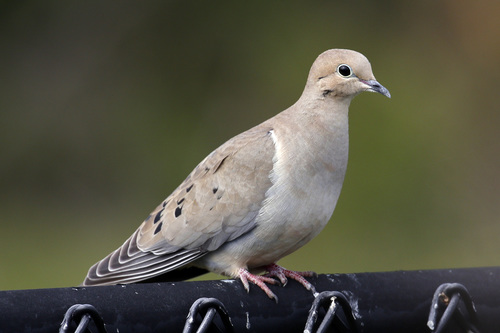
(c) Donna Pomeroy, some rights reserved (CC BY-NC), uploaded by Donna Pomeroy · cc-by-nc
Mourning Dove
Sign in to saveAlso known as American mourning dove, Carolina pigeon, rain dove
species of bird
OverviewAI-generated
The Mourning Dove, scientifically named *Zenaida macroura*, is a species of bird within the class Aves. It belongs to the genus *Zenaida* and is distinct from the Mourning Collared Dove. The species has been assessed as Least Concern on the IUCN Red List in 2024.
Its taxonomic range includes South America and Africa. The bird is not extinct and has recorded 291,476 observations on iNaturalist. Other common names for this taxon include *Zenaida huilota*, Tourterelle triste, and Carolinataube.
Synthesized by Vinony from 21 facts across 4 sources: Wikidata, iNaturalist, IUCN Red List, Vinony graph. Generated from structured data (not the Wikipedia text) and checked against those facts — may still contain errors.
Species
Least ConcernMourning Dove
species
Tonaufnahme Die Carolinataube (Zenaida macroura), auch Trauertaube genannt, ist ein mittelgroßer Vogel in der Familie der Tauben (Columbidae). Sie bewohnt in mehreren Unterarten Nord- und Mittelamerika. Wie bei allen Trauertauben ist ihr Gefieder unauffällig und weist mehrere Braunschattierungen auf. Charakteristisch für sie ist der schwarze Wangenfleck, die dunklen Flügelflecken und eine schwarzweiße Zeichnung. Die Carolinataube ist einer der häufigsten Vögel Nordamerikas und wird stark bejagt. Jährlich werden in den Vereinigten Staaten mehr als 70 Millionen dieser Art geschossen. Die Reproduktionsrate der Carolinataube ist sehr hoch. In klimatisch günstigen Regionen kann ein Paar Carolinatauben bis zu sechs Gelege großziehen. Zwei bis drei Jahresbruten sind auch in weniger günstigen Regionen typisch.
via IUCN
Wikidata facts
Show 10 more facts
- taxon rank
- species
- IUCN conservation status
- Least Concern
- taxon name
- Zenaida macroura
- Commons category
- Zenaida macroura
- Commons gallery
- Zenaida macroura
- taxon common name
- dugorepa gugutka
- different from
- Mourning Collared Dove
- short name
- Z. macroura
- Digital Atlas of Idaho URL
- digitalatlas.cose.isu.edu/bio/birds/pign/modo/modo_mai.htm
- taxon range
- Africa
via Wikidata · CC0
~19 min read
Encyclopedic overview
The mourning dove (Zenaida macroura) is a member of the dove family, Columbidae. The bird is also known as the American mourning dove, the rain dove, and colloquially as the turtle dove, and it was once known as the Carolina pigeon and Carolina turtledove. It is one of the most abundant and widespread North American birds and a popular gamebird, with more than 20 million birds (up to 70 million in some years) shot annually in the U.S., both for sport and meat. Its ability to sustain its population under such pressure is due to its prolific breeding; in warm areas, one pair may raise up to six broods of two young each in a single year. The wings make an unusual whistling sound upon take-off and landing, a form of sonation. The bird is a strong flier, capable of speeds up to 88 km/h (55 mph).
Mourning doves are light gray and brown and generally muted in color. Males and females are similar in appearance. The species is generally monogamous, with two squabs (young) per brood. Both parents incubate and care for the young. Mourning doves eat almost exclusively seeds, but the young are fed crop milk by their parents.
Excerpted from Wikipedia’s “Mourning Dove” article, available under the CC BY-SA 4.0 licence.