File:Murchison_crop.jpg · Wikimedia Commons · See Wikimedia Commons
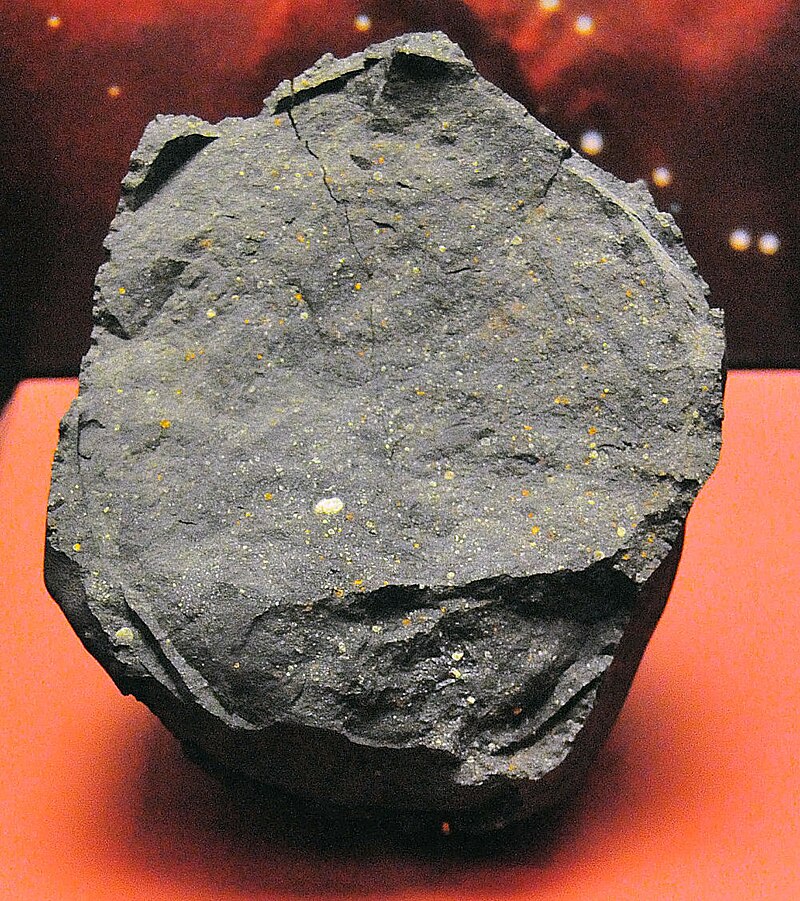
Murchison meteorite
Sign in to savemeteorite that fell in Murchison, Victoria, Australia.
Key facts
- Type
- Chondrite
- Class
- Carbonaceous chondrite
- Group
- CM2
- Composition
- 22.13% total iron , 12% water
- Shock stage
- S1–2
- Country
- Australia
- Region
- Victoria
- Observed fall
- Yes
- Fall date
- 28 September 1969
- Tkw
- 100 kg (220 lb)
via Wikipedia infobox
Wikidata facts
Show 4 more facts
Sources (3)
via Wikidata · CC0
~9 min read
Encyclopedic overview
The Murchison meteorite is a meteorite that fell in Australia in 1969 near Murchison, Victoria. It belongs to the carbonaceous chondrite class, a group of meteorites rich in organic compounds. Due to its mass (over 100 kg or 220 lb) and the fact that it was an observed fall, the Murchison meteorite is one of the most studied of all meteorites.
In January 2020, cosmochemists reported that the oldest material found on Earth to date are the silicon carbide particles from the Murchison meteorite, which have been determined to be 7 billion years old, about 2.5 billion years older than the 4.54-billion-year age of the Earth and the Solar System. The published study noted that "dust lifetime estimates mainly rely on sophisticated theoretical models. These models, however, focus on the more common small dust grains and are based on assumptions with large uncertainties."
Excerpted from Wikipedia’s “Murchison meteorite” article, available under the CC BY-SA 4.0 licence.