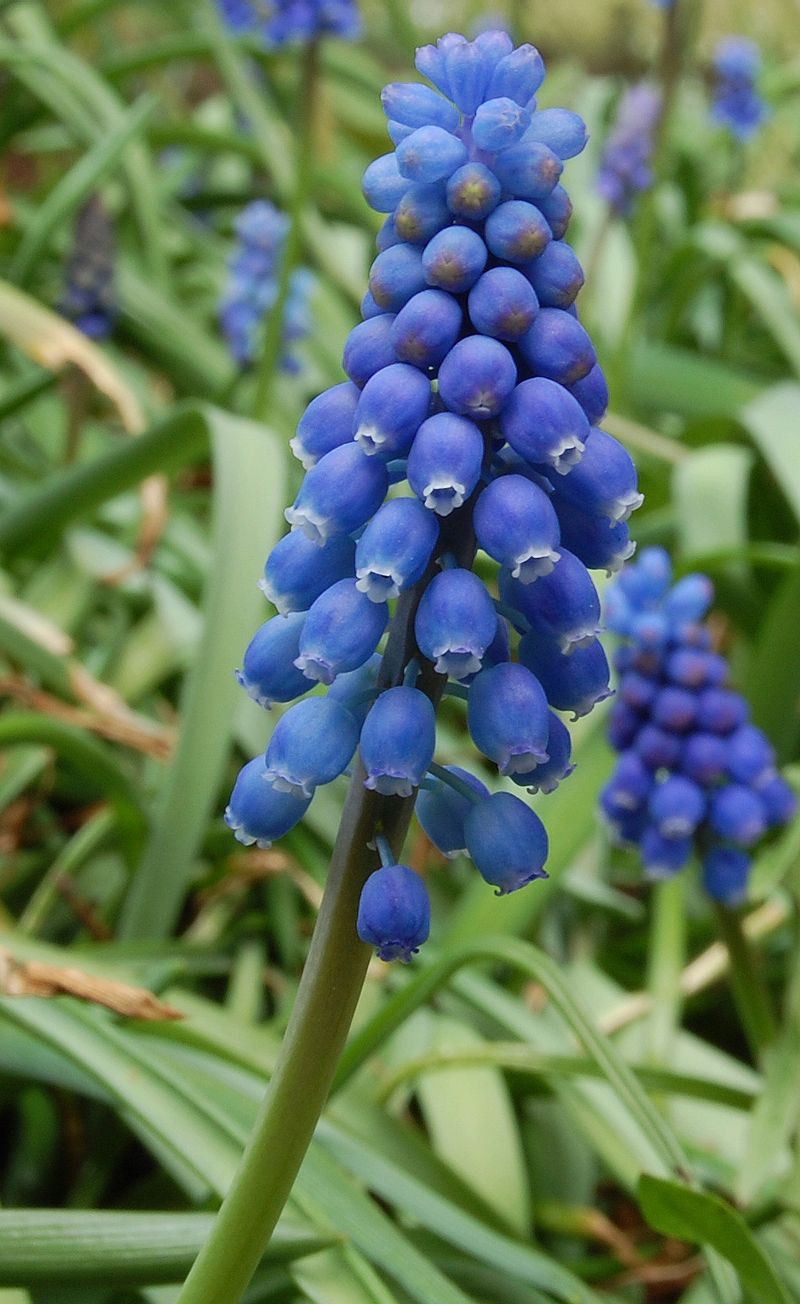
File:Muscari_Neglectum.jpg · Wikimedia Commons · See Wikimedia Commons
Muscari
Sign in to saveAlso known as grape hyacinth
Muscari is a genus of perennial bulbous plants native to Eurasia that produce spikes of dense, most commonly blue, urn-shaped flowers resembling bunches of grapes in the spring. The common name for the genus is grape hyacinth, but they should not be confused with hyacinths. A number of species of Muscari are used as ornamental garden plants.
OverviewAI-generated
Muscari is a genus within the plant kingdom Plantae. It belongs to the phylum Tracheophyta, class Liliopsida, order Asparagales, and family Asparagaceae. The genus is also referred to by the common name grape-hyacinths. Its taxonomic status is accepted.
Records for Muscari are held by various institutions, including those in the United States, Turkey, Iran, Lebanon, and Portugal. Specific institutional holdings are noted for NY, US, GH, MO, and CM. The subject has been documented in 580 records, which include 288 media files. A total of 249,845 occurrences have been logged.
Synthesized by Vinony from 30 facts across 7 sources: Wikidata, GBIF, iNaturalist, Gbif Occ, WoRMS, iDigBio, Vinony graph. Generated from structured data (not the Wikipedia text) and checked against those facts — may still contain errors.
Species
grape-hyacinths
GENUS
- KingdomPlantae
- PhylumTracheophyta
- ClassLiliopsida
- OrderAsparagales
- FamilyAsparagaceae
物种 见本文。 葡萄风信子属(学名:Muscari)又称蓝壶花属、串铃花属,是天門冬科的落叶草本植物,原产於欧亚大陆,花密集生长,玲壶形,多为蓝色,也有白色栽培种,花期为春季,开花时外形像一串串葡萄。 葡萄风信子属原产於旧大陆的地中海流域、欧洲中部和南部、北非、亚洲西部、中部和西南部。 目录 1 物种 2 分类学 3 特征 4 用途 5 花語 6 参考文献 7 外部链接 物种 亚美尼亚的葡萄风信子 葡萄风信子上的食蚜蝇 美国坎布里奇栽培的葡萄风信子 亚美尼亚葡萄风信子 约40种,包括: Muscari adilii Muscari apertum 麝香风信子 Muscari ambrosiacum 亞美尼亞葡萄風信子 Muscari armeniacum:栽培种中的重瓣品种包括“蓝钉子”('Blue Spike')、“幻想之作”('Fantasy Creation'),单瓣品种有“剑桥葡萄风信子”('Cantab')、“圣诞珍珠”('Christmas Pearl')、“超级星”('Superstar') Muscari atlanticum 深蓝串铃花 Muscari aucheri:栽培种很多,包括'Blue Magic'和'White Magic' 天蓝葡萄风信子 Muscari azureum:花为天蓝色,但也有淡蓝色和白色的栽培种 白花天蓝葡萄风信子 Muscari azureum alba Muscari babachii 葡萄风信子 Muscari botryoides 白葡萄风信子 Muscari botryoides album Muscari bourgaei Muscari caucasicum Muscari commutatum 流苏葡萄风信子 Muscari comosum Muscari dionysicum Muscari discolor Muscari eburnea Muscari gussonei Muscari grandifolium Muscari inconstrictum 渐变葡萄风信子 Muscari latifolium:花色由基部的深靛蓝色渐变到先端的淡紫罗兰色,故得名 Muscari leucostomum Muscari longifolium Muscari longipes 大果串铃花 Muscari macrocarpum:栽培种包括“金色芬芳”('Golden Fragrance') Muscari massayanum Muscari mcbeathianum Muscari microstomum Muscari mirum Muscari muscarimi (=M. moschatum) 蓝壶花 Muscari neglectum (=M. racemosum) Muscari pa
via GBIF
Museum specimens
- Specimen records
- 580
- With media
- 288
- Family
- Asparagaceae
- Collections
- NY, US, GH, MO, CM, MICH
- Recorded in
- United States, Turkey, Iran, Lebanon, Portugal, Italy, Syria, Spain
Wikidata facts
- Instance of
- taxon
- Parent taxon
- Hyacinthinae
- Image
- Muscari Neglectum.jpg
Show 8 more facts
- taxon rank
- genus
- Commons category
- Muscari
- taxon name
- Muscari
- Commons gallery
- Muscari
- topic's main category
- Category:Muscari
- taxon common name
- hrušica
- has fruit type
- capsule
Sources (2)
via Wikidata · CC0
~10 min read
Encyclopedic overview
10 sectionsContents
- Description
- Taxonomy
- Subgenera
- Species
- Formerly placed here
- Distribution
- Cultivation
- Cultivars
- References
- External links
Muscari is a genus of perennial bulbous plants native to Eurasia that produce spikes of dense, most commonly blue, urn-shaped flowers resembling bunches of grapes in the spring. The common name for the genus is grape hyacinth, but they should not be confused with hyacinths. A number of species of Muscari are used as ornamental garden plants.
==Description== Brian Mathew says that many species of grape hyacinths are difficult to distinguish. They usually have one or more narrow leaves which arise from a bulb. The flowers appear in the spring and form a spike or raceme, being held in a close or loose spiral around a central stalk. The flowers often become less tightly spaced as the flower matures. The flower colour varies from pale blue to a very dark blue, almost black in some cases (albino forms are also known). In some species, the upper flowers may be of a colour or shape different from the lower flowers. Individual flowers are composed of six fused tepals forming a spherical to obovoid shape, constricted at the end to form a mouth around which the ends of the tepals show as small lobes or "teeth", which may be of a color different from the rest of the tepal.
Excerpted from Wikipedia’s “Muscari” article, available under the CC BY-SA 4.0 licence.