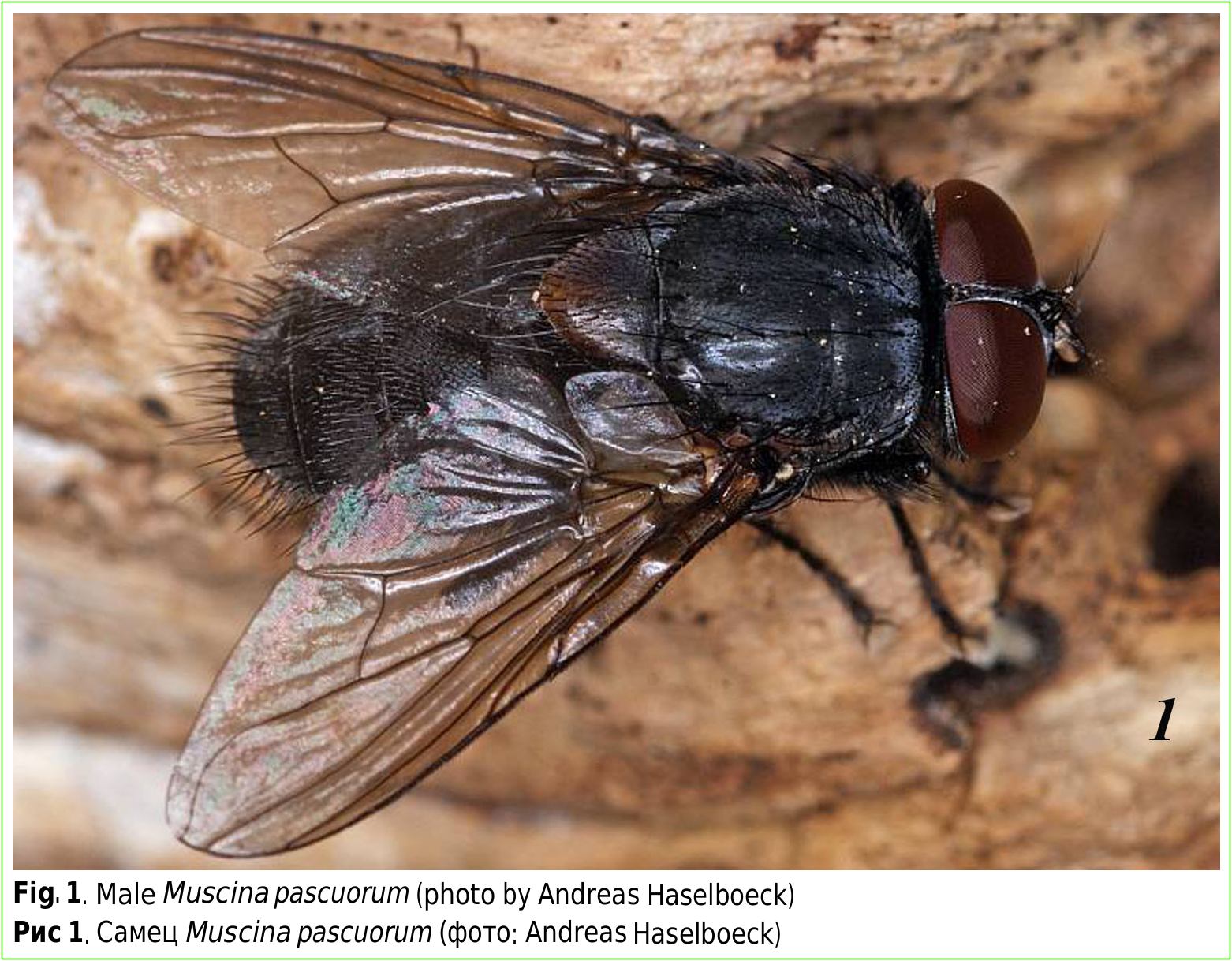
Vikhrev, Nikita E.;Esin, Mikhail N.
Muscina
Sign in to saveMuscina is a genus of flies that belongs to the family Muscidae, currently consisting of 27 species. They are worldwide in distribution and are frequently found in livestock facilities and outside restrooms. The most common species are M. stabulans (the most widely studied species), M. levida, and M. prolapsa. Muscina flies commonly breed in manure and defecate on food, which has been linked to the spread of some disease and illnesses. The occurrence of Muscina larvae on dead bodies has led to their regular use in forensic investigations, as they may be used to estimate the time of death. Rese
Species
GENUS
- KingdomAnimalia
- PhylumArthropoda
- ClassInsecta
- OrderDiptera
- FamilyMuscidae
Muscina[1] este un gen de muște din familia Muscidae.[1] Cladograma conform Catalogue of Life[1]: Muscina Muscina angustifrons Muscina arcuata Muscina dorsilinea Muscina flukei Muscina fulvacrura Muscina japonica Muscina krivosheinae Muscina levida Muscina minor Muscina pascuorum Muscina principalis Muscina prolapsa Muscina stabulans Muscina sumatrensis Referințe ^ a b c Bisby F.A., Roskov Y.R., Orrell T.M., Nicolson D., Paglinawan L.E., Bailly N., Kirk P.M., Bourgoin T., Baillargeon G., Ouvrard D. (red.) (2011). „Species 2000 & ITIS Catalogue of Life: 2011 Annual Checklist”. Species 2000: Reading, UK. Accesat în 24 september 2012. Verificați datele pentru: |access-date= (ajutor)Mentenanță CS1: Nume multiple: lista autorilor (link) Legături externe Wikispecies conține informații legate de Muscina Acest articol referitor la insecte din ordinul Diptera este un ciot. Puteți ajuta Wikipedia prin completarea sa.Acest infocasetă: v • d • mvizualizare • discuție • modificare
via GBIF
Museum specimens
- Specimen records
- 499
- With media
- 2
- Family
- Muscidae
- Collections
- UAM, CHAS
- Recorded in
- United States
Wikidata facts
Show 4 more facts
- taxon name
- Muscina
- taxon rank
- genus
- topic's main category
- Category:Muscina
- Commons category
- Muscina
Sources (1)
via Wikidata · CC0
~11 min read
Encyclopedic overview
15 sectionsContents
- Characteristics
- Life cycle
- Eggs and larvae
- Pupa
- Adults
- Medical importance
- Forensic importance
- Myiasis
- Human
- Sheep
- Ongoing research
- Species
- References
- Further reading
- External links
Muscina is a genus of flies that belongs to the family Muscidae, currently consisting of 27 species. They are worldwide in distribution and are frequently found in livestock facilities and outside restrooms. The most common species are M. stabulans (the most widely studied species), M. levida, and M. prolapsa. Muscina flies commonly breed in manure and defecate on food, which has been linked to the spread of some disease and illnesses. The occurrence of Muscina larvae on dead bodies has led to their regular use in forensic investigations, as they may be used to estimate the time of death. Research have shown the prevalence of certain species of Muscina flies as vectors of diseases such as poliomyelitis.
==Characteristics==
Excerpted from Wikipedia’s “Muscina” article, available under the CC BY-SA 4.0 licence.
Gallery (5)
Available in 10 languages
via Wikidata sitelinks · CC0