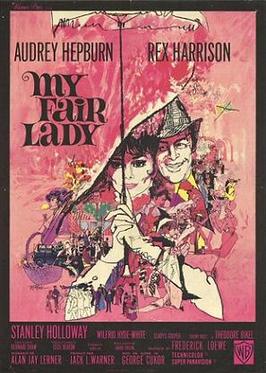
File:My_fair_lady_poster.jpg · Wikimedia Commons · See Wikimedia Commons
OverviewAI-generated
My Fair Lady is a 1964 American musical, romance, and drama film directed by George Cukor. The cast includes Audrey Hepburn, Rex Harrison, Stanley Holloway, and Wilfrid Hyde-White. Alan Jay Lerner and George Bernard Shaw served as screenwriters, while Frederick Loewe composed the music and Hermes Pan choreographed. Jack Warner produced the film, which was filmed in Los Angeles and set in London. The original language is English.
The film has a runtime of 170 or 171 minutes. It was released on December 1, 1964, with other release dates listed as October 21, 1964, and December 23, 1964. Warner Bros. Pictures distributed the film, which had a budget of 17,000,000 and earned 72,661,442 in revenue. The film received an IMDb rating of 7.7 and a TMDb vote average of 7.507.
My Fair Lady won the Academy Awards for Best Picture, Best Actor, Best Director, and Best Sound. It was also nominated for Best Supporting Actress and Best Supporting Actor. The film is recognized in the Academy Award Best Picture collection.
Synthesized by Vinony from 41 facts across 5 sources: Wikidata, TMDb, IMDb, Vinony collections, Vinony graph. Generated from structured data (not the Wikipedia text) and checked against those facts — may still contain errors.
Film · TMDB
7.5A snobbish phonetics professor agrees to a wager that he can take a flower girl and make her presentable in high society.
Cast
- Audrey Hepburn as Eliza Doolittle
- Rex Harrison as Professor Henry Higgins
- Stanley Holloway as Alfred P. Doolittle
- Wilfrid Hyde-White as Colonel Hugh Pickering
- Gladys Cooper as Mrs. Higgins
- Jeremy Brett as Freddy Eynsford-Hill
Themes
- transformation
- musical
- flower girl
- colonel
- suitor
- wager
- class differences
- tutor
- aristocrat
- linguist
This product uses the TMDB API but is not endorsed or certified by TMDB.
Wikidata facts
- Instance of
- film
- Part of
- National Film Registry
- Country of origin
- United States
- Original language
- English language
- Based on
- Pygmalion
- Director
- George Cukor
- Screenwriter
- George Bernard Shaw
- Cast member
- John Holland
- Composer
- Frederick Loewe
- Producer
- Jack Warner
- Cinematographer
- Harry Stradling
- Narrative location
- London
- Filming location
- Los Angeles
- Duration
- 171
- FilmAffinity ID
- 317417
- Distribution format
- video on demand
- Image
- Harry Stradling-Audrey Hepburn in My Fair Lady.jpg
Show 13 more facts
- Commons category
- My Fair Lady (film)
- publication date
- 1964-12-23
- film editor
- William H. Ziegler
- title
- My Fair Lady
- nominated for
- Academy Award for Best Sound
- choreographer
- Hermes Pan
- production designer
- Gene Allen
- distributed by
- Netflix
- costume designer
- Cecil Beaton
- capital cost
- 17000000
- box office
- 72000000
- set in period
- 20th century
- review score
- 7.7/10
Sources (11)
via Wikidata · CC0
~21 min read
Encyclopedic overview
My Fair Lady is a 1964 American musical comedy drama film adapted from Lerner and Loewe's 1956 stage musical based on George Bernard Shaw's 1913 stage play Pygmalion. With a screenplay by Alan Jay Lerner and directed by George Cukor, the film depicts a poor Cockney flower-seller named Eliza Doolittle who overhears a phonetics professor, Henry Higgins, as he casually wagers that he could teach her to speak English so well she could pass for a duchess in Edwardian-era London, or (better yet, from Eliza's viewpoint) secure employment in a flower store.
The film stars Audrey Hepburn as Eliza Doolittle—replacing Julie Andrews from the stage musical—and Rex Harrison as Henry Higgins—reprising his role from the stage musical—with Stanley Holloway, Gladys Cooper and Wilfrid Hyde-White in supporting roles. A critical and commercial success, it became the second-highest-grossing film of 1964 (after Mary Poppins) and won eight Academy Awards, including Best Picture, Best Director and Best Actor. The American Film Institute included the film as #91 in its 1998 AFI's 100 Years...100 Movies, as #12 in its 2002 AFI's 100 Years...100 Passions, and as #8 in its 2006 AFI's Greatest Movie Musicals.
Excerpted from Wikipedia’s “My Fair Lady” article, available under the CC BY-SA 4.0 licence.