File:Neuron.svg · Wikimedia Commons · See Wikimedia Commons
myelin
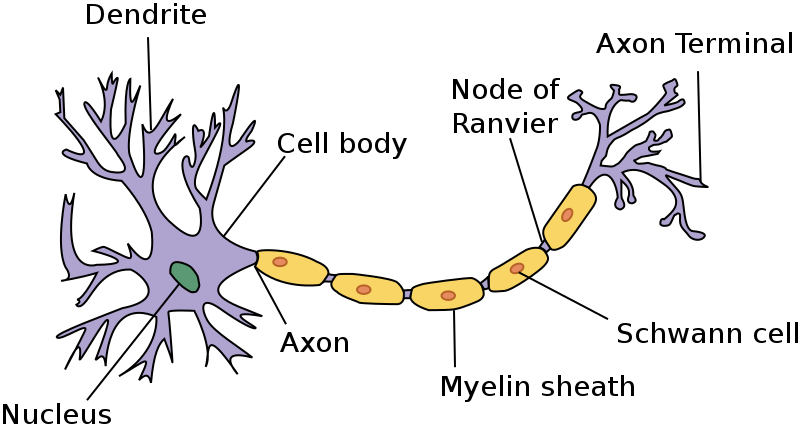
Sign in to saveMyelin ( ) is a lipid-rich material that in most vertebrates surrounds the axons of neurons to insulate them and increase the rate at which electrical impulses (called action potentials) pass along the axon. The myelinated axon can be likened to an electrical wire (the axon) with insulating material (myelin) around it. However, unlike the plastic covering on an electrical wire, myelin does not form a single long sheath over the entire length of the axon. Myelin ensheaths part of an axon known as an internodal segment, in multiple myelin layers of a tightly regulated internodal length.
Key facts
- Anatomy.name
- Myelin
- Anatomy.Image
- Neuron.svg
- Anatomy.Caption
- Structure of simplified neuron in the peripheral nervous system with myelinating Schwann cells
- Anatomy.Image2
- Neuron_with_oligodendrocyte_and_myelin_sheath.svg
- Anatomy.Caption2
- Neuron with myelinating oligodendrocyte and myelin sheath in the central nervous system
- Anatomy.System
- Nervous system
via Wikipedia infobox
Wikidata facts
- Subclass of
- lipoprotein
- Part of
- myelin sheath
Show 1 more fact
- different from
- myelin sheath
Sources (3)
via Wikidata · CC0
~16 min read
Encyclopedic overview
14 sectionsContents
- History
- Composition
- Function
- Development
- Clinical significance
- Demyelination
- Symptoms
- Myelin repair
- Dysmyelination
- Invertebrates
- See also
- References
- Further reading
- External links
Myelin ( ) is a lipid-rich material that in most vertebrates surrounds the axons of neurons to insulate them and increase the rate at which electrical impulses (called action potentials) pass along the axon. The myelinated axon can be likened to an electrical wire (the axon) with insulating material (myelin) around it. However, unlike the plastic covering on an electrical wire, myelin does not form a single long sheath over the entire length of the axon. Myelin ensheaths part of an axon known as an internodal segment, in multiple myelin layers of a tightly regulated internodal length.
The ensheathed segments are separated at regular short unmyelinated intervals, called nodes of Ranvier. Each node of Ranvier is around one micrometre long. Nodes of Ranvier enable a much faster rate of conduction known as saltatory conduction where the action potential recharges at each node to jump over to the next node, and so on until it reaches the axon terminal. At the terminal the action potential provokes the release of neurotransmitters across the synapse, which bind to receptors on the post-synaptic cell such as another neuron, myocyte or secretory cell.
Excerpted from Wikipedia’s “myelin” article, available under the CC BY-SA 4.0 licence.