Encyclopedia of Life · EOL (see source)
Myrmicaria
Sign in to saveMyrmicaria is an ant genus within the subfamily Myrmicinae.
Species
GENUS
- KingdomAnimalia
- PhylumArthropoda
- ClassInsecta
- OrderHymenoptera
- FamilyFormicidae
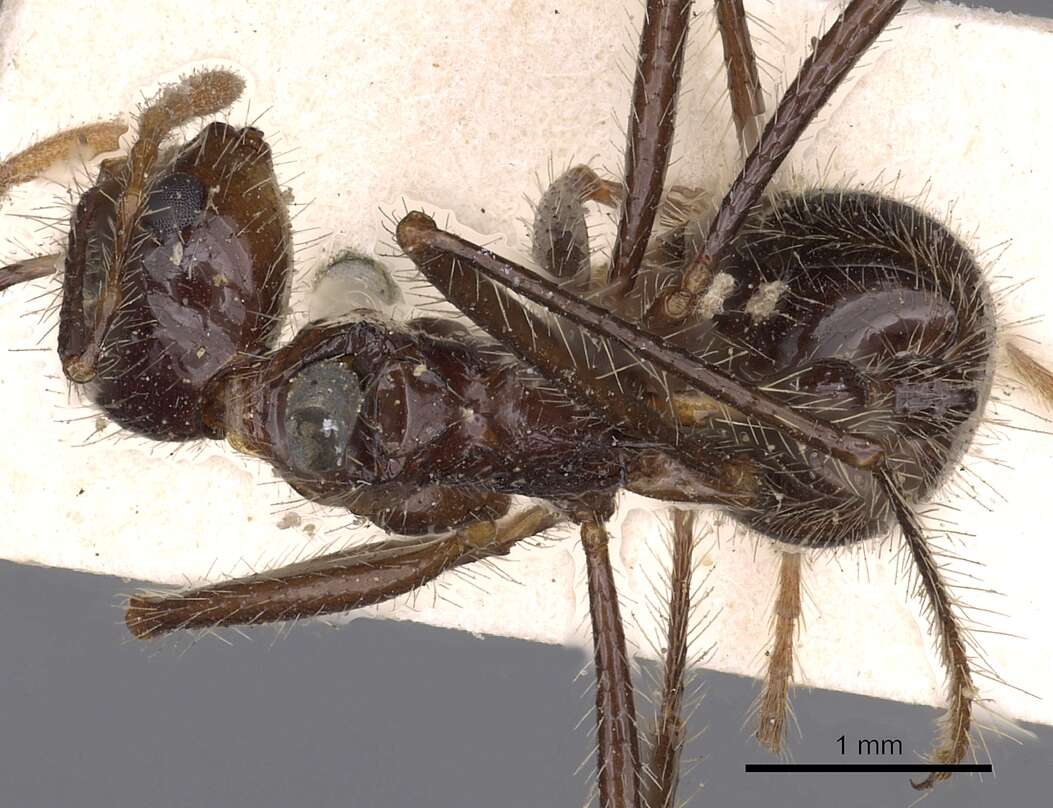
Small or medium-sized, coarsely hairy, brown or black ants, with monomorphic workers, which have 7-jointed antennae, the funiculus enlarged toward the tip but not clavate and all the joints, except the first, considerably longer than wide. Mandibles moderately large, subtriangular, with coarsely dentate apical border. Clypeus broad and convex. Frontal area indistinct behind. Frontal carinae short, rather far apart, not strongly diverging posteriorly. Eyes not very large, convex, behind the middle of the head; ocelli absent. Thorax with indistinct or obsolete premesonotal suture; mesoepinotal suture deep, the mesoepinotal constriction pronounced; the sides of the mesonotum raised and subauriculate behind. Epinotum armed with a pair of long, acute spines, which are often lobate or expanded at the base; inferior corners of pronotum dentate or spined. Petiole with a long peduncle sharply marked off from the abrupt node, which is high and rounded, subcorneal, sometimes laterally compressed. Postpetiole shaped like the node of the petiole, strongly contracted posteriorly. Gaster subglobose, its basal segment somewhat truncate in front. Legs long; median and hind tibiae with simple spurs;
via GBIF
Museum specimens
- Specimen records
- 492
- With media
- 13
- Family
- Formicidae
- Collections
- USNM, CAS
- Recorded in
- Mozambique, Myanmar, South Africa
Wikidata facts
- Instance of
- taxon
- Parent taxon
- Myrmicinae
- Image
- Myrmicaria brunnea.jpg
Show 3 more facts
- taxon name
- Myrmicaria
- taxon rank
- genus
- Commons category
- Myrmicaria
Sources (1)
via Wikidata · CC0
~2 min read
Encyclopedic overview
5 sectionsContents
- Description
- Biochemistry
- Species
- References
- External links
Myrmicaria is an ant genus within the subfamily Myrmicinae.
==Description== Myrmicaria can be discerned from related ant genera by a postpetiole with a complete tergosternal fusion, a postpetiole-gaster articulation shifted ventrally on the gaster, and an antenna with seven segments.
Excerpted from Wikipedia’s “Myrmicaria” article, available under the CC BY-SA 4.0 licence.