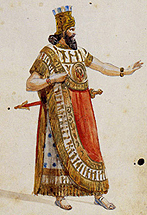
File:Verdi-Nabucco-1842-original_costume_sketch.jpg · Wikimedia Commons · See Wikimedia Commons
Nabucco
Sign in to saveAlso known as Nabucodonosor
Nabucco (; short for Nabucodonosor , i.e. "Nebuchadnezzar") is an Italian-language opera in four acts composed in 1841 by Giuseppe Verdi to an Italian libretto by Temistocle Solera. The libretto is based on the biblical books of 2 Kings, Jeremiah, Lamentations, and Daniel, and on the 1836 play by Auguste Anicet-Bourgeois and Francis Cornu. However, Antonio Cortese's ballet adaptation of the play (with its necessary simplifications), given at La Scala in 1836, was a more important source for Solera than the play itself. Under its original name of Nabucodonosor, the opera was first performed at
Nabucco is an Italian opera composed by Giuseppe Verdi in 1841 that tells a biblical story of the Babylonian king Nebuchadnezzar, drawing on Old Testament books and a French play from the 1830s. The work became one of Verdi's early successes and remains significant in opera history as an example of his dramatic style and his ability to create powerful music around historical and religious themes.
AI-generated from the Wikipedia summary — may contain errors.
Key facts
- Opera.name
- Nabucco
- Opera.composer
- Giuseppe Verdi
- Opera.image
- Verdi-Nabucco-1842-original costume sketch.jpg
- Opera.caption
- Costume sketch for Nabucco for the original production
- Opera.librettist
- Temistocle Solera
- Opera.language
- Italian
- Opera.based_on
- Play by Auguste Anicet-Bourgeois and Francis Cornu, as well as Antonio Cortese's ballet adaptation
- Opera.premiere_location
- La Scala, Milan
via Wikipedia infobox
Wikidata facts
- Genre
- opera
- Country of origin
- Italy
- Based on
- Nebuchadnezzar II
- Composer
- Giuseppe Verdi
- Librettist
- Temistocle Solera
- Image
- Disegno per copertina di libretto, disegno di Peter Hoffer per Nabucco (1954) - Archivio Storico Ricordi ICON012389.jpg
Show 13 more facts
- Commons category
- Nabucco (opera)
- date of first performance
- 1842-03-09
- title
- Nabucco
- number of parts of this work
- 7
- inception
- 1841-00-00
- language of work or name
- Italian
- location of first performance
- La Scala
- characters
- Jewish people
- publication date
- 1841-01-01
- copyright status
- public domain
- form of creative work
- opera
- native label
- Nabucco
- different from
- Nabucco pipeline
Sources (3)
via Wikidata · CC0
~25 min read
Encyclopedic overview
18 sectionsContents
- Composition history
- Performance history
- 19th century
- 20th century and beyond
- Roles
- Instrumentation
- Synopsis
- Act 1: Jerusalem
- Act 2: The Impious One
- Act 3: The Prophecy
- Act 4: The Broken Idol
- Historicity
- Critical reaction
- Music
- Recordings
- References
- Further reading
- External links
Nabucco (; short for Nabucodonosor , i.e. "Nebuchadnezzar") is an Italian-language opera in four acts composed in 1841 by Giuseppe Verdi to an Italian libretto by Temistocle Solera. The libretto is based on the biblical books of 2 Kings, Jeremiah, Lamentations, and Daniel, and on the 1836 play by Auguste Anicet-Bourgeois and Francis Cornu. However, Antonio Cortese's ballet adaptation of the play (with its necessary simplifications), given at La Scala in 1836, was a more important source for Solera than the play itself. Under its original name of Nabucodonosor, the opera was first performed at La Scala in Milan on the 9th of March 1842.
Nabucco is the opera that is considered to have permanently established Verdi's reputation as a composer. He commented that "this is the opera with which my artistic career really begins. And though I had many difficulties to fight against, it is certain that Nabucco was born under a lucky star."
Excerpted from Wikipedia’s “Nabucco” article, available under the CC BY-SA 4.0 licence.