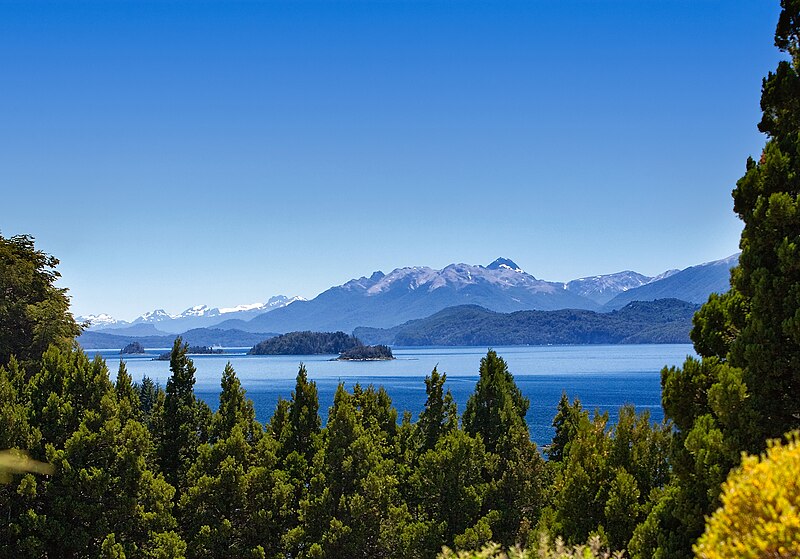
File:View_from_the_Golf_course_at_Llao_Llao.jpg · Wikimedia Commons · See Wikimedia Commons
Key facts
- Location
- Los Lagos Department , Neuquén Province / Bariloche Department , Río Negro Province , Argentina, in Patagonia
- Type
- Glacial lake
- Primary inflows
- Huemul river, Correntoso river, Bonito river, Machete river
- Primary outflows
- Limay River
- Catchment area
- 3,989 km (1,540 sq mi)
- Basin countries
- Argentina
- Max length
- 76 km (47 mi)
- Max width
- 10.1 km (6.3 mi)
- Surface area
- 530 km (205 sq mi)
- Average depth
- 157 m (515 ft)
- Max depth
- 464 m (1,522 ft) deeper places might exist
- Water volume
- 83.35 km (20.00 cu mi)
- Shore length
- 357 km (222 mi)
- Surface elevation
- 2,523 ft (769 m)
- Frozen
- never
- Islands
- Isla Victoria [ es ] , Isla Huemul
- Settlements
- San Carlos de Bariloche , Villa La Angostura
via Wikipedia infobox
Wikidata facts
- Instance of
- glacial lake
- Country
- Argentina
- Located in
- Río Negro Province
- Area
- 557
- Elevation
- 768
- Image
- View from the Golf course at Llao Llao.jpg
- Width
- 10.2
Show 8 more facts
- Commons category
- Nahuel Huapi Lake
- outflows
- Limay River
- located in protected area
- Nahuel Huapi National Park
- vertical depth
- 464
- volume as quantity
- 87449
- watershed area
- 4260
- basin country
- Argentina
- native label
- Lago Nahuel Huapi
via Wikidata · CC0
~8 min read
Encyclopedic overview
Nahuel Huapi Lake (Spanish: Lago Nahuel Huapi) is an Andean lake in the lake region of northern Patagonia between the provinces of Río Negro and Neuquén, in Argentina. The lake has a northwest-southeast elongated shape and complex geography with several branches, peninsulas and islands. The city of Bariloche is on the southern shore of the lake and the town of Villa La Angostura lies on its northwestern shores. The lake is wholly inside Nahuel Huapi National Park. It is one of the largest lakes in northern Patagonia. It is drained by Limay River and it is part of the watershed of Negro River which discharges into the South Atlantic.
Etymology
Excerpted from Wikipedia’s “Nahuel Huapi Lake” article, available under the CC BY-SA 4.0 licence.