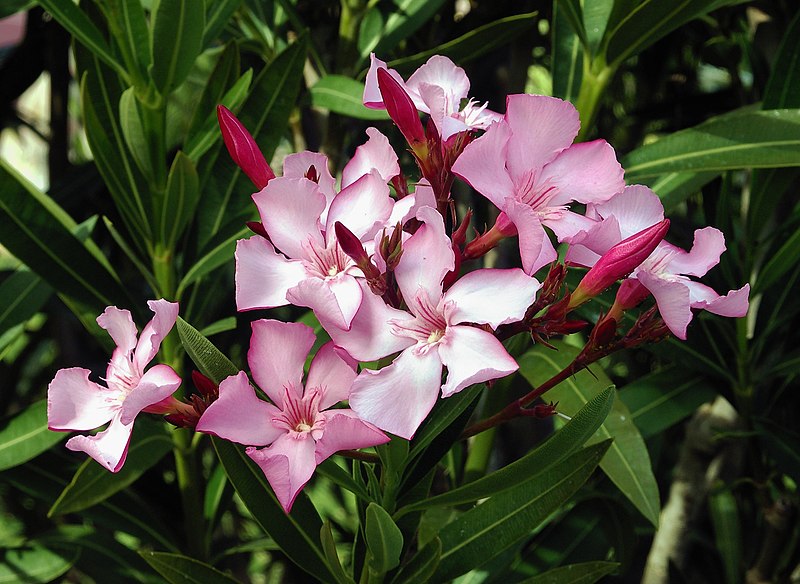
File:Nerium_oleander_flowers_leaves.jpg · Wikimedia Commons · See Wikimedia Commons
Nerium oleander
Sign in to saveAlso known as oleander, sweet-scented oleander
Nerium oleander ( ), commonly known as oleander, rose laurel, be-still tree or rosebay, is a shrub or small tree cultivated worldwide in temperate and subtropical areas as an ornamental and landscaping plant. It is the only species currently classified in the genus Nerium, belonging to subfamily Apocynoideae of the dogbane family Apocynaceae. It is so widely cultivated that no precise region of origin has been identified, though it is usually associated with the Mediterranean Basin.
OverviewAI-generated
Nerium oleander, commonly known as oleander, is a species of evergreen plant in the family Apocynaceae. It belongs to the genus Nerium and is classified within the order Gentianales, class Magnoliopsida, and phylum Tracheophyta. The species was described by Linnaeus and is listed as Least Concern on the IUCN Red List.
The plant produces follicles and has uses including fiber, wood, and as a medicinal plant. Its native range includes Afghanistan, Albania, Algeria, Baleares, Corse, Cyprus, East Aegean Is., France, Greece, Gulf States, India, and Iran. It is also found in China, specifically in Shanghai, the Tibet Autonomous Region, and Guangdong. Records indicate its presence in the United States and Mexico, with institutions such as the University of Alberta Museums and CICY holding specimens.
Synthesized by Vinony from 49 facts across 9 sources: Wikidata, GBIF, Encyclopedia of Life, IUCN Red List, Gbif Occ, Plants of the World, WoRMS, iDigBio, Vinony graph. Generated from structured data (not the Wikipedia text) and checked against those facts — may still contain errors.
Species
Least Concernoleander
Nerium oleander
SPECIES
- KingdomPlantae
- PhylumTracheophyta
- ClassMagnoliopsida
- OrderGentianales
- FamilyApocynaceae
Cultivado.
via GBIF · IUCN · Kew POWO
Museum specimens
- Specimen records
- 3,706
- With media
- 2,502
- Family
- Apocynaceae
- Collections
- UNIVERSITY OF ALBERTA MUSEUMS, CICY, UNICACH, ENCB-IPN, UACH, CIHS-UAC
- Recorded in
- United States, Mexico
Wikidata facts
- Instance of
- taxon
- Parent taxon
- Nerium
- Image
- Dettaglio - Apocinaceae Nerium oleander Lin. Erbario Frizzi Perugia n. 270.jpg
- Has use
- medicinal plant
Show 13 more facts
- taxon rank
- species
- taxon name
- Nerium oleander
- Commons category
- Nerium oleander
- IUCN conservation status
- Least Concern
- Commons gallery
- Nerium oleander
- has fruit type
- follicle
- taxon common name
- алеандар
- taxon range
- Gabon
- foliage type
- evergreen plant
- short name
- N. oleander
- taxon author citation
- L.
- external data available at URL
- www.gbif.org/dataset/31dc1507-a6e1-4233-a8df-c7a78596a7e4
via Wikidata · CC0
~28 min read
Encyclopedic overview
25 sectionsContents
- Description
- Taxonomy
- Synonymy
- Etymology
- Distribution and habitat
- Ecology
- Leaf scorch
- Cultivation
- History
- Ornamental gardening
- Colors and varieties
- Toxicity
- Effects of poisoning
- Treatment
- Research
- Culture
- Oracle of Delphi
- Folklore
- In painting
- In literature, film and music
- Gallery
- See also
- Notes
- References
- External links
Nerium oleander ( ), commonly known as oleander, rose laurel, be-still tree or rosebay, is a shrub or small tree cultivated worldwide in temperate and subtropical areas as an ornamental and landscaping plant. It is the only species currently classified in the genus Nerium, belonging to subfamily Apocynoideae of the dogbane family Apocynaceae. It is so widely cultivated that no precise region of origin has been identified, though it is usually associated with the Mediterranean Basin.
Nerium grows to tall. It is most commonly grown in its natural shrub form, but can be trained into a small tree with a single trunk. It is tolerant to both drought and inundation, but not to prolonged frost. White, pink or red five-lobed flowers grow in clusters year-round, peaking during the summer. The fruit is a long narrow pair of follicles, which splits open at maturity to release numerous downy seeds.
Excerpted from Wikipedia’s “Nerium oleander” article, available under the CC BY-SA 4.0 licence.
Gallery (35)
Available in 95 languages
- Español
- Français
- Deutsch
- 中文
- 日本語
- Русский
- Português
- Italiano
- العربية
- हिन्दी
- Afrikaans
- Aragonese
- Armenian
- Asturian
- azb
- Azerbaijani
- Bahasa Indonesia
- Balinese
Show 76 more
- Bangla
- Basque
- Bavarian
- Belarusian
- Bikol
- Bulgarian
- Burmese
- Catalan
- Cebuano
- Central Kurdish
- Croatian
- Czech
- Danish
- Egyptian Arabic
- eml
- Esperanto
- Filipino
- Finnish
- Galician
- Georgian
- Greek
- Gujarati
- Hebrew
- Hungarian
- Ido
- Irish
- Javanese
- Kabyle
- Kannada
- Kazakh
- Kurdish
- Latvian
- Lombard
- Macedonian
- Malagasy
- Malay
- Malayalam
- Marathi
- Nederlands
- Nepali
- Northern Frisian
- Norwegian
- Norwegian Nynorsk
- Ossetic
- Pampanga
- Papiamento
- Pashto
- Polski
- Punjabi
- Romanian
- Sanskrit
- Sardinian
- Serbian
- Serbian (Latin)
- simple
- Slovenian
- Svenska
- Tachelhit
- Tajik
- Tamil
- Tatar
- Telugu
- Tiếng Việt
- Tongan
- Türkçe
- Ukrainian
- Upper Sorbian
- Urdu
- Uzbek
- Waray
- Western Panjabi
- Wu Chinese
- zh_yue
- فارسی
- ไทย
- 한국어
via Wikidata sitelinks · CC0