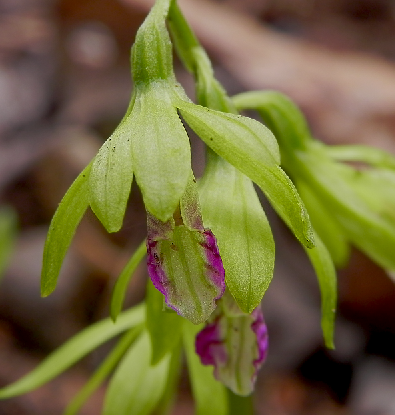
no rights reserved, uploaded by S.MORE · cc0
Nervilia
Sign in to saveNervilia, commonly known as shield orchids, is a genus of orchids with about 80 species widely distributed across most of sub-Saharan Africa, southern Asia (Saudi Arabia, Pakistan, India, China, Japan, Indochina, Indonesia, etc.), Australia, and various islands of the Pacific and Indian Oceans. Six species occur in Australia (2 or 3 of these endemic), with 16 in India, 10 in China and 5 in South Africa.
In the Vinony graph
Vinony's link graph records 14 inbound references to Nervilia, and connects out to Charles Gaudichaud-Beaupré, Japan and India.
Vinony files it under Nervilia, Nervilieae genera and Taxonbars with 20–24 taxon IDs.
Vinony links it to 20 Wikipedia language editions.
Species
tall shield orchid
GENUS
- KingdomPlantae
- PhylumTracheophyta
- ClassLiliopsida
- OrderAsparagales
- FamilyOrchidaceae
via GBIF · Kew POWO
Museum specimens
- Specimen records
- 140
- With media
- 108
- Family
- Orchidaceae
- Collections
- A, AMES, MO
- Recorded in
- Papua New Guinea, China, South Africa, Vietnam, Indonesia, Guinea, Philippines, Northern Mariana Islands
Wikidata facts
- Instance of
- taxon
- Image
- Nervilia aragoana 3.JPG
Show 7 more facts
- taxon common name
- 芋兰属
- Commons category
- Nervilia
- topic's main category
- Category:Nervilia
- taxon rank
- genus
- Commons gallery
- Nervilia
- taxon name
- Nervilia
Sources (1)
via Wikidata · CC0
~5 min read
Encyclopedic overview
5 sectionsContents
- Description
- Taxonomy and naming
- Species list
- References
- External links
Nervilia, commonly known as shield orchids, is a genus of orchids with about 80 species widely distributed across most of sub-Saharan Africa, southern Asia (Saudi Arabia, Pakistan, India, China, Japan, Indochina, Indonesia, etc.), Australia, and various islands of the Pacific and Indian Oceans. Six species occur in Australia (2 or 3 of these endemic), with 16 in India, 10 in China and 5 in South Africa.
==Description== Orchids in the genus Nervilia are terrestrial, perennial, deciduous, sympodial herbs with an oval to almost spherical tuber and sometimes a few short roots. One or two flowers are borne on an erect, fleshy, leafless flowering stem. When flowering the plants lack leaves, but a single erect or ground-hugging leaf develops after the flower has fully opened. The leaves are usually wrinkled or crumpled with distinct, fan-like veins, giving rise to the genus name. The flowers are often short-lived, lasting for only a few days. The sepals and petals are similar, but the labellum is prominent and often composed of three lobes. The genus is poorly understood, mainly because the flower and leaf are present at different times, so that herbarium specimens are often incomplete.
Excerpted from Wikipedia’s “Nervilia” article, available under the CC BY-SA 4.0 licence.
Gallery (3)
Available in 20 languages
- Español
- Français
- 中文
- Português
- Italiano
- Azerbaijani
- Cebuano
- Komi
- Komi-Permyak
- Nederlands
- Polski
- Svenska
- Türkçe
- Udmurt
- Waray
- Western Mari
- فارسی
- ไทย
Show 1 more
via Wikidata sitelinks · CC0