File:Gray726-Brodman.png · Wikimedia Commons · See Wikimedia Commons
neurolinguistics
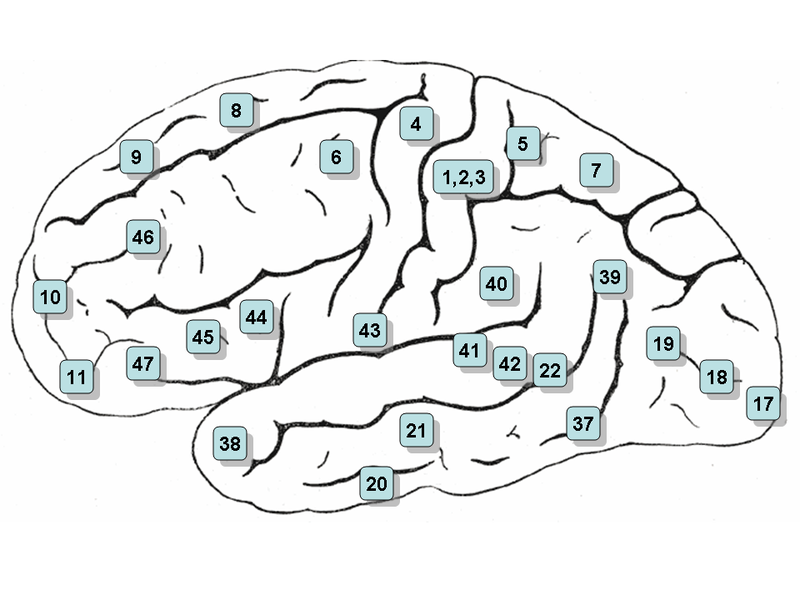
Sign in to saveright|thumb|Surface of the human brain, with Brodmann areas numbered right|thumb|An image of neural pathways in the brain taken using Diffusion MRI#Diffusion tensor imaging|diffusion tensor imaging
Wikidata facts
- Subclass of
- neurology
- Image
- ComponentsofERP.svg
Show 3 more facts
- topic's main category
- Category:Neurolinguistics
- Commons category
- Neurolinguistics
- different from
- cognitive linguistics
via Wikidata · CC0
~23 min read
Encyclopedic overview
29 sectionsContents
- History
- Discipline
- Interaction with other fields
- Topics considered
- Localizations of language processes
- Time course of language processes
- Language acquisition
- Language pathology
- Technology used
- Hemodynamic
- Electrophysiological
- Experimental design
- Experimental techniques
- Subtraction
- Mismatch paradigm
- Violation-based
- Priming
- Stimulation
- Subject tasks
- Lexical decision
- Grammaticality judgment, acceptability judgment
- Probe verification
- Truth-value judgment
- Active distraction and double-task
- See also
- Notes
- References
- Further reading
- External links
right|thumb|Surface of the human brain, with Brodmann areas numbered right|thumb|An image of neural pathways in the brain taken using Diffusion MRI#Diffusion tensor imaging|diffusion tensor imaging
Neurolinguistics is the study of neural mechanisms in the human brain that control the comprehension, production, and acquisition of language. As an interdisciplinary field, neurolinguistics draws methods and theories from fields such as neuroscience, linguistics, cognitive science, communication disorders and neuropsychology. Researchers are drawn to the field from a variety of backgrounds, bringing along a variety of experimental techniques as well as widely varying theoretical perspectives. Much work in neurolinguistics is informed by models in psycholinguistics and theoretical linguistics, and is focused on investigating how the brain can implement the processes that theoretical and psycholinguistics propose are necessary in producing and comprehending language. Neurolinguists study the physiological mechanisms by which the brain processes information related to language, and evaluate linguistic and psycholinguistic theories, using aphasiology, brain imaging, electrophysiology, and computer modeling.
Excerpted from Wikipedia’s “neurolinguistics” article, available under the CC BY-SA 4.0 licence.