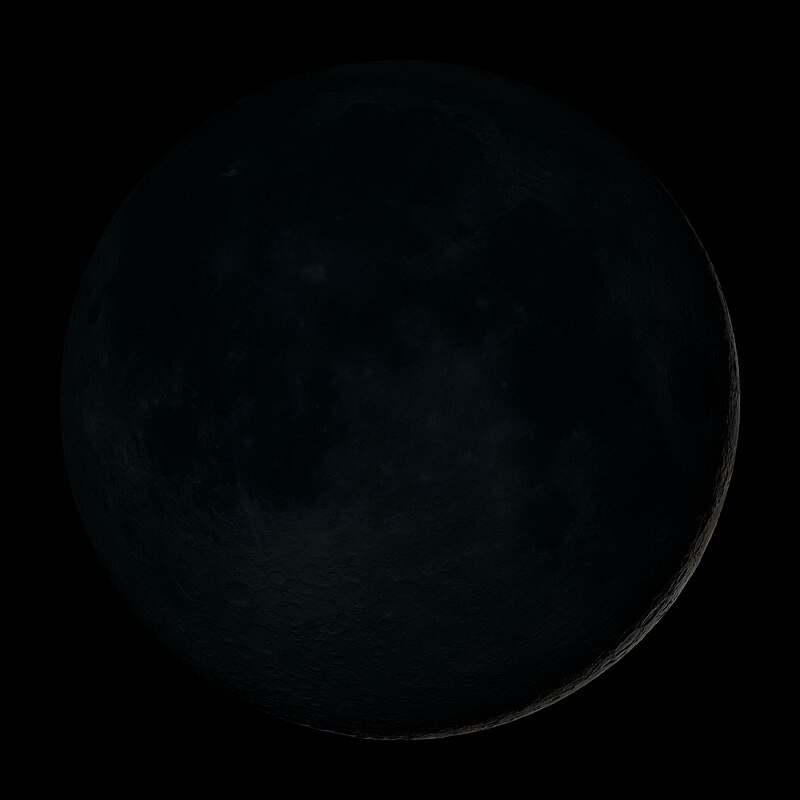
File:New_Moon.jpg · Wikimedia Commons · See Wikimedia Commons
A new moon is the phase when the Moon passes between Earth and the Sun, making it invisible from Earth because the Sun's light illuminates only its far side. This phase matters because it marks the beginning of the lunar cycle, which has been used historically to track time and seasons, and it's when solar eclipses can occur.
AI-generated from the Wikipedia summary — may contain errors.
Wikidata facts
- Instance of
- phase of the moon
- Followed by
- Noumenia
- Image
- Phase-000.jpg
Show 4 more facts
- Unicode character
- 🌚
- Commons category
- New moon
- opposite of
- full moon
- topic's main category
- Category:New moon
via Wikidata · CC0
~10 min read
Encyclopedic overview
(Learn how and when to remove this message)
A simulated image of the traditionally defined new Moon: the earliest visible waxing crescent (lower right), which signals the start of a new month in many lunar and lunisolar calendars. At new moon, mostly earthlight illuminates the near side of the Moon. As the Earth revolves around the Sun, approximate axial parallelism of the Moon's orbital plane (tilted five degrees to the Earth's orbital plane) results in the revolution of the lunar nodes relative to the Earth. This causes an eclipse season approximately every six months, in which a solar eclipse can occur at the new moon phase.
Excerpted from Wikipedia’s “new moon” article, available under the CC BY-SA 4.0 licence.
Gallery (3)
Available in 65 languages
- Español
- Français
- Deutsch
- 中文
- 日本語
- Русский
- Português
- Italiano
- العربية
- हिन्दी
- Armenian
- Bahasa Indonesia
- Bangla
- Belarusian
- Bulgarian
- Catalan
- Colognian
- Czech
Show 46 more
- dag
- Danish
- Esperanto
- Extremaduran
- Filipino
- Finnish
- Georgian
- Greek
- Hebrew
- Kashubian
- Kazakh
- Lithuanian
- Low German
- Luxembourgish
- Macedonian
- Malagasy
- Malay
- Malayalam
- Marathi
- Nederlands
- Nepali
- Northern Frisian
- Norwegian
- Norwegian Nynorsk
- Occitan
- Polski
- Quechua
- Romanian
- Santali
- Slovak
- Slovenian
- Svenska
- Swahili
- Tamil
- Tiếng Việt
- Türkçe
- Ukrainian
- Urdu
- Uzbek
- Walloon
- Western Frisian
- Wu Chinese
- zh_yue
- فارسی
- ไทย
- 한국어
via Wikidata sitelinks · CC0