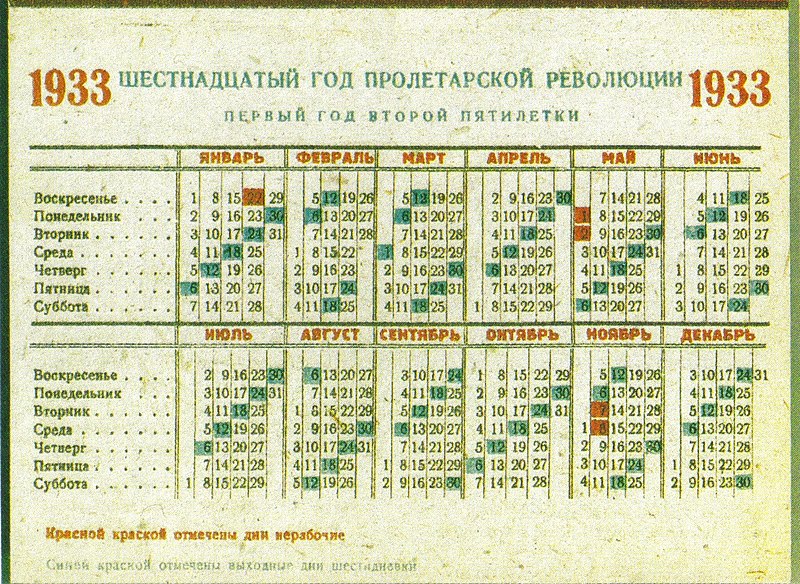
File:Soviet_calendar_1933_color.jpg · Wikimedia Commons · See Wikimedia Commons
week
Sign in to saveAlso known as weeks, weekly, week duration, 7 days
A week, in the Western and international context, is a unit of time equal to seven days. It is the standard calendrical period between a day and a month in most parts of the world. There are just over 52 weeks in a year, or on average weeks in a month. The days of the week are often used to set work days, rest days, and holy days. The term "week" may also be used to refer to a sub-section of the week, such as the workweek and weekend. Certain weeks within a year may be designated for a particular purpose, such as Golden Week in China and Japan. More informally, certain groups may advocate awar
A week is a unit of time consisting of seven days that serves as the standard calendrical period between a day and a month in most parts of the world. Weeks matter because they organize how people structure their time—determining work schedules, rest days, and religious observances—and certain weeks throughout the year may be designated for specific purposes.
AI-generated from the Wikipedia summary — may contain errors.
Wikidata facts
- Subclass of
- time interval
- Part of
- month
- Has part
- Friday
- Duration
- 7
- Image
- First Day of Week World Map.svg
- Has parts of class
- weekend
Show 11 more facts
- Commons category
- Weeks
- topic's main category
- Category:Weeks
- Commons gallery
- Week
- conversion to SI unit
- 604800
- conversion to standard unit
- 7
- exact match
- dati.beniculturali.it/cis/Week
- Wikidata SPARQL query equivalent
- wd:Q23387 p:P2370/psn:P2370 [wikibase:quantityAmount ?source; wikibase:quantityUnit ?base]. ?item p:P2370/psn:P2370 [wikibase:quantityAmount ?target; wikibase:quantityUnit ?base]. BIND(?source / ?target as ?value)
- described by source
- Pauly–Wissowa
- subdivision of this unit
- day
- unit symbol
- u
- on focus list of Wikimedia project
- Wikipedia:Vital articles/Level/4
Sources (1)
via Wikidata · CC0
~32 min read
Encyclopedic overview
29 sectionsContents
- Name
- Definition and duration
- Start and end
- Days of the week
- History
- Ancient Near East
- Achaemenid Persia
- Judaism
- Hellenistic and Roman era
- Islamic concept
- Adoption in Asia
- China and Japan
- India
- Christian Europe
- Numbering
- ISO week date system
- Determining ''Week 1''
- Week 52 and 53
- Schematic representation of [[ISO week date]]
- Other week numbering systems
- Uses
- "Weeks" in other calendars
- Pre-modern
- Modern reforms
- Soviet
- See also
- Notes
- References
- Further reading
A week, in the Western and international context, is a unit of time equal to seven days. It is the standard calendrical period between a day and a month in most parts of the world. There are just over 52 weeks in a year, or on average weeks in a month. The days of the week are often used to set work days, rest days, and holy days. The term "week" may also be used to refer to a sub-section of the week, such as the workweek and weekend. Certain weeks within a year may be designated for a particular purpose, such as Golden Week in China and Japan. More informally, certain groups may advocate awareness weeks, such as National Family Week in Canada, which are designed to draw attention to a certain subject or cause.
Some ancient and traditional cultures have or had different week lengths, including ten days in Egypt, an eight-day week for Etruscans and ancient Romans, and four- or five-day weeks between market days in modern West Africa. (See also the Japanese ten-day jun, used alongside the 7-day week.) The Romans later switched to a seven-day week. This was originally a so-called planetary or astrological week, a cycle of disputed origins which named each day after a classical planet and the god identified with that planet. Due to the spread of Christianity, the Romans' astrological week was identified and merged with the Christian seven-day week centred on Sunday (the day of the Resurrection of Christ), which had originated with the Jewish seven-day week centred on Saturday. Both the astrological week and the Jewish week may have been inspired by earlier seven-day cycles that existed in the Babylonian calendar, although the evidence for that is weak. In AD 321, Emperor Constantine the Great officially decreed a seven-day week in the Roman Empire, including making Sunday a public holiday. This later spread across Europe, then the rest of the world.
Excerpted from Wikipedia’s “week” article, available under the CC BY-SA 4.0 licence.
Gallery (14)
Available in 206 languages
- Español
- Français
- Deutsch
- 中文
- 日本語
- Русский
- Português
- Italiano
- العربية
- हिन्दी
- Afrikaans
- Albanian
- Albanian
- Amharic
- Angika
- Aragonese
- Aramaic
- Armenian
Show 187 more
- Arpitan
- Assamese
- Asturian
- Avaric
- Aymara
- azb
- Azerbaijani
- Bahasa Indonesia
- Bangla
- Bashkir
- Basque
- bat_smg
- be_x_old
- Belarusian
- Bhojpuri
- Bosnian
- Breton
- Bulgarian
- Buriat
- Catalan
- cdo
- Central Kurdish
- Chechen
- Church Slavic
- Chuvash
- Cornish
- Corsican
- Crimean Tatar
- Croatian
- Czech
- dag
- Danish
- dty
- Dzongkha
- Egyptian Arabic
- eml
- Erzya
- Esperanto
- Estonian
- Extremaduran
- Faroese
- Fiji Hindi
- Fijian
- Filipino
- Finnish
- fiu_vro
- Friulian
- Fula
- Galician
- Gan Chinese
- gcr
- Georgian
- Gilaki
- Gothic
- Greek
- Guarani
- Gujarati
- Haitian Creole
- Hakka Chinese
- Hausa
- Hebrew
- Hungarian
- Icelandic
- Ido
- Iloko
- Ingush
- Interlingua
- Interlingue
- Irish
- Javanese
- Jju
- Kabardian
- Kabyle
- Kannada
- Karachay-Balkar
- Kazakh
- kbp
- kge
- Kinyarwanda
- Komi
- Kongo
- Kyrgyz
- Ladino
- Lao
- Latin
- Latvian
- lbe
- Lezghian
- Lingala
- Lithuanian
- Lombard
- Low German
- Lower Sorbian
- Macedonian
- Maithili
- Malagasy
- Malay
- Malayalam
- Manipuri
- Marathi
- Mazanderani
- Mingrelian
- mnw
- Mongolian
- Moroccan Arabic
- nah
- nds_nl
- Nederlands
- Nepali
- Newari
- Northern Frisian
- Northern Sami
- Northern Sotho
- Norwegian
- Norwegian Nynorsk
- nrm
- Occitan
- Odia
- olo
- Ossetic
- Pashto
- Pennsylvania German
- Picard
- Piedmontese
- Polski
- Punjabi
- Quechua
- roa_rup
- Romanian
- Rusyn
- Sanskrit
- Santali
- Sardinian
- Saterland Frisian
- Scots
- Serbian
- Serbian (Latin)
- Shona
- Silesian
- simple
- Sindhi
- Sinhala
- Slovak
- Slovenian
- Somali
- Standard Moroccan Tamazight
- Svenska
- Swahili
- Tajik
- Talysh
- Tamil
- Tatar
- Telugu
- Tibetan
- Tiếng Việt
- Tok Pisin
- Toki Pona
- Tulu
- Türkçe
- Turkmen
- Tuvinian
- Tyap
- Ukrainian
- Upper Sorbian
- Urdu
- Uyghur
- Uzbek
- Veps
- Volapük
- Walloon
- Waray
- Welsh
- Western Frisian
- Western Panjabi
- Wolof
- Wu Chinese
- Yakut
- Yiddish
- Yoruba
- Zaza
- Zeelandic
- zh_classical
- zh_min_nan
- zh_yue
- فارسی
- ไทย
- 한국어
via Wikidata sitelinks · CC0