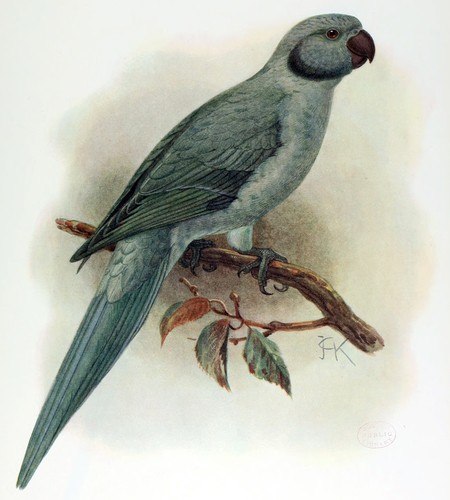
Creator:John Gerrard Keulemans, no known copyright restrictions (public domain) · pd
Newton's parakeet
Sign in to saveAlso known as Psittacula exsul, Rodrigues parakeet
extinct species of bird
Species
ExtinctNewton's Parakeet
species
via IUCN
Wikidata facts
- Instance of
- taxon
- Parent taxon
- Psittacula
- Named after
- Alfred Newton
- Image
- Newton's Parakeet.jpg
Show 9 more facts
- taxon rank
- species
- IUCN conservation status
- extinct species
- taxon name
- Psittacula exsul
- Commons category
- Psittacula exsul
- endemic to
- Rodrigues
- Commons gallery
- Psittacula exsul
- taxon common name
- periquito-da-rodrigues
- short name
- P. exsul
- taxon author citation
- (Newton, 1872)
Sources (3)
via Wikidata · CC0
~20 min read
Encyclopedic overview
Newton's parakeet (Psittacula exsul), also known as the Rodrigues parakeet or Rodrigues ring-necked parakeet, is an extinct species of parrot that was endemic to the Mascarene island of Rodrigues in the western Indian Ocean. Several of its features diverged from related species, indicating long-term isolation on Rodrigues and subsequent adaptation. The rose-ringed parakeet of the same genus is a close relative and probable ancestor. Newton's parakeet may itself have been ancestral to the endemic parakeets of nearby Mauritius and Réunion.
Around 40 centimetres (16 in) long, Newton's parakeet was roughly the size of a rose-ringed parakeet. Its plumage was mostly greyish or slate blue in colour, which is unusual in Psittacula, a genus containing mostly green species. The male had stronger colours than the female and possessed a reddish instead of black beak, but details of a mature male's appearance are uncertain; only one male specimen is known, and it is believed to be immature. Mature males might have possessed red patches on the wing like the related Alexandrine parakeet. Both sexes had a black collar running from the chin to the nape, but this was clearer in the male. The legs were grey and the iris yellow. Some 17th-century accounts indicate that some members of the species were green, which would suggest that both blue and green colour morphs occurred, but no definitive explanation exists for these reports. Little is known about its behaviour in life, but it may have fed on the nuts of the bois d'olive tree, along with leaves. It was very tame and was able to mimic speech.
Excerpted from Wikipedia’s “Newton's parakeet” article, available under the CC BY-SA 4.0 licence.