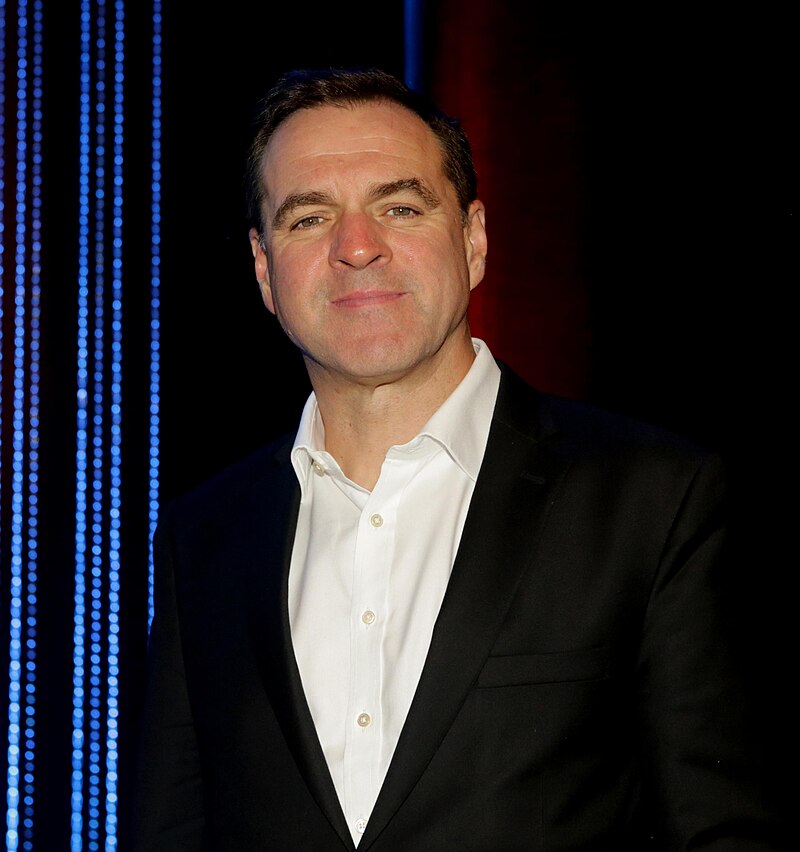
File:Niall_Ferguson_no_Fronteiras_do_Pensamento_São_Paulo_2017_(37840342015)_(cropped).jpg · Wikimedia Commons · See Wikimedia Commons
Also known as Niall Campbell Ferguson
historiador britânico
Top works
via Open Library + Wikidata
Tags
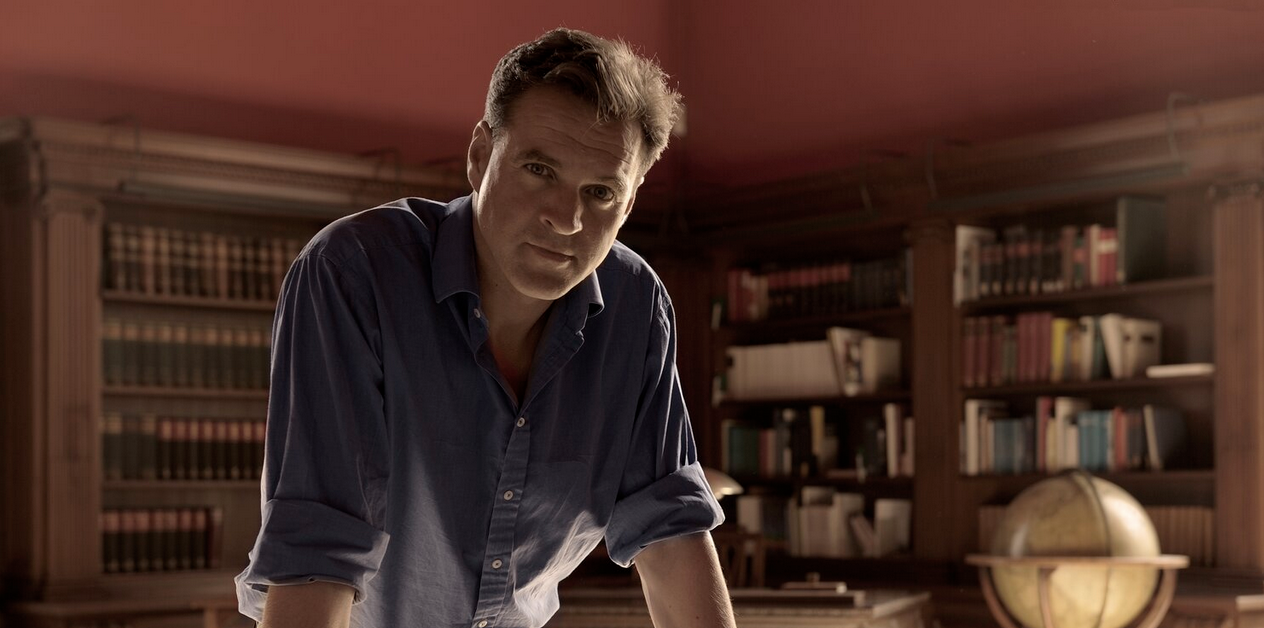
Niall Campbell Ferguson (Glasgow, Escócia, 18 de abril de 1964) é um historiador escocês. Leciona história na Universidade de Harvard, é um pesquisador em Oxford (sua alma mater), associado sénior no Instituto Hoover e na Universidade de Stanford e professor emérito da . Ele também é um comentador político, que escreve sobre história global, economia e finanças, além de questões a respeito de imperialismo britânico e americano. Niall, um neoconservador, é conhecido por suas opiniões controversas e diferentes. Ele escreveu livros como Empire: How Britain Made the Modern World, The Ascent of Money: A Financial History of the World e Civilization: The West and the Rest, todos que viraram séries de televisão do canal Channel 4. Em 2004, ele foi escolhido como uma das 100 pessoas mais influentes do mundo pela revista Time. Ele também é um colaborador do canal Bloomberg Television e é um colunista para a revista Newsweek. Ferguson foi conselheiro do candidato presidencial americano John McCain, em 2008, apoiou Mitt Romney em 2012 e foi crítico da presidência de Barack Obama. Na Europa, ele defendeu o movimento em favor do Brexit, em 2016, apoiou Marine Le Pen, a candidata de extrema-direita à presidência da França, e ainda apoiou uma maior aproximação dos Estados Unidos, da Rússia e da China, aconselhando o presidente americano Donald Trump a cultivar bons laços com o presidente russo Vladimir Putin e o chinês Xi Jinping. Em 2013, recebeu o prêmio Ludwig Erhard de jornalismo económico. Ferguson foi casado com a jornalista inglesa Susan Douglas de 1987 a 2011, com quem teve três filhos: Felix, Freya e Lachlan. Ainda em 2011, ele começou a namorar a ativista holandesa, de origem somali, Ayaan Hirsi Ali. Os dois casaram-se no mesmo ano e têm dois filhos.
Abstract from DBpedia / Wikipedia · CC BY-SA
Discovered by embedding cosine similarity (sentence-transformers MiniLM, 384-dim).
Niall Campbell Douglas Ferguson (born April 18, 1964, in Glasgow) is a British historian who specialises in financial and economic history as well as the history of colonialism. He is the Laurence A. Tisch Professor of History at Harvard University and the William Ziegler Professor of Business Administration at Harvard Business School. He was educated at the private Glasgow Academy in Scotland, and at Magdalen College, Oxford. He is best known <a href="https://www.last.fm/music/Niall+Ferguson
5 total works indexed
· 2003 · cited 20,919x
· 2013 · cited 13,117x
· 1995 · cited 11,809x
· 2002 · cited 8,514x
· 2012 · cited 7,922x
via Crossref · CC0
via Wikiquote · CC BY-SA
via Wikipedia infobox

NIALL FERGUSON
Niall Ferguson is one of the world’s foremost historians. He is the Milbank Family Senior Fellow at the Hoover Institution, Stanford University, and the managing director of Greenmantle, LLC. He is the author of sixteen books. His awards include the International Emmy for Best Documentary, the Benja, Niall Ferguson is one of the world’s foremost historians. He is the Milbank Family Senior Fellow at the Hoover Institution, Stanford University, and the managing director of Greenmantle, LLC. He is the author of sixteen books. His awards include the International Emmy for Best Documentary, the Benjamin Franklin Award for Public Service, and the Council on Foreign Relations Arthur Ross Book Award.
niallferguson.com →Link to the official site · 5,883 chars · not written by Vinony
Niall Ferguson - Powerbase
powerbase.info →Ferguson graduated from Magdalen College, Oxford with First Class Honours in 1985.[[3]]( Subsequently, writes Robert S. Boynton, "Ferguson was accepted into the postgraduate program. He chose as his mentor the historian Norman Stone") , who was a fellow-Scot, a Glasgow Academy alumnus, a much reviled Thatcherite, and-like one of Stone's heroes, A.J.P. Taylor") , a media don."[[4]]( In April 2009 Ferguson debated the financial crisis along with economist Paul Krugman") and others at the New York Metropolitan Museum of Art.[[10]]( The event proved to be the starting point for a literary spat. Krugman wrote on his New York Times blog that the event proved that "we’re living in a Dark Age of macroeconomics, in which hard-won knowledge has simply been forgotten." What’s the evidence? Niall Ferguson “explaining” that fiscal expansion will actually be contractionary, because it will drive up interest rates. At least that’s what I think he said; there were so many flourishes that it’s hard to tell. But in any case, this is really sad: John Hicks knew far more about this in 1937 than people who think they’re sophisticates know now.[[11]]( Ferguson claimed a month later in the Financial Times that a subsequent rise in bond yields "settled a rather public argument between me and the Princeton economist Paul Krugman."[[12]]( At the 2010 Hay Festival, the new Education Secretary Michael Gove invited Ferguson to "spend more time in Britain to help us design a more exciting and engaging history curriculum?."[[15]]( Gove had praised Ferguson in 2006 article because he "he dared to approach the legacy of the British Empire with a balanced mind, accepting its manifold evils but also ready to acknowledge its progressive side."[[16]]( In October 2015, Ferguson signed a letter in The Guardian along with more than 150 people drawn from the arts and politics. The letter launched Culture for Coexistence , an organisation that opposes the Boycott, Divestment and Sanctions movement.[[17]](
Excerpt from a page describing this subject · 17,611 chars · not written by Vinony
via Wikidata · CC0
via Wikidata sitelinks · CC0