
Nicaragua
Sign in to saveAlso known as ni, Republic of Nicaragua, NIC, NI, NCA
OverviewAI-generated
Nicaragua is a sovereign state and country in North America, specifically located in the subregion of Central America. Its official name is the Republic of Nicaragua. The capital city is Managua. The country shares borders with Costa Rica, Honduras, and Colombia. It operates as a republic with Daniel Ortega as the head of state. The inception of the state is recorded as 1821-01-01.
The official language is Spanish. The currency includes the Nicaraguan córdoba and the Nicaraguan peso. The top-level Internet domain is .ni, and the telephone country code is 505. Nicaragua is a member of the United Nations, World Trade Organization, International Bank for Reconstruction and Development, and International Development Association. It contains administrative entities such as the Boaco Department, Carazo Department, Chinandega Department, and Chontales Department.
The population is listed as 6803886 by REST Countries and 6916140 by the World Bank. The area is 130373. The forest area percentage is 25.8229183978727. The urban population percentage is 59.2628402709961. Life expectancy is 75.1 years. The unemployment percentage is 5.04. The GDP in USD is 19693982967.5926. Renewable energy accounts for 50.4 percent. Internet users make up 61.39550018 percent of the population.
Synthesized by Vinony from 67 facts across 9 sources: Wikidata, REST Countries, Open Meteo, Openweathermap, World Bank, OpenStreetMap, PubMed, Vinony graph, Geo. Generated from structured data (not the Wikipedia text) and checked against those facts — may still contain errors.
Weather now
7-day forecast
via Open-Meteo
Country
- Capital
- Managua
- Population
- 6,803,886
- Region
- Americas · Central America
- Demonym
- Nicaraguan
- Currencies
- NIO (C$)
- Languages
- Spanish
- Calling code
- +505
- Drives on
- Right
- Gini
- 46.2 (2014)
- FIFA code
- NCA
- TLD
- .ni
- Timezones
- UTC-06:00
- Borders
- CRI, HND
via REST Countries
Indicators · World Bank
- GDP
- $19.7B(2024)
- Population
- 6,916,140(2024)
- Life expectancy
- 75.1 yrs(2024)
- Unemployment
- 5 %(2025)
- Urban population
- 59.3 %(2024)
- Internet users
- 61.4 %(2024)
- Forest area
- 25.8 %(2023)
- Renewable energy
- 50.4 %(2021)
via World Bank Open Data · CC BY 4.0
Wikipedia views (30d)
119,934 totalvia Wikimedia Pageviews API
Key facts
- Country.conventional_long_name
- Republic of Nicaragua
- Country.common_name
- Nicaragua
- Country.native_name
- (Spanish)
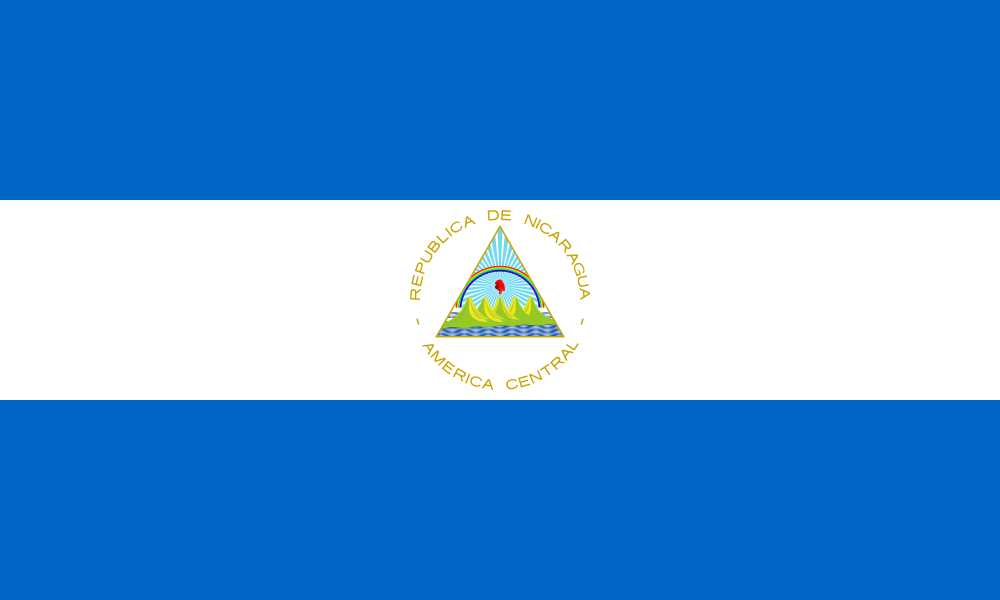
- Country.image_flag
- Flag of Nicaragua.svg
- Country.other_symbol
- 100px
- Country.other_symbol_type
- Dual flag:
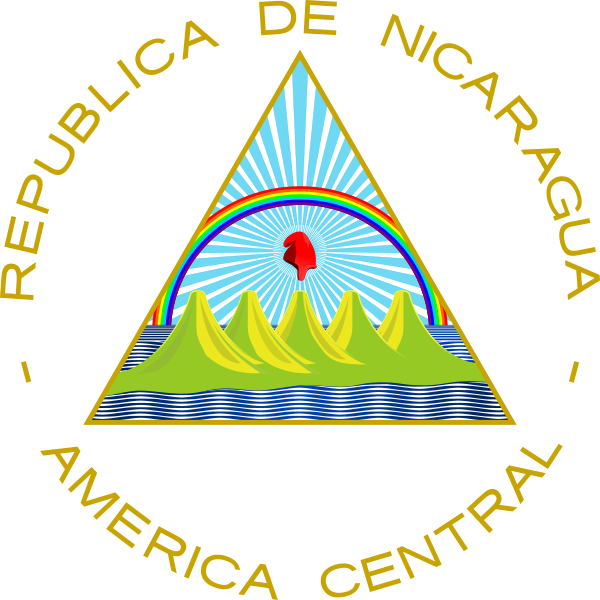
- Country.image_coat
- Coat of arms of Nicaragua.svg
- Country.national_motto
- "In God We Trust"
- Country.national_anthem
- Salve a ti, Nicaragua"Hail to Thee, Nicaragua"
- Country.image_map
- NIC orthographic.svg
- Country.capital
- Managua
- Country.largest_city
- capital
- Country.official_languages
- Spanish
- Country.ethnic_groups_year
- 2023
- Country.religion_year
- 2015
- Country.government_type
- Unitary diarchic presidential socialist republic under an authoritarian dictatorship
- Country.leader_title1
- Co-Presidents
- Country.leader_title2
- President of the National Assembly
via Wikipedia infobox
Research
3,530 papers- Nicaragua's surprising response to COVID-19.ReviewJournal of global health · 2020Pearson AA, Prado AM, Colburn FDDOI: 10.7189/jogh.10.010371
- Nicaragua's human rights crisis requires international response.PLoS neglected tropical diseases · 2019Huete-Pérez JADOI: 10.1371/journal.pntd.0007119
- Nicaragua.Department of State publication. Background notes series · 1993United States. Department of State. Bureau of Public Affairs. Office of Public Communication
- Global Dialysis Perspective: Nicaragua.Kidney360 · 2023Cajina-Aguirre CL, Strasma AK, Álvarez-Novoa RJDOI: 10.34067/KID.0005572022
- Nicaragua.Department of State publication. Background notes series · 1983United States. Department of State. Bureau of Public Affairs
- Nicaragua.Population policy compendium · 1985United Nations. Department of International Economic and Social Affairs. Population Division, United Nations Fund for Population Activities UNFPA
- Nicaragua's response to COVID-19.The Lancet. Global health · 2020Perry JDOI: 10.1016/S2214-109X(20)30218-7
- Nicaragua's response to COVID-19 - Authors' reply.The Lancet. Global health · 2020Jarquín MC, Prado AM, Gallo Marin BDOI: 10.1016/S2214-109X(20)30220-5
via PubMed
Wikidata facts
- Instance of
- country
- Part of
- Latin America
- Named after
- Nicarao
- Official name
- República de Nicaragua
- Demonym
- nicaragüenques
- Country
- Nicaragua
- Contains
- Managua Department
- Continent
- North America
- Capital
- Managua
- Official language
- Spanish
- Currency
- Nicaraguan peso
- Population
- 7005764
- Area
- 120340
- Head of government
- Daniel Ortega
- Head of state
- Daniel Ortega
- Form of government
- republic
- Legislature
- National Assembly of Nicaragua
- Anthem
- Salve a ti
- Shares border with
- Colombia
- Highest point
- Cerro Mogotón
- Official website
- www.visitnicaragua.us
- Image
- Кафедральный собор в Манагуа.jpg
- Life expectancy
- 75
- Nominal GDP
- 15671583878
Show 61 more facts
- Unemployment rate
- 5
- Calling code
- +505
- Licence plate code
- NIC
- Mains voltage
- 120
- Motto
- Unica. Original!
- Coat of arms
- coat of arms of Nicaragua
- top-level Internet domain
- .ni
- Commons category
- Nicaragua
- topic's main category
- Category:Nicaragua
- topic's main Wikimedia portal
- Portal:Nicaragua
- inception
- 1821-01-01
- category for people who died here
- Category:Deaths in Nicaragua
- category for people born here
- Category:Births in Nicaragua
- category for films shot at this location
- Category:Films shot in Nicaragua
- category of associated people
- Category:Nicaraguan people
- diplomatic relation
- China
- history of topic
- history of Nicaragua
- IPA transcription
- nɪkɑˈɾɑːɡʋɑ
- Commons gallery
- Nicaragua
- lowest point
- Caribbean Sea
- mobile country code
- 710
- driving side
- right
- geography of topic
- Geography of Nicaragua
- marriageable age
- 18
- office held by head of government
- President of Nicaragua
- office held by head of state
- President of Nicaragua
- number of out-of-school children
- 379914
- total fertility rate
- 2.264
- maritime identification digits
- 350
- native label
- República de Nicaragua
- Unicode character
- 🇳🇮
- central bank
- Central Bank of Nicaragua
- GS1 country code
- 743
- culture
- culture of Nicaragua
- VAT rate
- 15
- BTI Status Index
- 4.06
- BTI Governance Index
- 2.45
- economy of topic
- economy of Nicaragua
- demographics of topic
- demographics of Nicaragua
- Democracy Index
- 3.60
- topic has template
- Template:Departments of Nicaragua
- Human Development Index
- 0.667
- P11012
- Roger Federer
- hashtag
- Nicaragua
- on focus list of Wikimedia project
- Wikipedia:Vital articles/Level/4
- Happy Planet Index score
- 55.2
- Gini coefficient
- 46.2
- Inequality-adjusted Human Development Index
- 0.516
- P12749
- straight edge
- birth rate
- 20.018
- male population
- 3423787
- death rate
- 4.655
- rural population
- 2810208
- female population
- 3524605
- urban population
- 4138184
- P8168
- Noam Elkies
- located in/on physical feature
- Central America
- most populous urban area
- Managua
- short name
- NIC
Sources (15)
via Wikidata · CC0
Travel guide
Understand
Nicaraguans like to call their country "país de lagos y volcanes" - Land of lakes and volcanoes and this certainly an apt description of the overall layout, particularly of the Western half of the country.
Get in
thumb|450px|Visa policy of Nicaragua
See
Nicaraguans like to call their country the country of lakes and volcanoes. Some of the most noteworthy volcanoes include: Volcán Concepción and Maderas on Ometepe Volcán Mombacho near Granada Volcán Masaya near Masaya. If it is not considered too dangerous you can drive up by car. Volcán Cosigüina that used to be one of the highest in the region but exploded in the 19th century, dotting the Golfo de Fonseca between Nicaragua and El Salvador with many small islets made out of its debris. Other sights include: Wildlife on Ometepe or in the protected areas of Indio-Maiz (southeast, Rio San Juan Region) and Bosawas (northeast, Caribbean Nicaragua) Churches en masse especially in León (with one of the biggest churches of central America) and Granada Beaches along the country's east and west coasts, including the party resort San Juan del Sur Lake-panoramas and sunsets along the shores of Lake Nicaragua (Cocibolca) Museums and murals dedicated to the country's revolutionary past and its civil war (especially in Sandinista-strongholds such as León or Estelí) Thankfully, Nicaragua retains much more colonial era architecture than its southern neighbor, and if you are coming from the south, places like Granada or León can be a breath of fresh air, compared to the rather bland modernist architecture you'll find there.
Do
There is an endless selection of things to do in Nicaragua, but some of the most overlooked are the fiestas patronales or Saint Festivals that happen nearly every day in some town or village in the country. Participating in the fiestas patronales is a great way to really experience the culture of Nicaragua, and such customs such as the dance of the Gigantona and the Los Aguizotes parade are truly unforgettable to see. Unfortunately, it can be difficult to determine what is going on and when. After April 2018, the Catholic churches have stopped sponsoring fiestas patronales, replacing them with prayer meetings inside the churches. The government is now organizing fiestas patronales.
Eat
thumb|Nacatamal Nicaraguan food is very cheap for Western standards. A plate of food from the street will cost C$30-70. A typical dinner will consist of meat, rice, beans, salad (i.e. coleslaw) and some fried plantains, costing under US$3. Buffet-style restaurants/stalls called "fritanga" are very common, quality varies quite a bit. A lot of the food is fried in oil (vegetable or lard). It is possible to eat vegetarian: the most common dish is gallo pinto (beans and rice), and most places serve cheese (fried or fresh), fried plantains and cabbage salad. There are a 'few' vegetable dishes such as guiso de papas, pipián o ayote—a buttery creamy stew of potato, zucchini or squash; guacamole nica made with hard-boiled eggs, breaded pipian (zucchini), and various fried fritters of potatoes, cheese and other vegetables. However, the very concept of vegetarianism is unknown to the majority of Nicaraguans, especially in the countryside, and saying you "don't eat meat" may get people to offer you chicken instead, which is considered distinct from "meat" (pork or beef).
If you like meat, grilled chicken and beef is delicious, the beef is usually good quality but often cooked tough. Also try the nacatamales, a traditional Sunday food, that is essentially a large tamal made with pork or beef and other seasonings, wrapped in a banana leaf and tied with a banana-leaf string (C$35-40). People who make them often sell them from their homes on Fridays, Saturdays, and Sundays; watch for signs…
Drink
Rum is the liquor of choice, though you will find some whiskey and vodka as well. The local brand of Rum is Flor de Caña and is available in several varieties: Light, Extra Dry, Black Label, Gran Reserva (aged 7 years), Centenario (aged 12 years) and a new top-of-the line 18 year old aged rum. There is also a cheaper rum called Ron Plata.
Local beers include Victoria, Toña, Premium, and Brahva. Victoria is the best quality of these, similar in flavor to mainstream European lagers, while the others have much lighter bodies with substantially less flavour, and are more like the pallid mainstream US lagers. A new beer is "Victoria Frost" which is similarly light.
In the non-alcoholic arena you will find the usual soft drinks such as Coca-Cola and Pepsi Cola. Local drinks include pinolillo and cacao, which are delicious drinks from cocoa beans, corn and milk and usually some cinnamon, a thick cacao based drink; Milca, the first red soda in Nicaragua; and Rojita, a red soda that tastes similar to Inca Cola or "Red Pop" (if you're from Texas or the southern United States).
Nicaraguans drink a huge variety of natural fruit juices and beverages (jugos naturales which are usually pure juices, and (re)frescos naturales which are fresh fruit juices mixed with water and sugar). Popular are tamarind, cantaloupe, watermelon, hibiscus flower (flor de Jamaica), limeade, orange, grapefruit, dragon fruit, star fruit (usually mixed with orange), mango, papaya, pineapple, and countless others…
Sleep
thumb|Evening in León Accommodation can generally be had quite cheaply throughout Nicaragua. Options range from simple hammocks (US$2–3), to dorm rooms in hostels (US$5–9), to private double-bed ("matrimonial") rooms (US$10–35, depending on presence of TV, air-con and private shower room and WC). You will likely only find real luxury in major cities like Managua, León or Granada and in a very few resorts such as Montelimar (Somoza's old holiday residence) and even then prices almost never reach four figures.
High and low season are not as pronounced as in e.g. Costa Rica, but there is a pronounced spike in rates during semana santa (Easter week) which is the time of year most Nicaraguans take their vacation. Doubling and tripling of prices is not unheard of in e.g. San Juan del Sur during that time. There is another minor spike around Christmas / New Year's, but it isn't as pronounced. You can sometimes negotiate better rates during the rainy season, but don't count on it.
While Barrio Martha Quezada has typically been a budget destination for visitors to Managua due to its many inexpensive hotel options, it has become increasingly dangerous, especially for tourists, with robberies occurring in broad daylight. Unless you need to be in this area to catch an early morning bus from a nearby terminal, it is advisable to avoid Martha Quezada, particularly since it is far from what is termed the "new" centre of Managua. The area near the Tica Bus station has a reputation for bein…
Respect
thumb|Carnival in Managua Nicaraguan Spanish has a distinction between "formal" and "informal" you. The formal form ("usted" for one person, "ustedes" for several people) is used with strangers, older people and higher-ranking people. The informal form ("tu" or "vos" with one person; "vosotros" for several people is hardly ever used outside of the bible, but still correct (mainland) Spanish, Nicaraguans would talk to a group using "ustedes") is used among peers and friends and after you have been explicitly offered to address someone informally. Don (for men) and Doña (for women) are a common term to politely address people with their given name. e.g. Don Ramon or Doña Maria. It can be loosely translated as Mr./Mrs. Nicaraguans are very conscious about their appearance and don't understand why "rich" tourists would go around in shabby clothes or unkempt. It's true a smile goes a long way, but in Nicaragua a shower with your smile goes an even longer way. While Nicaragua has a sizable irreligious minority and a growing (US-style) evangelical community, most people like their faith (usually Catholic) the way it is, thank you, and don't take too well to it being ridiculed or overt attempts at proselytizing. Men in shorts are not a common sight among Nicaraguans, and considering mosquito-risk, you should consider wearing pants or jeans Some Nicaraguan women bath with a t-shirt on top of their bathing-suit. While you don't have to do that, females going topless at the beach is cer…
Stay safe
Nicaragua has made strides in terms of providing police presence and order throughout the country, and official crime rates are below the Central American average. However, since 2008, low-level gang violence has spread from Honduras and El Salvador. The National Nicaraguan Police has apprehended some gang members and reduced organized crime, but a major crime problem remains throughout the country.
Do not travel alone at night. Pay for a taxi to avoid being assaulted in dimly-lit areas. Tourists are advised to remain alert at all times in Managua. Although gang activity is not a major problem in Managua nor Nicaragua, caution should be exercised. Tourists are advised to travel in groups or with someone trusted who understands Spanish. There are local organizations that offer translator or guide services. One of them is Viva Spanish School Managua.
It is also advised that tourists refrain from using foreign currency in local transactions. It is best to have the local currency instead of having to convert with individuals on streets or non-tourist areas. Banks in Nicaragua require identification for any currency conversion transactions. Use ATMs that dispense the local currency. When using ATMs, follow precautions and be aware of your surroundings.
Buses can be extremely crowded and tight in terms of space. An overhead rack tends to be provided for the storage of bags and other items, but tourists are recommended to keep their bags at hand, in their sight, at all times and …
Stay healthy
thumb|Masaya volcano According to the U.S. State Department's Consular Sheet for Nicaragua, the tap water in Managua is safe to drink, but bottled water with chlorine is always the best choice. The water in Esteli is especially good as it comes from deep wells. Bottled water is readily available, with a gallon at a supermarket around an American dollar.
Given its tropical latitude, there are plenty of bugs flying about. Be sure to wear bug repellent containing DEET particularly if you head to more remote areas (Isla Ometepe, the Rio San Juan Region, or Caribbean Nicaragua).
Dengue fever is present in some areas and comes from a type of mosquito that flies mostly between dusk and dawn. Malaria is not of serious concern unless you are heading to the Caribbean coast or along the Rio San Juan east of San Carlos. You may be advised by a doctor to get Hepatitis A and typhoid vaccinations before heading to Nicaragua. These will substantially lower your odds of getting seriously ill from contaminated food or water, but they don't offer full protection, so you still need to be careful. Also, the Zika virus is known to be present in Nicaragua.
Even though there is a public health system and many public hospitals, these are terrible options for tourists apart from the gravest emergency and even then only until a private hospital can send an ambulance. However they can usually deal with minor problems just as well as any non-hospital doctor could and charge you nothing. There are seve…
Travel guide from Wikivoyage (CC BY-SA 4.0)
~40 min read
Encyclopedic overview
47 sectionsContents
- History
- Pre-Columbian history
- Spanish colonial era (1523–1821)
- Independent Nicaragua (1821–1909)
- United States occupation (1909–1933)
- Somoza dynasty (1936–1979)
- Nicaraguan Revolution (1961–1990)
- Contras (1981–1990)
- Post-war (1990–2018)
- Geography
- Pacific lowlands
- North-central highlands
- Caribbean lowlands
- Flora and fauna
- Government and politics
- Administrative divisions
- Foreign relations
- Military
- Law enforcement
- Economy
- Tourism
- Demographics
- Largest cities
- Ethnic groups
- Black Creoles
- Indigenous population
- Immigration
- Diaspora
- Languages
- Religion
- Education
- Health
- Gender equality
- Culture
- Music
- Dance
- Literature
- Media
- Cuisine
- Sports
- See also
- Notes
- References
- Additional sources
- External links
- Government
- Other
Nicaragua, officially the Republic of Nicaragua, is the geographically largest country in Central America, comprising 130,370 square kilometres (50,340 sq mi). With a population of 7,142,529 as of 2024, it is the third-most populous country in Central America after Guatemala and Honduras, and it is the largest by area in all of Central America.
Nicaragua is bordered by Honduras to the north, the Caribbean Sea of Atlantic Ocean to the east, Costa Rica to the south, and the Pacific Ocean to the west. The country also shares maritime borders with El Salvador to the west and Colombia to the east. Nicaragua's largest city and national capital is Managua, which is also the fourth-largest city in Central America, with a population of 1,055,247 as of December 2020. Nicaragua is known as "the breadbasket of Central America" due to having the most fertile soil and arable land in all of Central America. The official language is Spanish, though indigenous tribes on the Mosquito Coast speak their own languages and English. The mixture of cultural traditions has generated substantial diversity in folklore, cuisine, music, and literature, including contributions by Nicaraguan poets and writers such as Rubén Darío.
Excerpted from Wikipedia’s “Nicaragua” article, available under the CC BY-SA 4.0 licence.
Gallery (59)
On the map
6 mapped locations
Available in 240 languages
- Español
- Français
- Deutsch
- 中文
- 日本語
- Русский
- Português
- Italiano
- العربية
- हिन्दी
- Abkhazian
- Achinese
- Adyghe
- Afrikaans
- Albanian
- Albanian
- Amharic
- ami
Show 221 more
- Angika
- Aragonese
- Armenian
- Arpitan
- Asturian
- Aymara
- azb
- Azerbaijani
- Bahasa Indonesia
- Balinese
- Bambara
- Bangla
- Bashkir
- Basque
- bat_smg
- Batak Toba
- Bavarian
- be_x_old
- Belarusian
- Betawi
- Bhojpuri
- Bikol
- Bishnupriya
- Bislama
- Bosnian
- Breton
- Bulgarian
- Buriat
- Burmese
- Catalan
- cbk_zam
- cdo
- Cebuano
- Central Kurdish
- Chechen
- Chuvash
- Cornish
- Crimean Tatar
- Croatian
- Czech
- Danish
- Divehi
- dty
- Egyptian Arabic
- Erzya
- Esperanto
- Estonian
- Ewe
- Extremaduran
- Faroese
- Fiji Hindi
- Fijian
- Filipino
- Finnish
- fiu_vro
- Fula
- Gagauz
- Galician
- gcr
- Georgian
- Gilaki
- Goan Konkani
- Greek
- Guarani
- Gujarati
- Haitian Creole
- Hakka Chinese
- Hausa
- Hebrew
- Hungarian
- hyw
- Icelandic
- Ido
- Iloko
- Inari Sami
- Interlingua
- Interlingue
- Irish
- Jamaican Creole English
- Javanese
- Kabyle
- Kannada
- Kara-Kalpak
- Karachay-Balkar
- Kazakh
- kbp
- Khmer
- Kinyarwanda
- Komi
- Kongo
- Kotava
- Kurdish
- Kyrgyz
- Ladino
- Latin
- Latvian
- Ligurian
- Limburgish
- Lingala
- Lingua Franca Nova
- Lithuanian
- lld
- Lojban
- Lombard
- Low German
- Lower Sorbian
- Luxembourgish
- Macedonian
- Madurese
- Malagasy
- Malay
- Malayalam
- Maltese
- Manipuri
- Manx
- Māori
- Marathi
- Mari
- Mazanderani
- Minangkabau
- Mingrelian
- Mirandese
- Moksha
- Mongolian
- Moroccan Arabic
- Navajo
- nds_nl
- Nederlands
- Nepali
- Newari
- Northern Frisian
- Northern Sami
- Norwegian
- Norwegian Nynorsk
- Novial
- Nyanja
- Occitan
- Old English
- olo
- Oromo
- Ossetic
- Pampanga
- Papiamento
- Pashto
- Picard
- Piedmontese
- Polski
- ppl
- Punjabi
- Quechua
- rki
- Romanian
- Rusyn
- Samoan
- Sanskrit
- Santali
- Sardinian
- Saterland Frisian
- Scots
- Scottish Gaelic
- Serbian
- Serbian (Latin)
- Shan
- Shona
- Sicilian
- Silesian
- simple
- Sindhi
- Sinhala
- Slovak
- Slovenian
- Somali
- Standard Moroccan Tamazight
- Sundanese
- Svenska
- Swahili
- Swati
- szy
- Tajik
- Talysh
- Tamil
- Taroko
- Tatar
- tay
- Telugu
- Tetum
- Tibetan
- Tiếng Việt
- Toki Pona
- Tongan
- Türkçe
- Udmurt
- Ukrainian
- Upper Sorbian
- Urdu
- Uyghur
- Uzbek
- Venetian
- Veps
- Volapük
- Waray
- Welsh
- West Flemish
- Western Frisian
- Western Mari
- Western Panjabi
- Wolof
- Wu Chinese
- Yakut
- Yiddish
- Yoruba
- Zaza
- Zeelandic
- zh_classical
- zh_min_nan
- zh_yue
- Zhuang
- Zulu
- فارسی
- ไทย
- 한국어
via Wikidata sitelinks · CC0