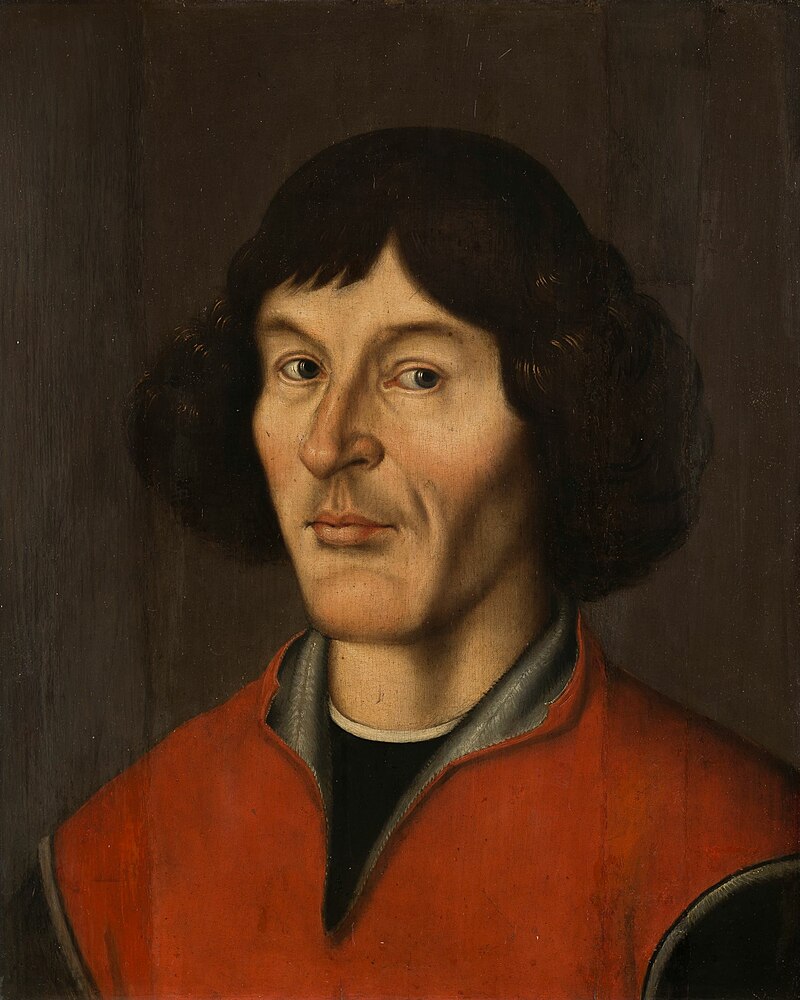
File:Nikolaus_Kopernikus_MOT.jpg · Wikimedia Commons · See Wikimedia Commons
Nicolaus Copernicus
Sign in to savePolish mathematician and astronomer (1473-1543)
OverviewAI-generated
Nicolaus Copernicus, born Nikolaus Koppernigk in 1473, was an astronomer, jurist, economist, and mathematician. He was a citizen of the Kingdom of Poland, Royal Prussia, and Germany, and later experienced statelessness. He spoke renaissance Latin, Middle Polish, Middle Low German, and Greek. His notable works include Commentariolus and De revolutionibus orbium coelestium. He was educated at the Jagiellonian University, University of Padua, University of Bologna, and University of Ferrara.
Copernicus worked in Frombork and was employed by the University of Padua and Jagiellonian University. He was influenced by Aristarchus of Samos, Martianus Capella, Domenico Maria Novara da Ferrara, and Ptolemy, with Novara da Ferrara serving as his doctoral advisor. He practiced Catholicism within the Catholic Church. He died of a stroke in 1543, with natural causes listed as the manner of death. He was buried in the Archcathedral Basilica of the Assumption of the Blessed Virgin Mary and Saint Andrew in Frombork.
Synthesized by Vinony from 28 facts across 3 sources: Wikidata, Open Library, Europeana Sparql. Generated from structured data (not the Wikipedia text) and checked against those facts — may still contain errors.
Person · Open Library
- Born
- 1473
- Died
- 1543
- Works
- 103
Top works
- De revolutionibus orbium coelestium
- Trattato sulla coniazione del denaro
- Nicolai Copernici Torinensis De revolvtionibvs orbium coelestium, Libri VI
- De lateribvs et angvlis triangulorum
- Wybor pism
via Open Library + Wikidata
Wikidata facts
- Instance of
- human
- Given name
- Nikolaus
- Gender
- male
- Citizenship
- Poland
- Place of birth
- Toruń
- Place of death
- Frombork
- Occupation
- writer
- Educated at
- University of Ferrara
- Employer
- Jagiellonian University
- Languages spoken
- Polish
- Native language
- Middle Low German
- Religion
- Catholic Church
- Notable work
- Commentariolus
- Doctoral student
- Georg Joachim Rheticus
- Field of work
- economics
- Image
- Nikolaus Kopernikus MOT.jpg
- Work location
- Frombork
- Residence
- Padua
Show 24 more facts
- Commons category
- Nicolaus Copernicus
- date of birth
- 1473-01-01
- date of death
- 1543-01-01
- topic's main category
- Category:Nicolaus Copernicus
- Commons gallery
- Nicolaus Copernicus
- described by source
- Granat Encyclopedic Dictionary
- birth name
- Niklas Koppernigk
- place of burial
- Archcathedral Basilica of the Assumption of the Blessed Virgin Mary and Saint Andrew in Frombork
- cause of death
- stroke
- influenced by
- Nasir al-Din al-Tusi
- manner of death
- natural causes
- on focus list of Wikimedia project
- Wikipedia:Vital articles/Level/4
- present in work
- Copernicus
- P6482
- Nicolaus Copernicus
- writing language
- renaissance Latin
- Commons Creator page
- Nicolaus Copernicus
- student
- Georg Joachim Rheticus
- ethnic group
- Poles
- interested in
- astronomy
- maintained by WikiProject
- WikiProject Mathematics
- topic has template
- Template:Nicolaus Copernicus
- significant person
- Johannes Dantiscus
- P12749
- Leopold Jessner
Sources (14)
via Wikidata · CC0
Works in European collections
20 objects attributed to Nicolaus Copernicus, held across European museums, libraries & archives · via Europeana

Nicolai Copernici Torinensis. Astronomia Instavrata Libris sex comprehensa, qui de Revolutionibus orbium cœlestium inscribuntur
Guilielmi Blaeu Institutio Astronomica De usu Globorum & Sphaerarum Caelestium ac Terrestrium : Duabus partibus adornata, Una, secundum hypothesin Ptolemaei per terram quiescentem. Altera, juxta mentem N. Copernici per terram mobile... [Texto impreso]
Guilielmi Blaeu Institutio Astronomica De usu Globorum & Sphaerarum Caelestium ac Terrestrium duabus partibus adornata, Una, secundum hypothesin Ptolemaei per terram quiescentem. Altera, juxta mentem N. Copernici per terram mobilem [Texto impreso]
Nicolai Copernici torinensis De reuolutionibus orbium coelestium, libri VI ...
Guilielmi Blaeu Institutio Astronomica De usu Globorum & Sphaerarum Caelestium ac Terrestrium duabus partibus adornata, Una, secundum hypothesin Ptolemaei per terram quiescentem. Altera, juxta mentem N. Copernici per terram mobile

Monumenta Copernicana : Festgabe zum 19. Februar 1873 von Leopold Prowe. Inhalt: 1) Aus dem Werke de revolutionibus orbium caelestium. 2) Gutachten und Denkschriften. 3) Uebersetzungen aus dem Griechischen. a) Die Briefe des Theophylactus Simocatta. b) Der Brief des Lysis an Hipparch. 4) Brief

Nicolai Copernici Torinensis De Revolvtionibvs Orbium coelestium, Libri VI.

Ta tou Themistiou Eufradous hapanta, toutesti parafraseis, kai Logoi Alexandrou Afrodisieōs Peri psychēs biblia duo, kai Peri eimarmenēs hen =

DE LATERIBVS ET ANGVLIS TRIangulorum, tum planorum rectilineorum, tum Sphaericorum, libellus eruditissimus & utilissimus, cum ad plerasque Ptolemaei demonstrationes intelligendas, tum vero ad alia multa, scriptus à Clarissimo & doctissimo viro D. Nicolao Copernico Toronensi, Additus est Canon semissium subtensarum rectarum linearum in Circulo

DE LATERIBVS ET ANGVLIS TRIangulorum :
![IOANNIS DE MONTE REGIO MATHEMATICI CLARISSIMI TABVLAE DIRECTIONVM PROFECTIOnumq[ue] :](https://api.europeana.eu/thumbnail/v2/url.json?uri=https%3A%2F%2Fimagines.manuscriptorium.com%2Floris%2FNKCR__-NKCR__14_J_000110_02P9XQ4-cs%2FIMG_MAIN_00000001%2Ffull%2F!400%2C400%2F0%2Fdefault.jpg&type=IMAGE)
IOANNIS DE MONTE REGIO MATHEMATICI CLARISSIMI TABVLAE DIRECTIONVM PROFECTIOnumq[ue] :
Untitled
Untitled
Untitled
Untitled
Untitled
Untitled
Untitled
Untitled

Untitled
~40 min read
Encyclopedic overview
Expansion · Future
Hubble's law · Redshift
Excerpted from Wikipedia’s “Nicolaus Copernicus” article, available under the CC BY-SA 4.0 licence.
Gallery (12)
Available in 178 languages
- Español
- Français
- Deutsch
- 中文
- 日本語
- Русский
- Português
- Italiano
- العربية
- हिन्दी
- abstract
- Afrikaans
- Albanian
- Albanian
- Amharic
- Aragonese
- Armenian
- Assamese
Show 159 more
- Asturian
- Awadhi
- azb
- Azerbaijani
- Bahasa Indonesia
- Balinese
- Bangla
- Bashkir
- Basque
- bat_smg
- Bavarian
- be_x_old
- Belarusian
- Bikol
- Bislama
- Bosnian
- Breton
- btm
- Bulgarian
- Buriat
- Burmese
- Catalan
- Central Kurdish
- Chechen
- Chuvash
- Cornish
- Crimean Tatar
- Croatian
- Czech
- Danish
- Egyptian Arabic
- Erzya
- Esperanto
- Estonian
- Fiji Hindi
- Filipino
- Finnish
- fiu_vro
- Galician
- Gan Chinese
- gcr
- Georgian
- Greek
- Guarani
- Haitian Creole
- Hausa
- Hebrew
- Hungarian
- Icelandic
- Ido
- Iloko
- Interlingua
- Interlingue
- Irish
- Jamaican Creole English
- Javanese
- Kabyle
- Kannada
- Kanuri
- Kara-Kalpak
- Kazakh
- kbp
- Kinyarwanda
- Kotava
- Kurdish
- Kyrgyz
- Latin
- Latvian
- Lezghian
- Ligurian
- Limburgish
- Lithuanian
- lld
- Lojban
- Lombard
- Low German
- Luxembourgish
- Macedonian
- Madurese
- Malagasy
- Malay
- Malayalam
- Marathi
- Minangkabau
- Mingrelian
- Mirandese
- Mongolian
- nds_nl
- Nederlands
- Nepali
- Newari
- Nias
- Northern Frisian
- Norwegian
- Norwegian Nynorsk
- Obolo
- Occitan
- Odia
- olo
- Ossetic
- Pampanga
- Pashto
- Piedmontese
- Polski
- Punjabi
- Quechua
- rki
- roa_rup
- Romanian
- rsk
- Rusyn
- Sanskrit
- Santali
- Sardinian
- Scots
- Scottish Gaelic
- Serbian
- Serbian (Latin)
- Sicilian
- Silesian
- simple
- Sindhi
- Sinhala
- Slovak
- Slovenian
- Svenska
- Swahili
- szy
- Tachelhit
- Tajik
- Tamil
- Tatar
- Telugu
- Tiếng Việt
- Türkçe
- Ukrainian
- Upper Sorbian
- Urdu
- Uzbek
- Veps
- Volapük
- Walloon
- Waray
- Welsh
- Western Frisian
- Western Mari
- Western Panjabi
- Wu Chinese
- Yakut
- Yiddish
- Yoruba
- Zaza
- Zeelandic
- zh_classical
- zh_min_nan
- zh_yue
- فارسی
- ไทย
- 한국어
via Wikidata sitelinks · CC0