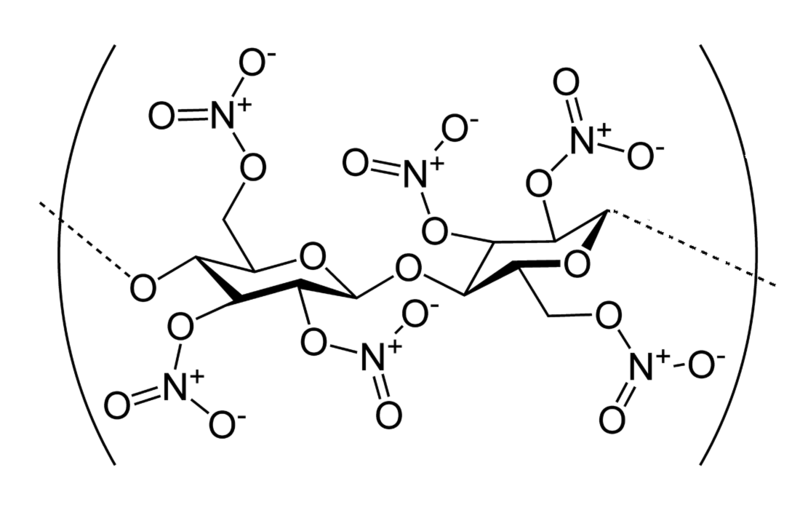
File:Nitrocellulose-2D-skeletal.png · Wikimedia Commons · See Wikimedia Commons
nitrocellulose
Sign in to saveAlso known as cellulose nitrate, flash paper, flash cotton, gun cotton, guncotton, flash string, gun-cotton, pyroxyline
Nitrocellulose (also known as cellulose nitrate, flash paper, flash cotton, guncotton, pyroxylin and flash string, depending on form) is a highly flammable compound formed by nitrating cellulose through exposure to a mixture of nitric acid and sulfuric acid.
Wikidata facts
- Subclass of
- cellulose derivative
- Image
- Cellulose nitrate.svg
- Has use
- plastic
Show 3 more facts
- discoverer or inventor
- Christian Friedrich Schönbein
- Commons category
- Nitrocellulose
- described by source
- New International Encyclopedia
Sources (3)
via Wikidata · CC0
~28 min read
Encyclopedic overview
17 sectionsContents
- Production
- Use
- Other uses
- Laboratory uses
- Hobbies
- Historical uses
- Early work on nitration of cellulose
- Guncotton
- Film
- Nitrate film fires
- Nitrocellulose decomposition and new "safety" stocks
- Fabric
- Coatings
- Hazards
- See also
- References
- External links
Nitrocellulose (also known as cellulose nitrate, flash paper, flash cotton, guncotton, pyroxylin and flash string, depending on form) is a highly flammable compound formed by nitrating cellulose through exposure to a mixture of nitric acid and sulfuric acid.
One of its first major uses was as guncotton, a replacement for gunpowder as propellant in firearms. It was also used to replace gunpowder as a low-order explosive in mining and other applications. In the form of collodion, it was also a critical component in an early photographic emulsion, the use of which revolutionized photography in the 1860s. In the 20th century, it was adapted to automobile lacquer and adhesives.
Excerpted from Wikipedia’s “nitrocellulose” article, available under the CC BY-SA 4.0 licence.