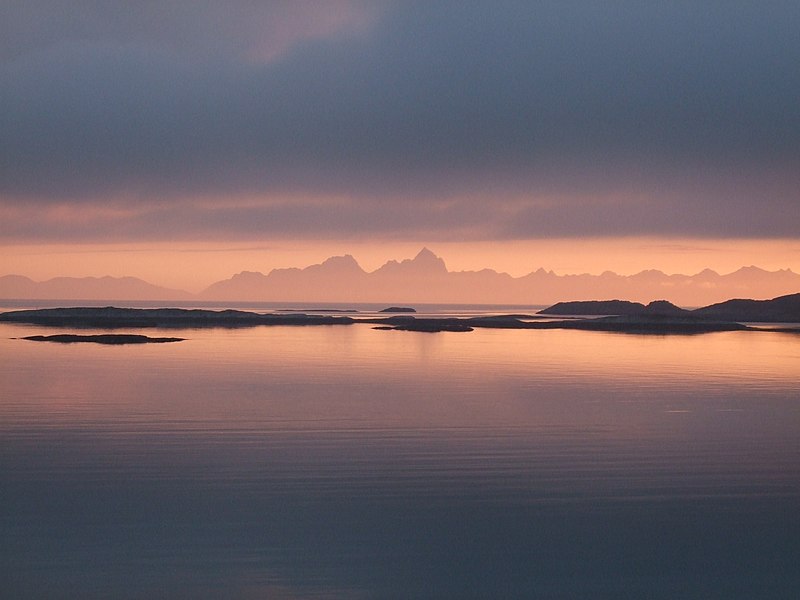
File:Vågakaillen_nattlys.JPG · Wikimedia Commons · See Wikimedia Commons
Norwegian Sea
Sign in to saveAlso known as European Northern Sea, Northern Ocean
marginal sea in the North Atlantic Ocean
The Norwegian Sea is a body of water in the North Atlantic Ocean located off the coast of Norway. It is an important maritime region that serves as a significant shipping route and fishing ground.
AI-generated from the Wikipedia summary — may contain errors.
Wikidata facts
- Instance of
- marginal sea
- Part of
- North Atlantic Ocean
- Has part
- Balsfjorden
- Country
- Norway
- Area
- 1383000
- Image
- Vågakaillen nattlys.JPG
Show 8 more facts
- Commons category
- Norwegian Sea
- topic's main category
- Category:Norwegian Sea
- volume as quantity
- 2000000
- basin country
- Norway
- vertical depth
- 3970
- inflows
- Stjørdalselva
- on focus list of Wikimedia project
- Wikipedia:Vital articles/Level/4
- category for the water basin
- Category:Norwegian Sea Basin
Sources (1)
via Wikidata · CC0
~33 min read
Encyclopedic overview
The Norwegian Sea is a marginal sea, grouped with either the Atlantic Ocean or the Arctic Ocean, northwest of Norway between the North Sea and the Greenland Sea, adjoining the Barents Sea to the northeast. In the southwest, it is separated from the Atlantic Ocean by a submarine ridge running between Iceland and the Faroe Islands. To the north, the Jan Mayen Ridge separates it from the Greenland Sea.
Unlike many other seas, most of the bottom of the Norwegian Sea is not part of a continental shelf and therefore lies at a great depth of about two kilometres (1.2 miles) on average. Rich deposits of oil and natural gas are found under the sea bottom and are being explored commercially, in the areas with sea depths of up to about one kilometre (0.6 miles). The coastal zones are rich in fish that visit the Norwegian Sea from the North Atlantic or Barents Sea (cod) for spawning. The warm North Atlantic Current ensures relatively stable and high water temperatures, so that unlike the Arctic seas, the Norwegian Sea is ice-free throughout the year. Recent research has concluded that the large volume of water in the Norwegian Sea with its large heat absorption capacity is more important as a source of Norway's mild winters than the Gulf Stream and its extensions.
Excerpted from Wikipedia’s “Norwegian Sea” article, available under the CC BY-SA 4.0 licence.
Gallery (12)
On the map
5 mapped locations
Available in 106 languages
- Español
- Français
- Deutsch
- 中文
- 日本語
- Русский
- Português
- Italiano
- العربية
- हिन्दी
- Abkhazian
- Afrikaans
- Albanian
- Armenian
- Asturian
- azb
- Azerbaijani
- Bahasa Indonesia
Show 87 more
- Bangla
- Bashkir
- Basque
- bat_smg
- be_x_old
- Belarusian
- Betawi
- Bosnian
- Breton
- Bulgarian
- Catalan
- Central Kurdish
- Chechen
- Chuvash
- Corsican
- Croatian
- Czech
- Danish
- Esperanto
- Estonian
- Faroese
- Fiji Hindi
- Finnish
- Galician
- Georgian
- Greek
- Hebrew
- Hungarian
- Icelandic
- Iloko
- Karachay-Balkar
- Kazakh
- Kurdish
- Kyrgyz
- Latin
- Latvian
- Limburgish
- Lithuanian
- Low German
- Lower Sorbian
- Macedonian
- Malagasy
- Malay
- Malayalam
- Manx
- Marathi
- Mazanderani
- Mingrelian
- Mongolian
- Nederlands
- Northern Frisian
- Norwegian
- Norwegian Nynorsk
- Occitan
- Ossetic
- Pashto
- Piedmontese
- Polski
- Punjabi
- Romanian
- Serbian
- Serbian (Latin)
- simple
- Slovak
- Slovenian
- Svenska
- Swahili
- Tajik
- Tamil
- Tiếng Việt
- Türkçe
- Ukrainian
- Upper Sorbian
- Urdu
- Uzbek
- Venetian
- Veps
- Waray
- West Flemish
- Western Frisian
- Western Panjabi
- Wu Chinese
- Yiddish
- zh_yue
- فارسی
- ไทย
- 한국어
via Wikidata sitelinks · CC0