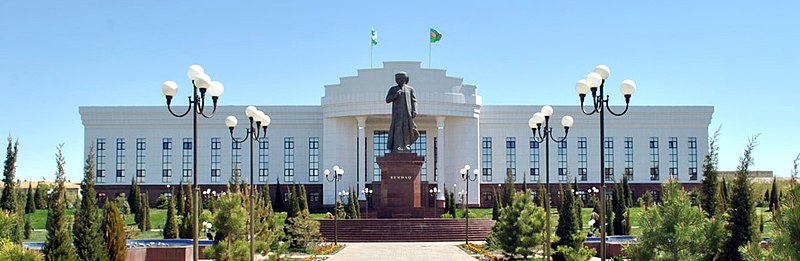
File:Karakalpakstan_Parliament_Buiding_in_Nukus.jpg · Wikimedia Commons · See Wikimedia Commons
Nukus
Sign in to saveAlso known as Nókis, Нөкис
Nukus (; ) is the sixth-largest city in Uzbekistan and the capital of the autonomous Republic of Karakalpakstan. The population of Nukus as of 1 January 2022 was 329,100. The Amu Darya river passes west of the city. Administratively, Nukus is a district-level city, that includes the urban-type settlement Karatau.
OverviewAI-generated
Nukus, also known by its native name Nókis, is a city in Uzbekistan that serves as the capital of Karakalpakstan. Established in 1860, the city is located at an elevation of 76 meters above sea level and covers an area of 221 square kilometers. It operates within the UTC+05:00 time zone.
The population of Nukus is recorded as 319,583, with another source citing a figure of 332,500. The city’s postal code is 230100. While specific weather data such as temperature and air quality indices have been recorded, these fluctuate and are not permanent attributes of the location.
Synthesized by Vinony from 46 facts across 7 sources: Wikidata, Open Meteo, Openweathermap, OpenStreetMap, GeoNames, Vinony graph, Geo. Generated from structured data (not the Wikipedia text) and checked against those facts — may still contain errors.
Weather now
7-day forecast
via Open-Meteo
Place details
- Locality
- Nókis
- Region
- Qaraqalpaqstan Respublikası
- Country
- Oʻzbekiston
- Population
- 332,500
- Timezone
- Asia/Samarkand
via OpenStreetMap · GeoNames
Key facts
- Settlement.official_name
- Nukus
- Settlement.settlement_type
- City
- Settlement.image_seal
- Герб_города_Нукус.png
- Settlement.pushpin_map
- Uzbekistan
- Settlement.pushpin_relief
- yes
- Settlement.pushpin_label_position
- bottom
- Settlement.pushpin_map_caption
- Location in Uzbekistan
- Settlement.subdivision_type
- Country
- Settlement.subdivision_type1
- Sovereign Republic
- Settlement.subdivision_name1
- Karakalpakstan
- Settlement.established_title
- Established
- Settlement.established_date
- 1860
- Settlement.government_type
- City Administration
- Settlement.leader_title
- Hakim (Mayor)
- Settlement.area_total_km2
- 222
- Settlement.population_as_of
- 2022
- Settlement.population_total
- 332500
- Settlement.population_density_km2
- auto
via Wikipedia infobox
Wikidata facts
- Instance of
- big city
- Official name
- Nókis
- Country
- Uzbekistan
- Located in
- Karakalpakstan
- Population
- 194000
- Area
- 221
- Elevation
- 76
- Time zone
- UTC+05:00
- Capital of
- Karakalpakstan
- Official website
- nukus.uzbekgo.com
- Image
- Nukus.jpg
Show 9 more facts
- Commons category
- Nukus
- category for people born here
- Category:Births in Nukus
- category of associated people
- Category:People from Nukus
- topic's main category
- Category:Nukus
- postal code
- 230100
- inception
- 1860-00-00
- native label
- Nókis
- P8168
- Stefan Sagmeister
- P12749
- parc de la Tête d'Or
via Wikidata · CC0
Travel guide
Get around
Taxis are plentiful and cheap: a short hop in town should cost 500-1000 som. Everything you'll want to see is in walking distance. Aral Sea Khiva Urgench thumb|Karakalpakstan State Museum of Arts
See
Nearby is the Museum of Applied Arts showing local fabrics, traditional clothing and jewellery. The Karakalpak State Museum exhibits examples of natural history, including the very last Turan Tiger, caught in 1972.
Do
Due to being the closest major city to the Aral Sea, Nukus is a good place to start trips to the shore and to Moynoq. The former fishing town is some 200 km away and a witness of the dying Aral Sea. Its main "attraction" is the infamous ship graveyard.
A taxi from Nukus to Moynaq costs around US$70, higher if booked through a hotel. For a day trip, start early as it is 3-3½ hr one way. Marshrutkas also go to Moynaq via Kungrad.
Buy
There is a huge sprawling market near the bus station, selling the usual range of cheap consumer goods, clothing and food. Most of it is under cover and hence not a bad place to wander during the heat of the day. A camera and a polite 'Mogu li ya snyatʹ vashu fotografiyu?' (May I take your photograph?.) can lead to some very atmospheric pictures.
Eat
There are few options, both the Mona Lisa and the Sheraton restaurants, listed in a popular guidebook, have shut. Searching around you will find acceptable kebab places, such as the one just east of the Savitsky museum (42°27'54.03"N, 59°37'11.17"E, on the corner of Rashidova & Dosnazarov).
"Samsa" are popular, samosa-type pastries filled with ground beef and onions. 1,500-3,000 som, and they're rather filling. For a meat-free option some places sell slightly cheaper potato versions, ask for "kartoshka samsa".
As in the rest of the country Plov is the most widely known dish of the region and delicious, especially when homemade. Usually made with chicken.
Kimchi is popular with the locals, and is sold it at the main fruit and vegetable market. A large Korean community was resettled in Nukus after the second world war and now comprises ~20% of the population of the city.
Drink
Find some "Qarataw" brand vodka. Local to Qaraqalpaqstan and even difficult to find outside of the region, it's smooth and complex, and the Qaraqalpaks are rightly proud of it.
Sleep
The prices in US dollars are higher than prices in som, and the hotels will want you to pay in US dollars (except in Nukus Hotel).
Connect
As of Sep 2024, Nukus has 4G from all Uzbek carriers, but with a poor signal on its approach highways. 5G has not reached town.
Travel guide from Wikivoyage (CC BY-SA 4.0)
~13 min read
Encyclopedic overview
12 sectionsContents
- History
- Sights
- Climate
- Population
- Attractions
- Science and education, medicine, culture and sports
- Football
- Economy
- Politics
- Notable people
- See also
- References
Nukus (; ) is the sixth-largest city in Uzbekistan and the capital of the autonomous Republic of Karakalpakstan. The population of Nukus as of 1 January 2022 was 329,100. The Amu Darya river passes west of the city. Administratively, Nukus is a district-level city, that includes the urban-type settlement Karatau.
The city is best known for its Nukus Museum of Art.
Excerpted from Wikipedia’s “Nukus” article, available under the CC BY-SA 4.0 licence.
Gallery (13)
On the map
3 mapped locations
Available in 79 languages
- Español
- Français
- Deutsch
- 中文
- 日本語
- Русский
- Português
- Italiano
- العربية
- Afrikaans
- Armenian
- azb
- Azerbaijani
- Bahasa Indonesia
- Bashkir
- Basque
- Belarusian
- Bikol
Show 60 more
- Bosnian
- Bulgarian
- Catalan
- Cebuano
- Chechen
- Chuvash
- Crimean Tatar
- Czech
- Danish
- Egyptian Arabic
- Esperanto
- Estonian
- Filipino
- Finnish
- Georgian
- Greek
- Hebrew
- Hungarian
- Interlingue
- Kara-Kalpak
- Kazakh
- kge
- Kikuyu
- Kyrgyz
- Latvian
- Lithuanian
- Mari
- Mazanderani
- Nederlands
- Northern Frisian
- Norwegian
- Ossetic
- Pashto
- Polski
- Punjabi
- Romanian
- Scots
- Serbian
- Silesian
- simple
- Slovenian
- Svenska
- Tajik
- Tatar
- Tiếng Việt
- Türkçe
- Turkmen
- Tuvinian
- Ukrainian
- Upper Sorbian
- Urdu
- Uzbek
- Veps
- Waray
- Western Panjabi
- Wu Chinese
- zh_yue
- فارسی
- ไทย
- 한국어
via Wikidata sitelinks · CC0