.jpg)
nyckelharpa
Sign in to saveAlso known as keyed fiddle
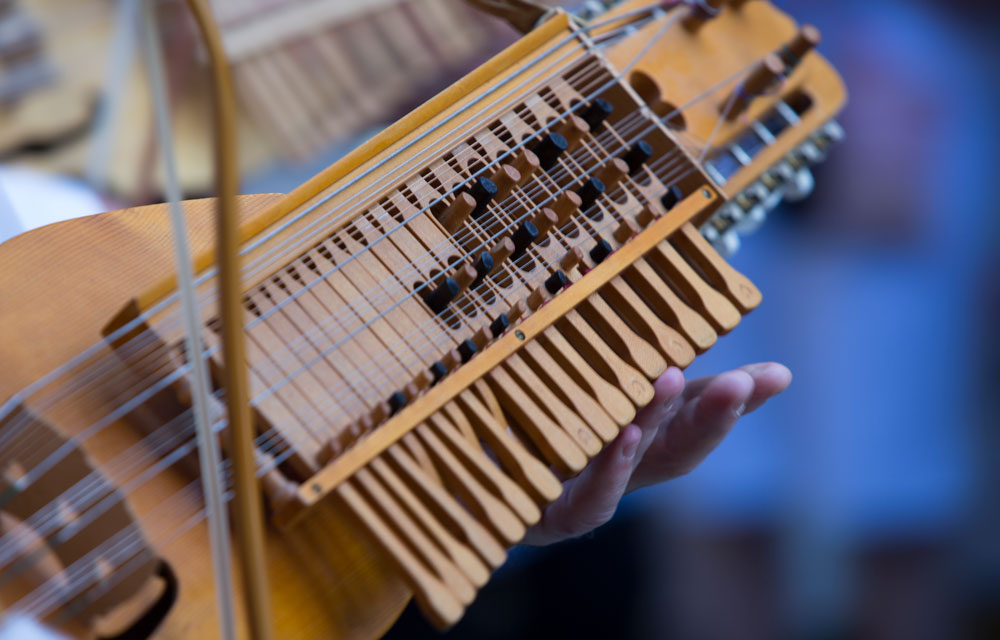
Nyckelharpa (, roughly "keyed fiddle" in Swedish, , plural: ) is a "keyed" bowed chordophone, primarily originating from Sweden in its modern form, but with its historical roots scattered across medieval Europe. It is similar in appearance to a fiddle or violin but larger (in its earlier forms essentially a modified vielle), which employs key-actuated tangents along the neck to change the pitch during play, much like a hurdy-gurdy. The keys slide under the strings, with the tangents set perpendicularly to the keys, reaching above the strings. Upon key-actuation, the tangent is pressed to meet
Key facts
- Instrument.name
- Nyckelharpa
- Instrument.image
- Nyckelharpa 0930 (cropped).jpg
- Instrument.caption
- Nyckelharpa being played
- Instrument.background
- string
- Instrument.names
- Key harp ("key harp") ("key violin") ("key vielle") ("keyed viola") ("keyed violin")
- Instrument.classification
- Bowed string instrument
- Instrument.hornbostel_sachs
- 321.322–71
- Instrument.inventors
- Folk instrument
- Instrument.developed
- 12th century
- Instrument.related
- Hurdy-gurdy
- Intangible heritage.ICH
- Nyckelharpa network, an innovative dissemination of a music and instrument-building tradition with roots in Sweden
- Intangible heritage.Country
- Sweden
- Intangible heritage.ID
- 01976
- Intangible heritage.Region
- ENA
- Intangible heritage.Year
- 2023
- Intangible heritage.Session
- 18th
- Intangible heritage.List
- Good Safeguarding Practices
via Wikipedia infobox
Described at
Nyckelharpa - Levande kulturarv
Nyckelharpan har tillverkats och spelats i Sverige i obruten tradition åtminstone sedan 1600-talet.
levandekulturarv.se →Nyckelharpan har tillverkats och spelats i Sverige i obruten tradition åtminstone sedan 1600-talet. I och med den svenska folkmusikens uppsving under 1960-talet ökade intresset för nyckelharpan. Från 1970-talet har nyckelharpan spridits och idag anordnas kurser i byggande och spel över hela landet. Den har senare även fått internationell spridning. En nyckelharpa är ett stråkinstrument med en relativt långsmal kropp. När den spelas hålls den strax nedanför bröstet, ungefär som en gitarr. Nyckelharpans ursprung är omtvistat, men den har tillverkats och spelats i Sverige åtminstone sedan 1600-talet. Instrumentbyggare har under alla tider experimenterat med olika modeller av instrumentet, och några varianter har överlevt till våra dagar. Själva tillverkningen av instrumentet kräver förutom god hantverkskunskap också kännedom om tillverkning av akustiska instrument. Överförandet av kunskapen om tillverkning och spelande har av tradition skett ”från mästare till lärling” vilket fortfarande är den vanligaste formen av tradering. I och med den svenska folkmusikens uppsving under 1970-talet ökade intresset för nyckelharpan, och det förekommer utbildning i spel över hela landet. Musikhögskolan har fleråriga kurser i nyckelharpspel, och 1997 skapades Eric Sahlström institutet – med bland annat utbildning i nyckelharpspel- och bygge. För att säkra tillverkningen av instrumentet nyckelharpa bör ytterligare dokumentation ske, inte minst av äldre instrumentbyggares kunskaper. Eric Sahlström i verkstaden där han tillverkar sina egna nyckelharpor. Göksby, Uppland år 1982. Foto: Tommy Arvidsom/Upplandsmuseet (CC BY-NC-ND): År 2023 togs Nyckelharpans nätverk upp i Unescos internationella register över goda metoder, efter att ha föreslagits av Sverige. I samband med att nyckelharpans nätverk föreslogs togs det fram en film om nätverkets arbete för att vidareföra nyckelharpan. Informationen är på engelska. En nyckelharpa är ett stråkinstrument med en relativt långsmal kropp. När den spelas hålls den strax nedanför bröstet, ungefär som en gitarr. Nyckelharpan har en klaviatur som liknar vevlirans med en mekanik där tangenter trycks in och förkortar strängen. Den moderna nyckelharpan har tre melodisträngar och en bassträng. Dessutom finns tolv så kallade resonanssträngar, eller medklingande strängar som inte spelas med stråken; de förstärker instrumentets klang och ger nyckelharpan dess karakteristiska sound. Själva tillverkningen av instrumentet kräver förutom god hantverkskunskap också kännedom om tillverkning av akustiska instrument. Överförandet av kunskapen om tillverkning och utövande har av tradition skett ”från mästare till lärling” vilket fortfarande är den vanligaste formen av tradering. Till nyckelharpan knyts även tradering av spelmanslåtar med gehörsmetoden vilket kan ses som en direkt fortsättning på äldre tiders tradering av musik. Nyckelharpan avbildades redan under 14- och 1500-talet i svenska och danska stenkyrkor varav flertalet från Uppland. I en portal i Källunge kyrka på Gotland finns en fris daterad till 1350 med musikanter som spelar på olika stränginstrument. Figurerna är dock starkt söndervittrade och det är svårt att fastställa exakt vilka instrument det rör sig om. Ett av dem ser ut att vara en nyckelharpa. Den nyckelharpstyp som under 1600-talet dyker upp i Uppland är försedd med resonanssträngar och benämns kontrabasharpa Ett intressant fynd härrör från en utgrävning i Sigtuna i mitten av 1930-talet i form av en nyckelharpsnyckel (knaver). Nyckeln hamnade i museets magasin men har helt nyligen daterats till 1200-talet. Det råder delade meningar om vilken betydelse man kan dra av det fyndet. Spelades den här eller kan den vara ett krigsbyte? Svaret får vi kanske aldrig. Instrumentbyggare har under alla tider experimenterat med olika modeller av instrumentet. Den modell som dök upp, eller snarare föddes i Uppland under 1600-talet, som i dag kallas för kontrabasharpa, är ett så kallat borduninstrument. Under 18
Excerpt from a page describing this subject · 14,743 chars · not written by Vinony
Wikidata facts
- Image
- 2022-07-28 Nyckelharpa-Spielerin in der Schillerstraße Ecke Rosenstraße in Hannover.jpg
Show 5 more facts
- Hornbostel-Sachs classification
- 321.322-71
- Commons category
- Nyckelharpa
- described by source
- Encyclopædia Britannica 11th edition
- indigenous to
- Uppland
via Wikidata · CC0
~23 min read
Encyclopedic overview
19 sectionsContents
- Etymology
- History
- 1000s–1200s (first keyed instruments)
- 1300s–1500s (first keyed vielles)
- 1500s–1600s (written records)
- 1600s–1800s (early modern period)
- 1900s–onward (modern period)
- Reconstructional archaeology
- Technique
- Variants
- Variants with resonance strings
- Variants without resonance strings
- Derivatives
- In films
- Gallery
- See also
- References
- Further reading
- External links
Nyckelharpa (, roughly "keyed fiddle" in Swedish, , plural: ) is a "keyed" bowed chordophone, primarily originating from Sweden in its modern form, but with its historical roots scattered across medieval Europe. It is similar in appearance to a fiddle or violin but larger (in its earlier forms essentially a modified vielle), which employs key-actuated tangents along the neck to change the pitch during play, much like a hurdy-gurdy. The keys slide under the strings, with the tangents set perpendicularly to the keys, reaching above the strings. Upon key-actuation, the tangent is pressed to meet the corresponding string, much like a fret, shortening its vibrating length to that point, changing the pitch of the string. It is primarily played underarm, suspended from the shoulder using a sling, with the bow in the overhanging arm.
The origin of the instrument is unknown, but its historical foothold and modern development is much larger in Sweden than other countries. Many of the early historical depictions of the instrument are found in Sweden, with the earliest probable depiction being found on a relief located on a 14th century church portal. While historically not too common an instrument in Sweden (relatively speaking), the violin outshining it in usage among spelmän (players of Swedish folk music), the nyckelharpa became a popular folk instrument in the Swedish province of Uppland during the 17th century, subsequently leading to its popularization and spread throughout Sweden the following centuries. By the 19th century it had become a "fine" instrument, being played at concerts in Stockholm, and by the early 20th century it had become an archetypal instrument alongside the violin for Swedish folk music. Today it is considered by many to be the quintessential national instrument of Sweden. The oldest surviving nyckelharpa is dated 1526 and is part of the Zorn Collections in Mora Municipality, Sweden.
Excerpted from Wikipedia’s “nyckelharpa” article, available under the CC BY-SA 4.0 licence.
Gallery (12)
On the map
60 mapped locations