Official website (https://www.oldmelbournegaol.com.au/)
Old Melbourne Gaol
Sign in to saveformer jail in Melbourne, Victoria, Australia and now a tourist attraction
Official website
Victoria's oldest prison | Old Melbourne Gaol | Official Site
, Sentence yourself to a day at Old Melbourne Gaol, Victoria's oldest prison, which housed tough criminals and the infamous bushranger, Ned Kelly.
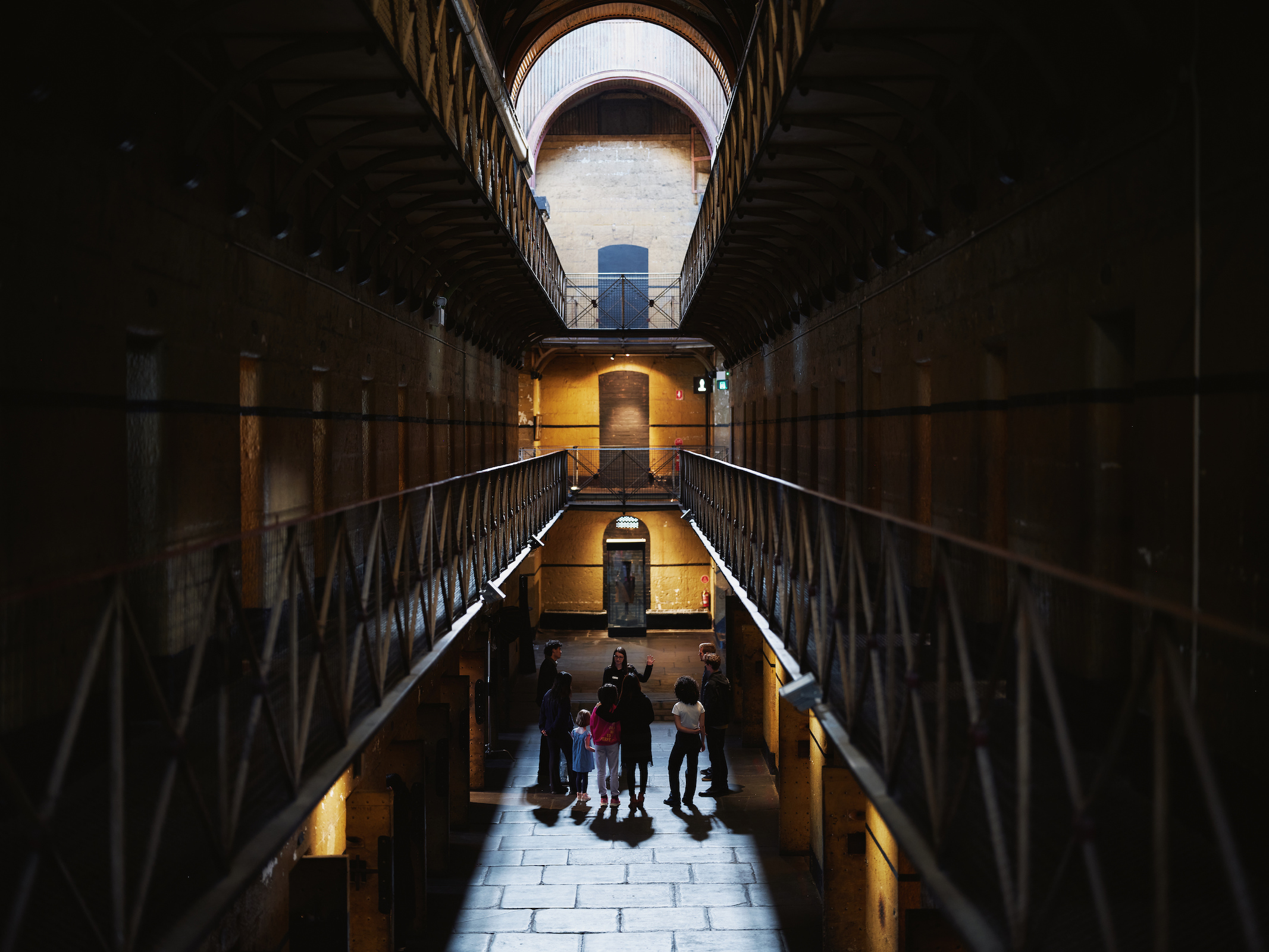
oldmelbournegaol.com.au →WARNING: Aboriginal and Torres Strait Islander viewers are warned that the following website contains images deceased persons. A small group of Tasmanian Palawa men and women were brought to Victoria by George Augustus Robinson, Chief Protector of the Port Phillip Aboriginal Protectorate, to help him subdue the Victorian Koori people. At Western Port Bay, five of the Tasmanians – Tunnerminnerwait, Maulboyheenner, Truganini, Planobeena and Pyterruner –joined the frontier wars wreaking violence across the District of Port Phillip. Two whalers were murdered by the group, for which Tunnerminnerwait and Maulboyheenner were hanged, despite the defence of Redmond Barry. Their executions on 20 January 1842, took place outside the Melbourne Gaol as Judge John Walpole Willis designed their punishment “to deter similar transgressions” by the local Koori people. Most of the Melbourne population turned out to watch as the two men slowly strangled to death in a bungled hanging. This clash between cultures led to five of the first nine executions in Victoria being of Aboriginal men. The Gaol’s first cellblock was opened in 1845. Gold was discovered in 1851 and in the next four years Melbourne’s population increased from 23,000 to nearly 90,000. Overcrowding soon became a huge problem for the Gaol, with the Argus newspaper complaining in 1853 that the old cellblock was “literally crammed to suffocation”. A second cellblock was not completed until 1859. It was similar in design to the earlier cellblock but contained what the Argus described as “an aspect of greater airiness and cheerfulness”. This new cellblock had a modern, progressive design. It included innovations such as good ventilation, a clean water supply, a food hoist, adequate exercise yards and the use of steam in the bath-house, wash-house and kitchen. By late 1864 an identical replica of the second cellblock was completed, running from the west end of the second cellblock. This new cellblock was for female prisoners and mostly staffed by female warders. The women’s cellblock represented the final major building project at the Gaol and, by 1870, all construction was complete. Previously men, women and children had all been housed together in the same cellblock although the sexes were kept apart as much as possible. Conditions for women and children were degrading and often dangerous. Some very young children were incarcerated in the Gaol for their own safety as a refuge while many children were imprisoned in the adult prison for offences such as theft. Kelly remains one of Australia’s greatest folk heroes, a flawed, complex hero whose story has captured the imagination of millions. After a frantic eighteen months on the run and a controversial trial, bushranger Ned Kelly was hanged on the Gaol gallows on 11 November,1880. Kelly’s elusiveness and high profile as horse thief, bank robber and murderer meant that authorities were under great pressure to bring him to justice. His execution had started an intriguing sequence of events that has kept the Kelly legend alive. Immediately after his death public order was threatened in Melbourne and beyond; a major inquiry was held into the police and their actions; body parts were supposedly souvenired when Kelly was disinterred in 1929; and what was thought to be his skull was stolen from the Gaol in 1978. Opened in 1909 on the site of the original cellblock of the Melbourne Gaol, the City Watch House provided Victoria Police with a charging and custodial facility. The Watch house soon gained a reputation for being a tough, uncompromising place. It was designed as a short-term lockup for those who had been charged with a criminal offence, arrested on warrant or been drunk in a public place. Until its closure in 1994, the City Watch House was witness to an endless procession of drunks, petty criminals, women of ill repute, and a regular who’s who from Melbourne’s criminal underworld. These included high-profile gangster Squizzy Taylor
Read more on their site →Excerpt from the official site · 32,504 chars · not written by Vinony
Wikidata facts
- Instance of
- museum
- Country
- Australia
- Located in
- City of Melbourne
- Operator
- National Trust of Australia
- Official website
- www.oldmelbournegaol.com.au
- Image
- Old Melbourne Gaol - Melbourne (76468479).jpg
Show 5 more facts
- Commons category
- Old Melbourne Gaol
- date of official opening
- 1845-01-01
- date of official closure
- 1924-07-00
- street address
- 377 Russell Street, Melbourne VIC 3000
- inception
- 1839-00-00
Sources (2)
via Wikidata · CC0