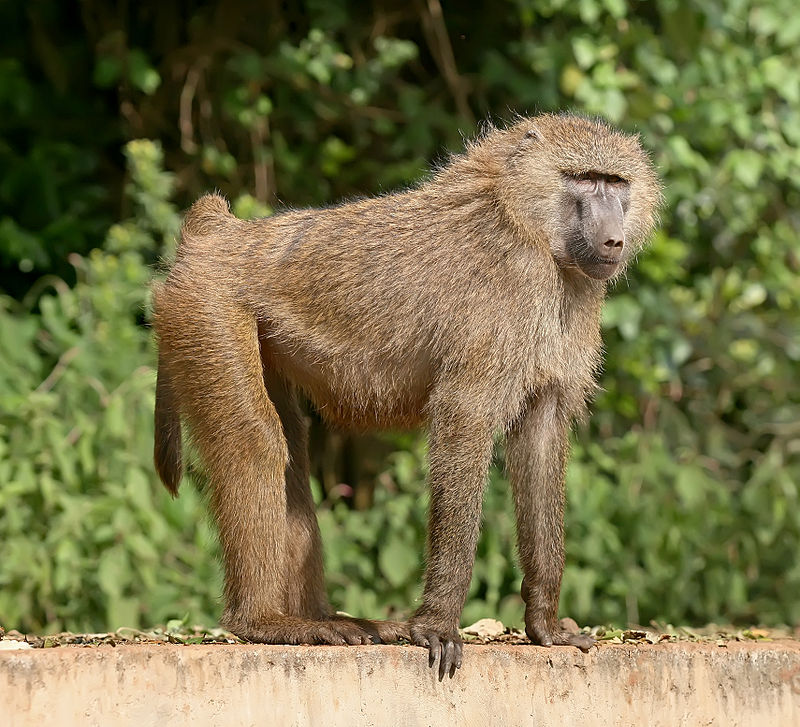
File:Olive_baboon_Ngorongoro.jpg · Wikimedia Commons · See Wikimedia Commons
OverviewAI-generated
The olive baboon, scientifically designated as *Papio anubis*, is a species within the genus *Papio*. This taxon is also referred to by the common names Papión Oliva, Babouin anubis, and Anubis Baboon. The species name honors Anubis. Its IUCN conservation status is classified as Least Concern, a designation recorded in 2020.
Synthesized by Vinony from 16 facts across 4 sources: Wikidata, PubMed, IUCN Red List, Vinony graph. Generated from structured data (not the Wikipedia text) and checked against those facts — may still contain errors.
Species
Least Concern東非狒狒(學名:Papio anubis)又名阿努比斯狒狒和橄榄狒狒,猴科獼猴亞科(Cercopithecinae)狒狒屬的一種,主要分布在馬利、衣索比亞、坦桑尼亚北部。天敵為獅子、豹等棲息於非洲之肉食性動物。 在非洲,數量頗多,分佈也很廣泛。因為牠們會吃農作物,所以當地的農民非常厭惡東非狒狒,常常射殺牠們。
via IUCN
Research
1,231 papers- Olive baboon (Papio anubis anubis) as a model for intrauterine research.ReviewJournal of medical primatology · 2007Chai D, Cuneo S, Falconer H et al.DOI: 10.1111/j.1600-0684.2006.00204.x
- Diurnal transcriptome atlas of a primate across major neural and peripheral tissues.Science (New York, N.Y.) · 2018Mure LS, Le HD, Benegiamo G et al.DOI: 10.1126/science.aao0318
- Macronutrient composition of olive baboon (Papio anubis) milk: A comparison to rhesus macaque (Macaca mulatta) milk.American journal of primatology · 2021Glick VJ, Bentley-Condit VK, Power MLDOI: 10.1002/ajp.23315
- Pitted Keratolysis in an Olive Baboon (Papio anubis).Journal of medical primatology · 2025Blackwell EA, Navarro RC, Crakes KR et al.DOI: 10.1111/jmp.70019
- Accurate assembly of the olive baboon (Papio anubis) genome using long-read and Hi-C data.GigaScience · 2020Batra SS, Levy-Sakin M, Robinson J et al.DOI: 10.1093/gigascience/giaa134
- Confessions of a baboon watcher: from inside to outside the paradigm.ReviewPrimates; journal of primatology · 2023Strum SCDOI: 10.1007/s10329-023-01060-1
- Zika Virus Infection, Reproductive Organ Targeting, and Semen Transmission in the Male Olive Baboon.Journal of virology · 2019Peregrine J, Gurung S, Lindgren MC et al.DOI: 10.1128/JVI.01434-19
- Early and mid-gestation Zika virus (ZIKV) infection in the olive baboon (Papio anubis) leads to fetal CNS pathology by term gestation.PLoS pathogens · 2022Gurung S, Reuter D, Norris A et al.DOI: 10.1371/journal.ppat.1010386
via PubMed
Wikidata facts
- Instance of
- taxon
- Parent taxon
- Papio
- Named after
- Anubis
- Image
- Olive baboon (Papio anubis) with juvenile.jpg
Show 8 more facts
- taxon rank
- species
- IUCN conservation status
- Least Concern
- Commons category
- Papio anubis
- taxon name
- Papio anubis
- Commons gallery
- Papio anubis
- taxon common name
- anubijev pavijan
- sequenced genome URL
- www.ensembl.org/Papio_anubis
- short name
- P. anubis
via Wikidata · CC0
~16 min read
Encyclopedic overview
The olive baboon (Papio anubis), also called the Anubis baboon, is a member of the family Cercopithecidae Old World monkeys. The species is the most wide-ranging of all baboons, being native to 25 countries throughout Africa, extending from Mali eastward to Ethiopia and Tanzania. Isolated populations are also present in some mountainous regions of the Sahara. It inhabits savannahs, steppes, and forests. The common name is derived from its coat colour, which is a shade of green-grey at a distance. A variety of communications, vocal and non-vocal, facilitate a complex social structure.
Characteristics
Excerpted from Wikipedia’s “olive baboon” article, available under the CC BY-SA 4.0 licence.