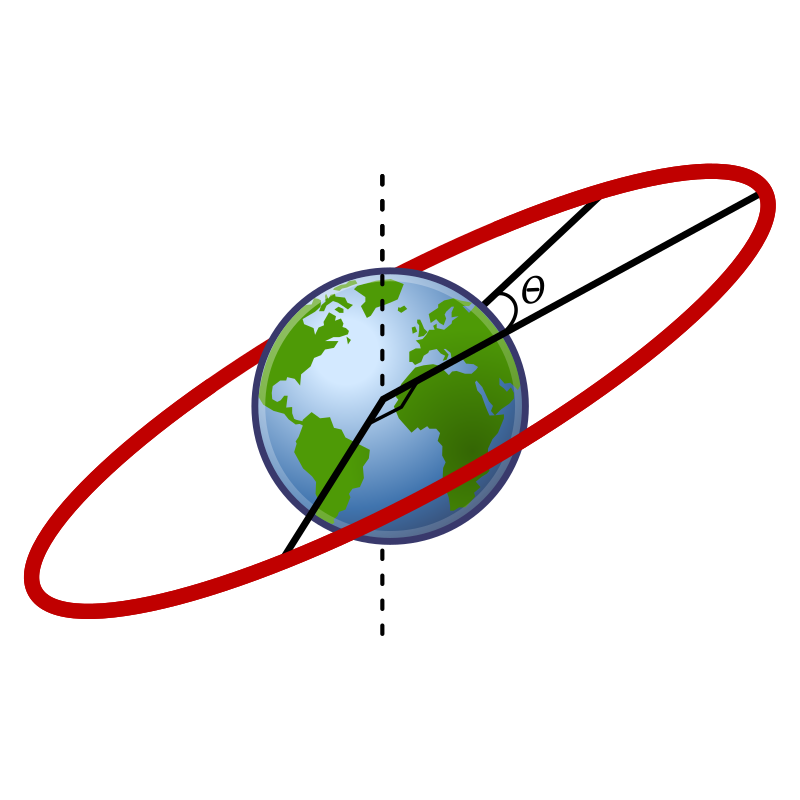
File:Orbit_mechanics_icon.svg · Wikimedia Commons · See Wikimedia Commons
orbital period
Sign in to saveAlso known as revolution period, astronomical period, astronomical time period, astronomical horological period, astronomical orbit period, period of orbit, year
time taken for a given object to make one complete orbit around another object, and applies in astronomy to mostly either planets or asteroids orbiting the Sun, moons orbiting planets, exoplanets orbiting other stars, or binary stars
An orbital period is the time it takes for one object to complete one full orbit around another object, such as a planet orbiting the Sun or a moon orbiting a planet. Knowing an object's orbital period helps astronomers understand and predict the motions of celestial objects throughout space.
AI-generated from the Wikipedia summary — may contain errors.
Wikidata facts
- Subclass of
- physical quantity
- Image
- Pluto Orbit.gif
Show 3 more facts
- on focus list of Wikimedia project
- Wikipedia:Vital articles/Level/4
- maintained by WikiProject
- WikiProject Mathematics
- facet of
- orbital revolution
Sources (2)
via Wikidata · CC0
~12 min read
Encyclopedic overview
The orbital period (also revolution period) is the amount of time a given astronomical object takes to complete one orbit around another object. In astronomy, it usually applies to planets or asteroids orbiting the Sun, moons orbiting planets, exoplanets orbiting other stars, or binary stars. It may also refer to the time it takes a satellite orbiting a planet or moon to complete one orbit.
For celestial objects in general, the orbital period is determined by a 360° revolution of one body around its primary, e.g. Earth around the Sun.
Excerpted from Wikipedia’s “orbital period” article, available under the CC BY-SA 4.0 licence.
Gallery (3)
Available in 75 languages
- Español
- Français
- Deutsch
- 中文
- 日本語
- Русский
- Português
- Italiano
- العربية
- हिन्दी
- Albanian
- Albanian
- Angika
- Aragonese
- Armenian
- Asturian
- Azerbaijani
- Bahasa Indonesia
Show 56 more
- Bangla
- Basque
- Bosnian
- Bulgarian
- Catalan
- Croatian
- Czech
- Danish
- Esperanto
- Estonian
- Finnish
- Galician
- Georgian
- Greek
- Hebrew
- Hungarian
- Igbo
- Irish
- Kabyle
- Kyrgyz
- Latin
- Latvian
- Lithuanian
- Low German
- Luxembourgish
- Macedonian
- Malay
- Marathi
- Nederlands
- Norwegian
- Norwegian Nynorsk
- Occitan
- Papiamento
- Polski
- Romanian
- Serbian
- Serbian (Latin)
- Sicilian
- Silesian
- simple
- Sinhala
- Slovak
- Slovenian
- Svenska
- Swahili
- Tamil
- Telugu
- Tiếng Việt
- Türkçe
- Ukrainian
- Uzbek
- Wu Chinese
- zh_yue
- فارسی
- ไทย
- 한국어
via Wikidata sitelinks · CC0