Encyclopedia of Life · EOL (see source)
Oreophrynella
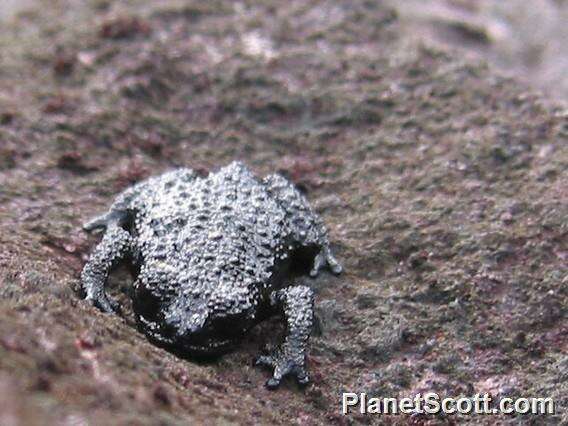
Sign in to saveOreophrynella, commonly known as bush toads, is a genus of true toads native to the tepuis of southern Venezuela and adjacent Guyana. The distribution of some species is restricted to a couple of tepuis or even a single tepui, as in the case of Oreophrynella weiassipuensis, which occurs on Wei-Assipu-tepui.
Species
GENUS
- KingdomAnimalia
- PhylumChordata
- ClassAmphibia
- OrderAnura
- FamilyBufonidae
Oreophrynella ist eine südamerikanische Gattung der Froschlurche aus der Familie der Kröten (Bufonidae). Sie wurde 1895 von George Albert Boulenger erstbeschrieben. Inhaltsverzeichnis 1 Beschreibung 2 Verbreitung 3 Systematik 4 Belege 4.1 Einzelnachweise 5 Weblinks Beschreibung Die Pupillen sind waagerecht ausgerichtet. Die Zunge ist elliptisch geformt, ganzrandig und hinten frei; der Gaumen ist glatt. Es ist kein Trommelfell vorhanden. Die Eustachi-Röhre ist extrem winzig. Finger und Zehen sind kurz, stumpf und haben keine ausgeprägten Schwimmhäute – dies trifft allerdings nicht für die 2009 neu beschriebene Art O. seegobini zu.[1] Die Füße können greifen, der innere Zeh ist opponierbar und länger als der zweite. Die Coracoide und Präcoracoide sind sehr kräftig ausgebildet. Erstere bilden in der Mitte eine extensive Struktur mit letzteren und umfassen auf allen Seiten ein ziemlich kleines, kreisförmiges Foramen. Ein Omosternum ist nicht vorhanden. Das Sternum ist knorpelig. Die Diaphysen der sakralen Wirbel sind stark geweitet.[2] Verbreitung Das Areal der Gattung umfasst Tepuis im Süden von Zentral-Venezuela sowie im angrenzenden Guyana.[3] Systematik Die Gattung Oreophrynella wu
via GBIF
Museum specimens
- Specimen records
- 83
- Family
- Bufonidae
- Collections
- RBINS-SCIENTIFIC HERITAGE, ROM, USNM
- Recorded in
- Venezuela, Guyana
Wikidata facts
Show 5 more facts
- taxon rank
- genus
- taxon name
- Oreophrynella
- Commons category
- Oreophrynella
- topic's main category
- Category:Oreophrynella
- taxon common name
- Bush Toads
Sources (1)
via Wikidata · CC0
~3 min read
Encyclopedic overview
4 sectionsContents
- Description
- Species
- References
- External links
Oreophrynella, commonly known as bush toads, is a genus of true toads native to the tepuis of southern Venezuela and adjacent Guyana. The distribution of some species is restricted to a couple of tepuis or even a single tepui, as in the case of Oreophrynella weiassipuensis, which occurs on Wei-Assipu-tepui.
==Description== Species of the genus Oreophrynella are small frogs, less than in snout–vent length. They are characterized by opposable digits of the foot, dorsal skin that bears tubercules, and direct development (i.e., there is no free-living larval stage). The presence of opposable digits, unique among bufonids, in combination with an extension of the interdigital integument and the relative length/orientation of the digits, is likely to be an adaptation to facilitate life on rocky tepui summits and an exaptation to arboreality The genus also displays cranial simplification in the form of cranial fontanelles and absence of the quadratojugal, which may be driven by a reduction of developmental costs, increase in flexibility, and reduction of body weight. The cranial simplification combined with the shortening of the vertebral column and shift towards a partly firmisternal girdle may be adaptations to the peculiar tumbling behaviour displayed by Oreophrynella.
Excerpted from Wikipedia’s “Oreophrynella” article, available under the CC BY-SA 4.0 licence.