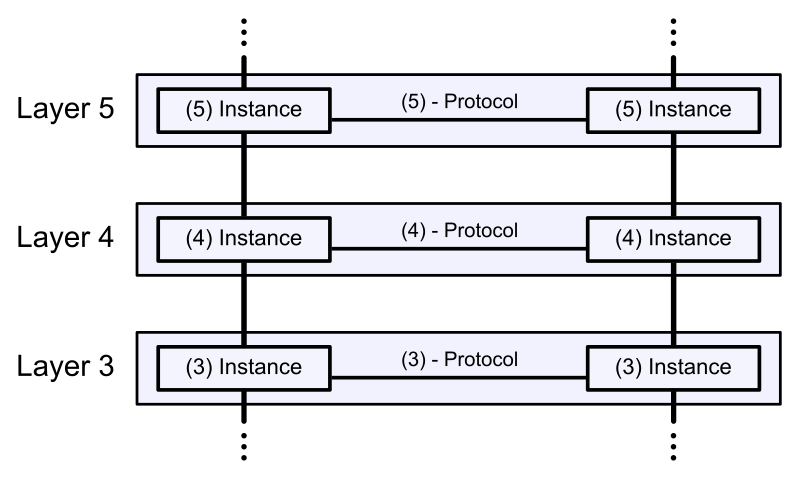
File:OSI-model-Communication.svg · Wikimedia Commons · See Wikimedia Commons
OSI model
Sign in to saveAlso known as Seven Layers Model, 7 Layers Model, Open Systems Interconnection model, OSI reference model, Open System Interconnection, ISO/IEC 7498, ISORM
model with 7 layers to describe communication systems
The OSI model is a framework with seven layers that describes how different parts of a communication system work together to send data from one place to another. It matters because it provides a common language that helps engineers design, troubleshoot, and understand computer networks in a consistent way.
AI-generated from the Wikipedia summary — may contain errors.
Official website
ISO - 35.100 - Open systems interconnection (OSI)
iso.org →Link to the official site · 5,245 chars · not written by Vinony
Wikidata facts
- Instance of
- reference model
- Has part
- transport layer
- Official website
- www.iso.org/ics/35.100/x
- Has parts of class
- abstraction layer
Show 7 more facts
- Commons category
- OSI model
- Stack Exchange tag
- networkengineering.stackexchange.com/tags/osi
- topic's main category
- Category:OSI model
- topic has template
- Template:OSI model
- standards body
- International Organization for Standardization
- partially coincident with
- TCP/IP model
- has immediate cause
- Open Systems Interconnection
via Wikidata · CC0
~30 min read
Encyclopedic overview
The Open Systems Interconnection (OSI) model is a reference model developed by the International Organization for Standardization (ISO) that "provides a common basis for the coordination of standards development for the purpose of systems interconnection."
In the OSI reference model, the components of a communication system are distinguished in seven abstraction layers: Physical, Data Link, Network, Transport, Session, Presentation, and Application.
Excerpted from Wikipedia’s “OSI model” article, available under the CC BY-SA 4.0 licence.
Available in 74 languages
- Español
- Français
- Deutsch
- 中文
- 日本語
- Русский
- Português
- Italiano
- العربية
- हिन्दी
- Afrikaans
- Albanian
- Armenian
- Asturian
- Azerbaijani
- Bahasa Indonesia
- Bangla
- Basque
Show 55 more
- be_x_old
- Belarusian
- Bosnian
- Bulgarian
- Burmese
- Catalan
- Croatian
- Czech
- Danish
- Esperanto
- Estonian
- Finnish
- Galician
- Georgian
- Greek
- Gujarati
- Hebrew
- Hungarian
- Ido
- Irish
- Kazakh
- Latin
- Latvian
- Lithuanian
- Lombard
- Macedonian
- Malay
- Malayalam
- Mongolian
- Nederlands
- Norwegian
- Norwegian Nynorsk
- Polski
- Romanian
- Scots
- Serbian
- Serbian (Latin)
- simple
- Sinhala
- Slovak
- Slovenian
- Svenska
- Telugu
- Tiếng Việt
- Tumbuka
- Türkçe
- Ukrainian
- Uzbek
- Wu Chinese
- Yoruba
- zh_min_nan
- zh_yue
- فارسی
- ไทย
- 한국어
via Wikidata sitelinks · CC0