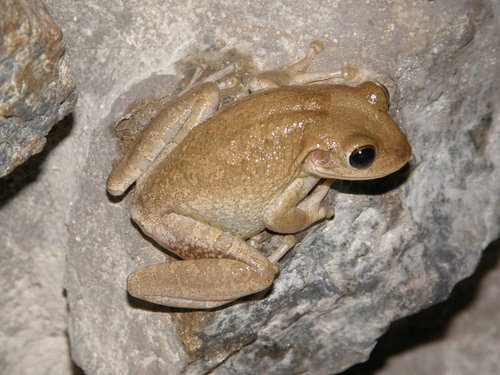
(c) copepodo, some rights reserved (CC BY-NC-ND) · cc-by-nc-nd
Osteopilus
Sign in to saveOsteopilus is a genus of frogs in the family Hylidae. These species have a bony co-ossification on the skull resulting in a casque, hence its name ‘bone-cap’, from osteo- (‘bone’) and the Greek '' (, ‘felt cap’). Color varies between uniform brown, brown-gray, or olive with darker markings or marbled with greens, grays or brown, making a distinct pattern. The finger disks are round; the fingers with a reduced webbing; eyes and tympanum are large. Their natural range includes the Greater Antilles (except Puerto Rico) and the Bahamas, but O. septentrionalis'' has also been introduced to the Le
Species
Cuban Tree Frog
GENUS
- KingdomAnimalia
- PhylumChordata
- ClassAmphibia
- OrderAnura
- FamilyHylidae
via GBIF
Museum specimens
- Specimen records
- 64
- With media
- 1
- Family
- Hylidae
- Collections
- UTA, UF, CM, CUMV, SDNHM
- Recorded in
- United States, Cuba, Haiti, United Kingdom, Jamaica, Dominican Republic
Wikidata facts
Show 5 more facts
- Commons category
- Osteopilus
- taxon name
- Osteopilus
- taxon rank
- genus
- topic's main category
- Category:Osteopilus
- taxon common name
- Cuban Treefrogs
Sources (1)
via Wikidata · CC0
~2 min read
Encyclopedic overview
3 sectionsContents
- Species
- References
- External links
Osteopilus is a genus of frogs in the family Hylidae. These species have a bony co-ossification on the skull resulting in a casque, hence its name ‘bone-cap’, from osteo- (‘bone’) and the Greek '' (, ‘felt cap’). Color varies between uniform brown, brown-gray, or olive with darker markings or marbled with greens, grays or brown, making a distinct pattern. The finger disks are round; the fingers with a reduced webbing; eyes and tympanum are large. Their natural range includes the Greater Antilles (except Puerto Rico) and the Bahamas, but O. septentrionalis has also been introduced to the Lesser Antilles, Hawaii and Florida, USA.
==Species== Eight species are recognized in this genus:
Excerpted from Wikipedia’s “Osteopilus” article, available under the CC BY-SA 4.0 licence.