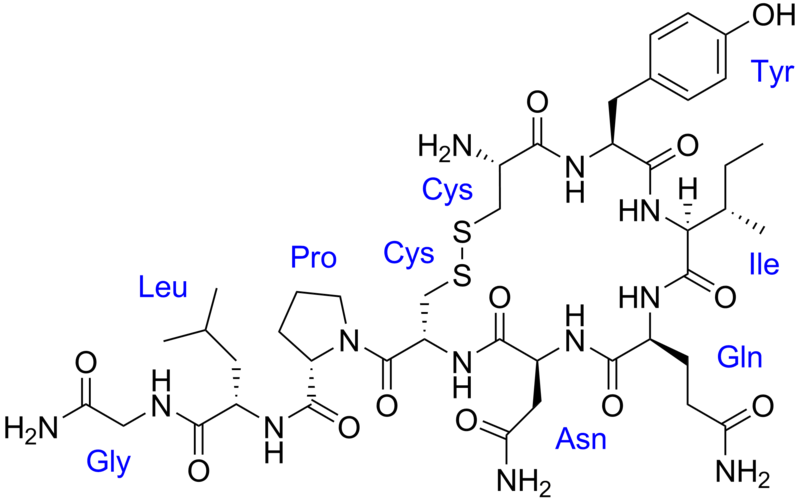
File:Oxytocin_with_labels.png · Wikimedia Commons · See Wikimedia Commons
oxytocin
Sign in to saveOxytocin is a peptide hormone and neuropeptide normally produced in the hypothalamus and released by the posterior pituitary. Present in animals since early stages of evolution, in humans it plays roles in behavior that include social bonding, love, reproduction, childbirth, and the period after childbirth. Oxytocin is released into the bloodstream as a hormone in response to sexual activity and during childbirth. It is also available in pharmaceutical form. In either form, oxytocin stimulates uterine contractions to speed up the process of childbirth.
OverviewAI-generated
Oxytocin is a chemical compound with the formula C₄₃H₆₆N₁₂O₁₂S₂. It has a mass of 1006.436 and a weight of 1007.2. The molecule carries a charge of 0 and features 12 hydrogen bond donors and 15 hydrogen bond acceptors. Its topological polar surface area is 450, and its xlogp value is -2.6.
The compound is associated with the MCN codes 3004.39.22, 2937.19.50, and 3003.39.22. In scientific literature, the term oxytocin appears in 33,587 PubMed records. Additionally, the subject is referenced by 1,106 other encyclopedia articles.
Synthesized by Vinony from 16 facts across 4 sources: Wikidata, PubChem, PubMed, Vinony graph. Generated from structured data (not the Wikipedia text) and checked against those facts — may still contain errors.
Key facts
- Drug.ChEMBL
- 395429
- Drug.C
- 43
- Drug.H
- 66
- Drug.N
- 12
- Drug.O
- 12
- Drug.S
- 2
- Drug.Watchedfields
- changed
- Drug.verifiedrevid
- 691721176
- Drug.IUPAC_name
- 1-({(4R,7S,10S,13S,16S,19R)-19-amino-7-(2-amino-2-oxoethyl)-10-(3-amino-3-oxopropyl)-16-(4-hydroxybenzyl)-13-[(1S)-1-methylpropyl]-6,9,12,15,18-pentaoxo-1,2-dithia-5,8,11,14,17-pentaazacycloicosan-4-yl}carbonyl)-L-prolyl-L-leucylglycinamide
- Drug.image
- Oxytocin with labels.png
- Drug.image_class
- skin-invert-image
- Drug.image2
- Oxytocin-from-NMR-soln-3D-bs-17.png
- Drug.image_class2
- bg-transparent
- Drug.ATC_prefix
- H01
- Drug.ATC_suffix
- BB02
- Drug.tradename
- Induxin
- Drug.source_tissues
- Pituitary gland
- Drug.target_tissues
- Wide spread
via Wikipedia infobox
Chemical data
- Formula
- C43H66N12O12S2
- Molecular weight
- 1007.2 g/mol
- IUPAC name
- (2S)-1-[(4R,7S,10S,13S,16S,19R)-19-amino-7-(2-amino-2-oxoethyl)-10-(3-amino-3-oxopropyl)-13-[(2S)-butan-2-yl]-16-[(4-hydroxyphenyl)methyl]-6,9,12,15,18-pentaoxo-1,2-dithia-5,8,11,14,17-pentazacycloicosane-4-carbonyl]-N-[(2S)-1-[(2-amino-2-oxoethyl)amino]-4-methyl-1-oxopentan-2-yl]pyrrolidine-2-carboxamide
- SMILES
- CC[C@H](C)[C@H]1C(=O)N[C@H](C(=O)N[C@H](C(=O)N[C@@H](CSSC[C@@H](C(=O)N[C@H](C(=O)N1)CC2=CC=C(C=C2)O)N)C(=O)N3CCC[C@H]3C(=O)N[C@@H](CC(C)C)C(=O)NCC(=O)N)CC(=O)N)CCC(=O)N
- InChIKey
- XNOPRXBHLZRZKH-DSZYJQQASA-N
- XLogP
- -2.6
- Polar surface area
- 450 Ų
- H-bond donors
- 12
- H-bond acceptors
- 15
- Formal charge
- 0
via PubChem
Drug data · ChEMBL
- Max clinical phase
- Approved
- Molecule type
- Protein
- First approval
- 1980
- Admin. routes
- parenteral, topical
- Indications
- autism spectrum disorder, hemorrhage, preeclampsia, alcohol withdrawal
via ChEMBL · EBI
Research
33,587 papers- The physiology and pharmacology of oxytocin in labor and in the peripartum period.ReviewAmerican journal of obstetrics and gynecology · 2024Uvnäs-Moberg KDOI: 10.1016/j.ajog.2023.04.011
- Oxytocin in neurodevelopmental disorders: Autism spectrum disorder and Prader-Willi syndrome.ReviewPharmacology & therapeutics · 2024Josselsohn A, Zhao Y, Espinoza D et al.DOI: 10.1016/j.pharmthera.2024.108734
- Oxytocin and Olfaction.ReviewCurrent topics in behavioral neurosciences · 2018Oettl LL, Kelsch WDOI: 10.1007/7854_2017_8
- Oxytocin therapy in hypopituitarism: Challenges and opportunities.ReviewClinical endocrinology · 2019Bhargava R, Daughters KL, Rees ADOI: 10.1111/cen.13909
- Oxytocin and Social Cognition.ReviewCurrent topics in behavioral neurosciences · 2018Ebert A, Brüne MDOI: 10.1007/7854_2017_21
- Oxytocin and the Neurobiology of Prosocial Behavior.ReviewThe Neuroscientist : a review journal bringing neurobiology, neurology and psychiatry · 2021Marsh N, Marsh AA, Lee MR et al.DOI: 10.1177/1073858420960111
- Oxytocin and social functioning.ReviewDialogues in clinical neuroscience · 2017Jones C, Barrera I, Brothers S et al.DOI: 10.31887/DCNS.2017.19.2/cjones
- The oxytocin system and early-life experience-dependent plastic changes.ReviewJournal of neuroendocrinology · 2021Onaka T, Takayanagi YDOI: 10.1111/jne.13049
via PubMed
Wikidata facts
- Has part
- carbon
- Mass
- 1006.436
Show 16 more facts
- used by
- biological basis of love
- chemical formula
- C₄₃H₆₆N₁₂O₁₂S₂
- described by source
- Armenian Soviet Encyclopedia
- World Health Organisation international non-proprietary name
- oxytocin
- Commons category
- Oxytocin
- isomeric SMILES
- CC[C@H](C)[C@H]1C(=O)N[C@H](C(=O)N[C@H](C(=O)N[C@@H](CSSC[C@@H](C(=O)N[C@H](C(=O)N1)CC2=CC=C(C=C2)O)N)C(=O)N3CCC[C@H]3C(=O)N[C@@H](CC(C)C)C(=O)NCC(=O)N)CC(=O)N)CCC(=O)N
- canonical SMILES
- CCC(C)C1C(=O)NC(C(=O)NC(C(=O)NC(CSSCC(C(=O)NC(C(=O)N1)CC2=CC=C(C=C2)O)N)C(=O)N3CCCC3C(=O)NC(CC(C)C)C(=O)NCC(=O)N)CC(=O)N)CCC(=O)N
- active ingredient in
- Oxytocin
- subject has role
- hormone
- MCN code
- 3003.39.22
- permanent duplicated item
- Oxytocin
- different from
- oxycodone
- has characteristic
- biopharmaceutical
- legal status (medicine)
- boxed warning
- facet of
- women's health
Sources (9)
via Wikidata · CC0
~39 min read
Encyclopedic overview
22 sectionsContents
- Etymology
- History
- Biochemistry
- Biosynthesis
- Neural sources
- Non-neural sources
- Evolution
- Biological function
- Physiological{{anchor|Actions within the brain}}
- Psychological
- Bonding
- Drugs
- Fear and anxiety
- Mood and depression
- Sex differences
- Social
- Chemistry
- In medicine
- See also
- References
- Further reading
- External links
{{Infobox drug | Watchedfields = changed | verifiedrevid = 691721176 | IUPAC_name = 1-({(4R,7S,10S,13S,16S,19R)-19-amino-7-(2-amino-2-oxoethyl)-10-(3-amino-3-oxopropyl)-16-(4-hydroxybenzyl)-13-[(1S)-1-methylpropyl]-6,9,12,15,18-pentaoxo-1,2-dithia-5,8,11,14,17-pentaazacycloicosan-4-yl}carbonyl)-L-prolyl-L-leucylglycinamide | image = Oxytocin with labels.png | image_class = skin-invert-image | width = | image2 = Oxytocin-from-NMR-soln-3D-bs-17.png | image_class2 = bg-transparent | ATC_prefix = H01 | ATC_suffix = BB02 | tradename = Induxin
| source_tissues = Pituitary gland | target_tissues = Wide spread | receptors = Oxytocin receptor | agonists = | antagonists = Atosiban | precursor = Oxytocin/neurophysin I prepropeptide | biosynthesis =
Excerpted from Wikipedia’s “oxytocin” article, available under the CC BY-SA 4.0 licence.
Gallery (13)
Available in 74 languages
- Español
- Français
- Deutsch
- 中文
- 日本語
- Русский
- Português
- Italiano
- العربية
- हिन्दी
- Albanian
- Armenian
- azb
- Azerbaijani
- Bahasa Indonesia
- Bangla
- Basque
- be_x_old
Show 55 more
- Belarusian
- Bosnian
- Bulgarian
- Burmese
- Catalan
- Croatian
- Czech
- dag
- Danish
- Divehi
- Esperanto
- Estonian
- Finnish
- Galician
- Georgian
- gpe
- Greek
- Hebrew
- Hungarian
- Icelandic
- Irish
- Kannada
- Kazakh
- Kurdish
- Kyrgyz
- Latin
- Latvian
- Lithuanian
- Macedonian
- Malay
- Marathi
- Nederlands
- Norwegian
- Odia
- Polski
- Romanian
- Serbian
- Serbian (Latin)
- simple
- Sinhala
- Slovak
- Somali
- Sundanese
- Svenska
- Tamil
- Telugu
- Tiếng Việt
- Türkçe
- Ukrainian
- Western Panjabi
- Wu Chinese
- zh_yue
- فارسی
- ไทย
- 한국어
via Wikidata sitelinks · CC0