
File:Padma_Shri_India_IIIe_Klasse.jpg · Wikimedia Commons · See Wikimedia Commons
The Padma Shri is India's fourth highest civilian award, given to recognize exceptional achievements and contributions across various fields. It matters because it represents the nation's highest official honors for distinguished service to the country.
AI-generated from the Wikipedia summary — may contain errors.
Key facts
- Type
- National Civilian
- Country
- India
- Presented by
- Government of India
- Obverse
- A centrally located lotus flower is embossed and the text "Padma" written in Devanagari script is placed above and the text "Shri" is placed below the lotus.
- Reverse
- A platinum State Emblem of India placed in the centre with the national motto of India, " Satyameva Jayate " (Truth alone triumphs) in Devanagari Script
- Established
- 1954 ; 72 years ago ( 1954 )
- Website
- padmaawards .gov .in
- Next higher
- Kirti Chakra (military), Padma Bhushan (civilian)
- Next lower
- Sarvottam Jeevan Raksha Padak
via Wikipedia infobox
Official website
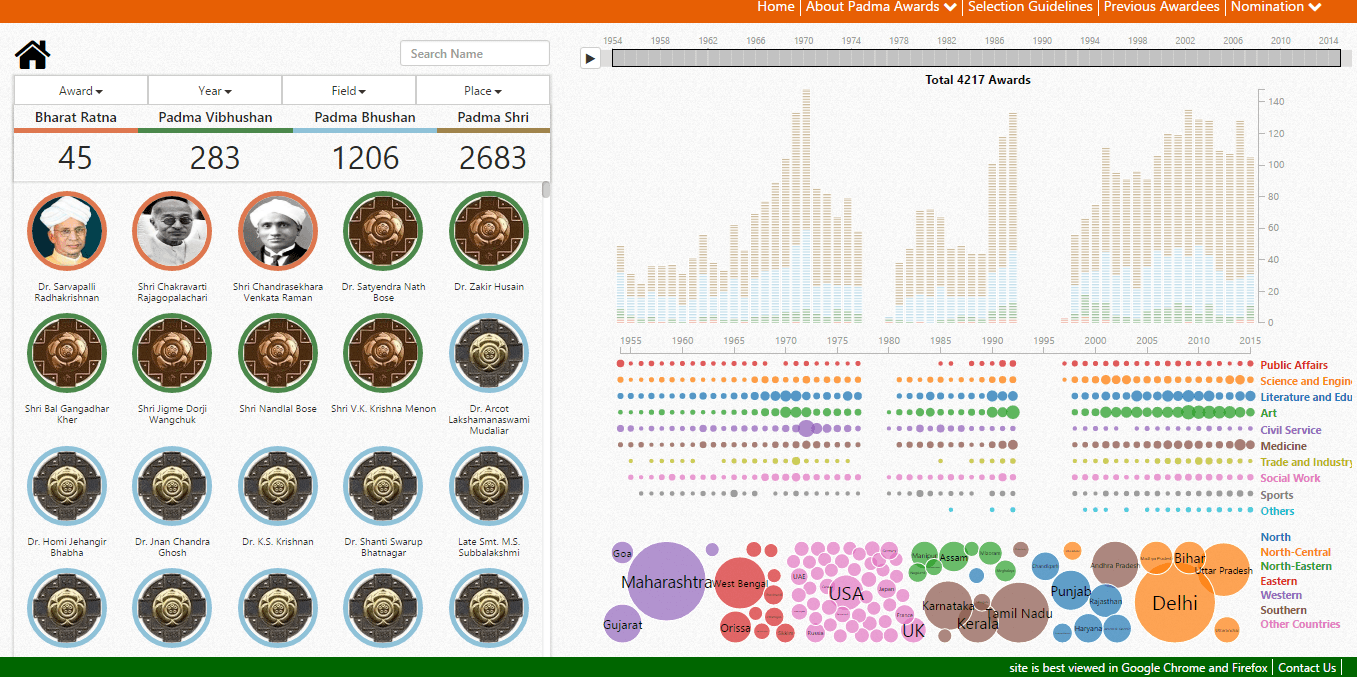
Padma Awards
dashboard-padmaawards.gov.in →Link to the official site · 492 chars · not written by Vinony
Wikidata facts
- Instance of
- civil decoration
- Country
- India
- Official website
- dashboard-padmaawards.gov.in/?Award=Padma%20Shri
- Image
- Padma Shri India IIIe Klasse.jpg
Show 8 more facts
- topic has template
- Template:Padma Shri Awards
- native label
- पद्म श्री
- Commons category
- Padma Shri
- inception
- 1954-00-00
- category for recipients of this award
- Category:Recipients of the Padma Shri
- quantity
- 2679
- next higher rank
- Kirti Chakra
- next lower rank
- Sarvottam Jeevan Raksha Padak
Sources (1)
via Wikidata · CC0
~4 min read
Encyclopedic overview
The Padma Shri (IAST: padma śrī, lit. 'Lotus Honour'), also spelled Padma Shree, is the fourth-highest civilian award of the Republic of India, after the Bharat Ratna, the Padma Vibhushan and the Padma Bhushan. Instituted on 2 January 1954, the award is conferred in recognition of "distinguished contribution in various spheres of activity including the arts, education, industry, literature, science, acting, medicine, social service and public affairs". It is awarded by the Government of India every year on India's Republic Day.
History
Excerpted from Wikipedia’s “Padma Shri” article, available under the CC BY-SA 4.0 licence.