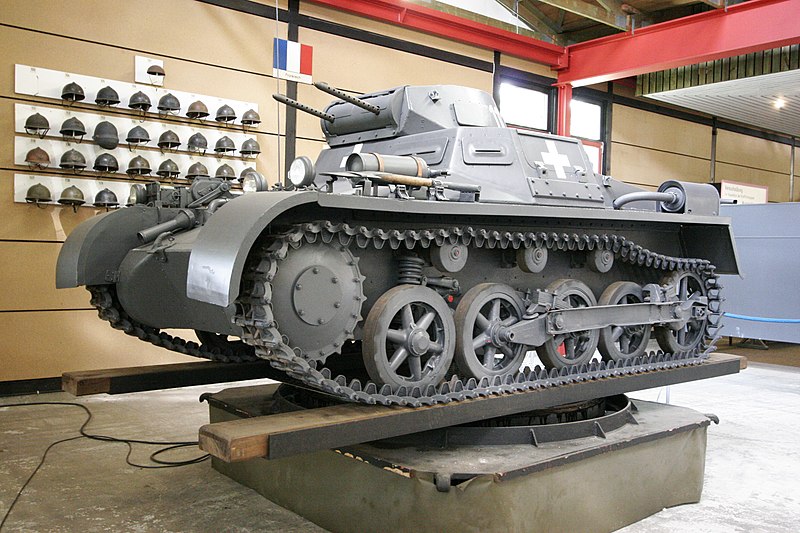
File:SdKfz101.jpg · Wikimedia Commons · See Wikimedia Commons
Panzer I
Sign in to saveAlso known as Panzer 1, Panzerkampfwagen I, PzKpfw I, SdKfz 101, Armored Combat Vehicle I
German light tank
Key facts
- Type
- Light tank
- Place of origin
- Germany
- In service
- 1934–1945
- Used by
- Nazi Germany , Bulgaria , Republic of China , Hungary , Francoist Spain
- Wars
- Spanish Civil War , World War II , Second Sino-Japanese War
- Designed
- 1932–1934
- Manufacturer
- Henschel , MAN , Krupp , Daimler
- Unit cost
- 38,000 ℛ ︁ ℳ ︁ (Ausf. B Without weapons)
- Produced
- 1934–1938, 1943
- Number span no built
- 1,659 as light tanks, 184 as command tanks, 445 as training tanks, 147 as special convertible chassis
- Mass
- 5.4 tonnes (6.0 short tons )
- Length
- 4.02 m (13 ft 2 in)
- Width
- 2.06 m (6 ft 9 in)
- Height
- 1.72 m (5 ft 8 in)
- Crew
- 2: commander and driver
- Armor
- 7–13 mm
- Main armament
- 2 × 7.92 mm MG 13 machine guns
- Engine
- Ausf.A:Krupp M 305 four-cylinder air-cooled gasoline engine , Ausf.B: Maybach NL38 TR , Ausf.A:60 PS (59 hp , 44 kW) , Ausf.B:100 metric horsepower (74 kW)
via Wikipedia infobox
Wikidata facts
- Subclass of
- light tank
- Has part
- Panzer IF
- Country of origin
- Nazi Germany
- Followed by
- Panzer II
- Mass
- 5.4
- Manufacturer
- Daimler-Benz AG
- Conflict
- Second Sino-Japanese War
- Image
- SdKfz101.jpg
- Height
- 1.72
- Width
- 2.1
- Length
- 4.45
Show 8 more facts
- Commons category
- Panzerkampfwagen I
- service entry
- 1934-01-01
- service retirement
- 1945-00-00
- total produced
- 1493
- Commons gallery
- Panzerkampfwagen I
- name in kana
- いちごうせんしゃ
- native label
- Panzerkampfwagen I
- different from
- Panzer IC
via Wikidata · CC0
~28 min read
Encyclopedic overview
The Panzer I was a light tank produced by Nazi Germany in the 1930s. Its name is short for Panzerkampfwagen I (German for "armored fighting vehicle mark I"), abbreviated as Pz.Kpfw. I. The tank's official German ordnance inventory designation was Sd.Kfz. 101 ("special purpose vehicle 101").
Design of the Panzer I began in 1932 and mass production began in 1934. Intended only as a training tank to introduce the concept of armored warfare to the German Army, the Panzer I saw combat in Spain during the Spanish Civil War, in Poland, France, the Soviet Union and North Africa during the Second World War, and in China during the Second Sino-Japanese War. Experiences with the Panzer I during the Spanish Civil War helped shape the German Panzerwaffe's invasion of Poland in 1939 and France in 1940. By 1941, the Panzer I chassis design was used as the basis of tank destroyers and assault guns. There were attempts to upgrade the Panzer I throughout its service history, including by foreign nations, to extend the design's lifespan. It continued to serve in the Spanish Armed Forces until 1954.
Excerpted from Wikipedia’s “Panzer I” article, available under the CC BY-SA 4.0 licence.