Russell A. Mittermeier;Don E. Wilson
Parantechinus apicalis
Sign in to saveAlso known as Dibbler
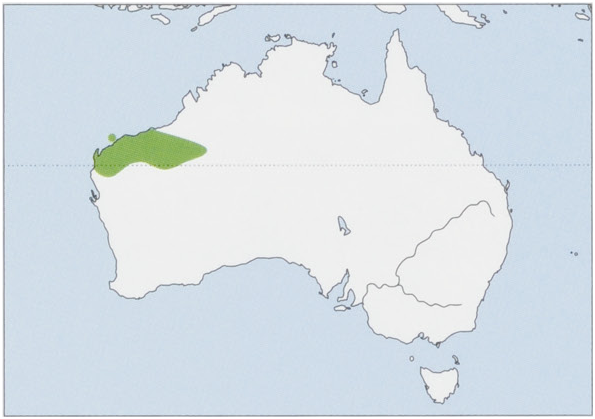
The dibbler (Parantechinus apicalis) is an endangered species of marsupial. It is an inhabitant of the southwest mainland of Western Australia and some offshore islands. It is a member of the order Dasyuromorphia, and the only member of the genus Parantechinus. The dibbler is a small, nocturnal carnivore with speckled fur that is white around the eyes.
Species
EndangeredSPECIES
- KingdomAnimalia
- PhylumChordata
- ClassMammalia
- OrderDasyuromorphia
- FamilyDasyuridae
Maximum longevity: 5.5 years (captivity) Observations: These animals are expected to live more than 3 years in the wild (Bernhard Grzimek 1990). One specimen lived 5.5 years in captivity (Richard Weigl 2005).
via GBIF · IUCN
Museum specimens
- Specimen records
- 136
- With media
- 5
- Family
- Dasyuridae
- Collections
- AM, WAM, SAMA
- Recorded in
- Australia
Wikidata facts
- Instance of
- taxon
- Parent taxon
- Parantechinus
- Mass
- 82.5
- Image
- Parantechinus apicalis - Gould.jpg
- Length
- 110
Show 14 more facts
- taxon rank
- species
- IUCN conservation status
- Endangered status
- Commons category
- Parantechinus apicalis
- taxon name
- Parantechinus apicalis
- Commons gallery
- Parantechinus apicalis
- taxon common name
- Sprenkelbeutelmaus
- endemic to
- Australia
- longest observed lifespan
- 5.5
- taxon author citation
- (J.E. Gray, 1842)
- has characteristic
- viviparity
- gestation period
- 48
- litter size
- 7
- period of lactation
- 3.5
- short name
- P. apicalis
Sources (3)
via Wikidata · CC0
~6 min read
Encyclopedic overview
7 sectionsContents
- Description
- Taxonomy
- Classification
- Common name
- Conservation status
- References
- External links
The dibbler (Parantechinus apicalis) is an endangered species of marsupial. It is an inhabitant of the southwest mainland of Western Australia and some offshore islands. It is a member of the order Dasyuromorphia, and the only member of the genus Parantechinus. The dibbler is a small, nocturnal carnivore with speckled fur that is white around the eyes.
==Description== The dibbler is long with a tail; it weighs . Distinctive features include a white eye-ring, gray-brown fur flecked with white hairs, and a short tapering tail. It has strong jaws and large canine teeth for killing prey, which include small vertebrates such as mice, birds and lizards, as well as insects and other invertebrates. They are semi-arboreal and will also feed on nectar from flowering plants and berries. Dibblers weigh about 40–135 grams (1.4–3.6 oz).The breeding season for the species is March–April, with the female able to give birth and raise up to eight young. The dibbler is a solitary, mostly crepuscular species.
Excerpted from Wikipedia’s “Parantechinus apicalis” article, available under the CC BY-SA 4.0 licence.