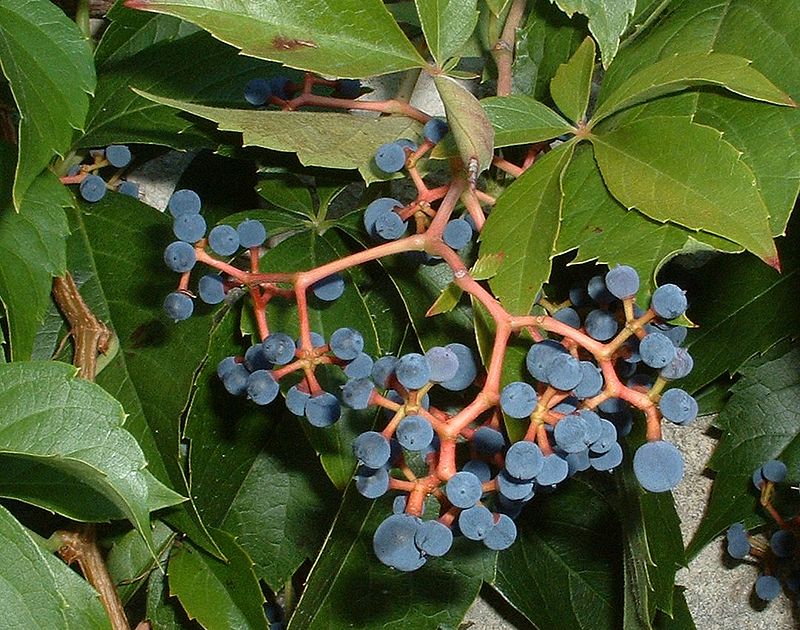
File:Parthenocissus_quinquefolia_fructis.jpg · Wikimedia Commons · See Wikimedia Commons
Parthenocissus
Sign in to savethumb|Creeper stalk transversal cross section. Parthenocissus , is a genus of tendril climbing plants in the grape family, Vitaceae. It contains about 12 species native to the Himalaya, eastern Asia and North America. Several are grown for ornamental use, notably P. henryana, P. quinquefolia and P. tricuspidata.
OverviewAI-generated
Parthenocissus is a genus within the family Vitaceae. It belongs to the order Vitales, class Magnoliopsida, and phylum Tracheophyta in the kingdom Plantae. The taxon is currently accepted and is commonly referred to as Virginia-creepers, creeper, Jungfernreben, Villiviinit, or Wilde wingerd. The genus includes the appressorium as a part.
Records for this genus have been documented in Mexico, the United States, and China. These records are held by institutions including IBUNAM, UCMP, INECOL, A, and NEBC. The total occurrence count stands at 209,315, while the record count is 526 with 347 associated media items.
Synthesized by Vinony from 33 facts across 7 sources: Wikidata, GBIF, Gbif Occ, Plants of the World, WoRMS, iDigBio, Vinony graph. Generated from structured data (not the Wikipedia text) and checked against those facts — may still contain errors.
Species
Virginia-creepers
GENUS
- KingdomPlantae
- PhylumTracheophyta
- ClassMagnoliopsida
- OrderVitales
- FamilyVitaceae
Jungfernreben (Parthenocissus), auch Zaunreben oder Wilder Wein[1] ist eine Pflanzengattung innerhalb der Familie der Weinrebengewächse (Vitaceae). Die etwa 13 Arten sind in den gemäßigten Breiten Asiens und Nordamerikas beheimatet. Einige Arten und ihre Sorten werden als Zierpflanze hauptsächlich zur Begrünung von Häuserwänden, Mauern und Zäunen verwendet. Inhaltsverzeichnis 1 Beschreibung 2 Systematik und Verbreitung 3 Perldrüsen 4 Rezeption 5 Quellen 5.1 Einzelnachweise 6 Weblinks Beschreibung Parthenocissus ist ähnlich wie Vitis vinifera eine sommergrüne Liane. Die Besonderheit sind die Sprossranken am Ende, die zu scheibchenförmigen Haftorganen umgewandelt sind. Die ganzrandigen, gestielten Laubblätter sind einfach und gelappt oder drei- bis siebenteilig gefingert. Die Blütenstände sind verzweigt. Die Blüten sind zwittrig oder seltener funktional männlich. Die unscheinbaren Blüten sind radiärsymmetrisch und fünfzähligen mit doppelter Blütenhülle. Die fünf grünlichen Kronblätter sind frei. Es ist nur ein Kreis mit fünf Staubblättern vorhanden, der epipetal ist. Ein intrastaminaler Diskus ist vorhanden. Die bläulich schwarzen Beeren enthalten nur ein bis drei meist kugelige Same
via GBIF · Kew POWO
Museum specimens
- Specimen records
- 526
- With media
- 347
- Family
- Vitaceae
- Collections
- IBUNAM, UCMP, INECOL, A, NEBC
- Recorded in
- Mexico, United States, China
Wikidata facts
- Instance of
- taxon
- Has part
- appressorium
- Image
- Parthenocissus quinquefolia fructis.jpg
Show 7 more facts
- taxon rank
- genus
- taxon name
- Parthenocissus
- Commons category
- Parthenocissus
- topic's main category
- Category:Parthenocissus
- Commons gallery
- Parthenocissus
- taxon common name
- 爬山虎属(地锦属)
Sources (2)
via Wikidata · CC0
~2 min read
Encyclopedic overview
7 sectionsContents
- Etymology
- Fossil record
- Food plants
- Species
- From Asia
- From North America
- References
thumb|Creeper stalk transversal cross section. Parthenocissus , is a genus of tendril climbing plants in the grape family, Vitaceae. It contains about 12 species native to the Himalaya, eastern Asia and North America. Several are grown for ornamental use, notably P. henryana, P. quinquefolia and P. tricuspidata.
==Etymology== The name derives from the Greek παρθένος (parthenos) "virgin", and κισσός (kissós) (Latinized as "cissus"), "ivy". The reason is variously given as the ability of these creepers to form seeds without pollination or the English name of P. quinquefolia, Virginia creeper, which has become attached to the whole genus.
Excerpted from Wikipedia’s “Parthenocissus” article, available under the CC BY-SA 4.0 licence.