Paul R. Williams
Sign in to saveAlso known as Paul Revere Williams, Paul Williams
American architect (1894–1980)
Person · Open Library
- Works
- 18
Top works
- Ukraine and the Legal Accountability of Russia
- Simulating Kosovo
- Council for the Central Laboratory of the Research Councils Accounts 1996-97
- When All Plans Fail
- Lawyering Peace
via Open Library + Wikidata
Described at
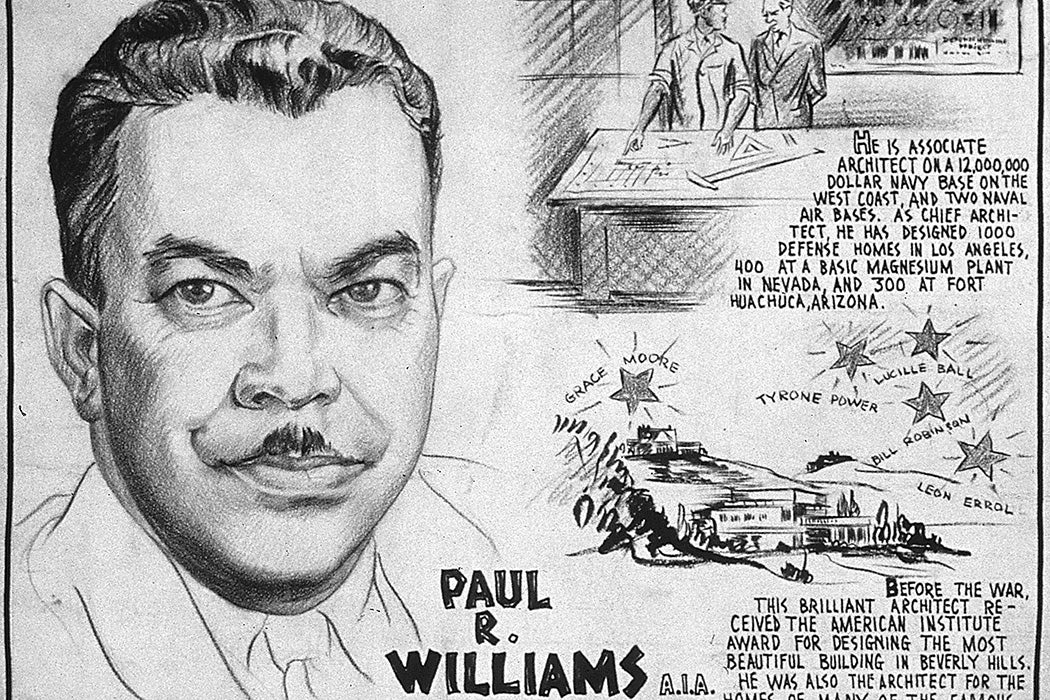
Paul Revere Williams: An Architect of Firsts - JSTOR Daily
The first African American architect licensed in the state of California, Williams blazed a trail to the (Hollywood) stars.
daily.jstor.org →The first African American architect licensed in the state of California, Williams blazed a trail to the (Hollywood) stars. Zsa Zsa Gabor. Frank Sinatra . Lucille Ball and Desi Arnaz. All names that harken back to the glamor and glitz of Old Hollywood. They’re also names that harken back to the career of architect Paul Revere Williams, who designed homes for them and many others in Hollywood. His work was such a defining characteristic of the era that he became known as the “architect of the stars.” Becoming a Black architect wasn’t and still isn’t easy. Today, only about 2 percent of architects in the United States identify as Black. In other words, little has changed in the ten years since architect Gabriel Kroiz wrote in his examination of Melvin Mitchell’s The Crisis of the African-American Architect: Conflicting Cultures of Architecture and (Black) Power that “since the civil rights movement in the United States, professions such as engineering, law, and medicine have made significant progress in diversification, but the percentage of black architects has remained largely unchanged, at less than 2 percent.” Williams’s path to architecture wasn’t a simple one. Born in Los Angeles in 1894, he was orphaned by age four. When he expressed an interest in becoming an architect during his high school years, he was told to reconsider. As Ellen Weiss explains in her review of Karen E. Hudson’s books on Williams , he was “discouraged during high school from his early interest in architecture because his teachers believed that the black community could not support this profession as it could medicine, law, and the ministry.” Williams was Hudson’s grandfather, and she has dedicated decades to recording and writing about his career. from 1892 to 1968 a handful of HBCU architecture programs emerged, including those at Howard University, Hampton University, and several of the Land Grant Universities founded during Reconstruction. [Yet] a small number of African Americans, including Paul Revere Williams, also broke the color barrier at major institutions. After graduating from LA’s Polytechnic High School , Williams went on to earn a degree in architectural engineering from the University of Southern California in 1919 and opened his own design practice in 1923. in order not to offend the racial sensitivities of white clients, Williams learned to draw upside down. This way he would not have to lean over the backs of his white clients when showing or revising architectural plans. As an architect, he showed his incredible skill set through the variety of building types he was hired to design and the variety of architectural styles in which he worked. While he was trained in the classical Beaux Arts tradition, he embraced the modernist approach of the mid-twentieth century. The soaring curves of the lobby for his design of the La Concha Motel in Las Vegas are an iconic example of Googie architecture now preserved as part of the Neon Museum, while his own home follows the International Style’s simple lines and rejection of ornamentation. Get your fix of JSTOR Daily’s best stories in your inbox each Thursday. Williams passed away in 1980, and it was believed that the majority of his archive was destroyed during the 1992 Los Angeles uprising . Williams’s records were housed in the Broadway Federal Savings and Loan Building, which he had remodeled from a Woolworth’s in 1955 to create a bank. The building caught fire during the riots . However, while some business records were lost, the vast majority of the archive—drawings, blueprints, photographs, and correspondence—were actually stored elsewhere. This was dramatically revealed in June 2020 when the Getty Institute and the University of Southern California released a joint statement announcing they had acquired the archive from Hudson. The “rediscovery” of Williams’s archive is one example of the work architectural historians continue to do to uncover new Black architectural histories
Excerpt from a page describing this subject · 14,896 chars · not written by Vinony
Wikidata facts
- Instance of
- human
- Given name
- Paul
- Family name
- Williams
- Gender
- male
- Citizenship
- United States
- Place of birth
- Los Angeles
- Place of death
- Los Angeles
- Occupation
- architect
- Languages spoken
- English language
- Notable work
- Guardian Angel Cathedral
- Image
- Paul Williams.jpg
Show 6 more facts
- place of burial
- Inglewood Park Cemetery
- Commons category
- Paul R. Williams
- date of birth
- 1894-02-18
- date of death
- 1980-01-23
- ethnic group
- African Americans
- described at URL
- daily.jstor.org/paul-revere-williams-an-architect-of-firsts
Sources (7)
via Wikidata · CC0