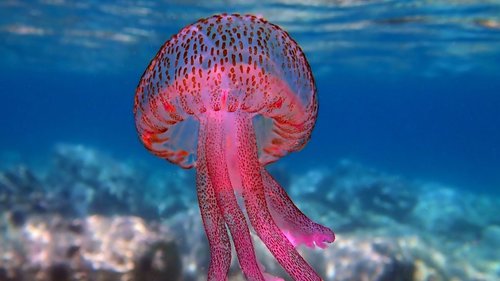
(c) Seawater, some rights reserved (CC BY-NC), uploaded by Seawater · cc-by-nc
Species
mauve stinger
SPECIES
- KingdomAnimalia
- PhylumCnidaria
- ClassScyphozoa
- OrderSemaeostomeae
- FamilyPelagiidae
via GBIF
Museum specimens
- Specimen records
- 233
- With media
- 19
- Family
- Pelagiidae
- Collections
- CMN, CAS, DESZC-CUCSUR-UDG, FC-UNAM, USNM, NMV
- Recorded in
- United States, Mexico, Costa Rica, New Zealand, Philippines, Japan, Australia
Wikidata facts
Show 4 more facts
- Commons category
- Pelagia noctiluca
- taxon rank
- species
- taxon name
- Pelagia noctiluca
- taxon common name
- 야광원양해파리
Sources (2)
via Wikidata · CC0
~13 min read
Encyclopedic overview
Pelagia noctiluca is a jellyfish in the family Pelagiidae and the only currently recognized species in the genus Pelagia. It is typically known in English as the mauve stinger, but other common names are purple-striped jelly (causing potential confusion with Chrysaora colorata), purple stinger, purple people eater, purple jellyfish, luminous jellyfish and night-light jellyfish. In Greek, pelagia means "(she) of the sea", from pelagos "sea, open sea"; in Latin noctiluca is the combining form of nox, "night", and lux, "light"; thus, Pelagia noctiluca can be described as a marine organism with the ability to glow in the dark (bioluminescence). It is found worldwide in tropical and warm temperate seas, although it is suspected that records outside the North Atlantic region, which includes the Mediterranean and Gulf of Mexico, represent closely related but currently unrecognized species.
A fairly small and variably coloured species, both its tentacles and (unusual among jellyfish) bell are covered in stinging cells. Stinging incidents are common, painful and the symptoms may continue for a considerable time after the encounter, but they are generally not dangerous. When large numbers of this oceanic species are washed ashore, the local economy can be affected because tourists avoid the beaches and fishers are stung while trying to retrieve their nets, which can be clogged by the jellyfish. Additionally, swarms of Pelagia noctiluca have been recorded wiping out entire fish farms. Because of this, it has become one of the most studied jellyfish species.
Excerpted from Wikipedia’s “Pelagia noctiluca” article, available under the CC BY-SA 4.0 licence.