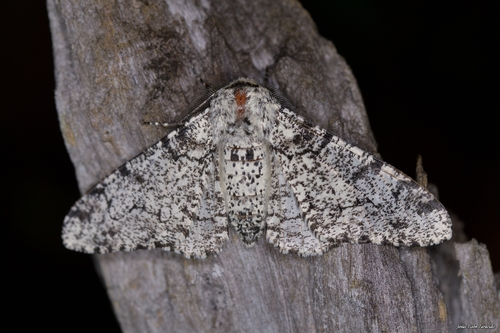
(c) Suso Tizón, some rights reserved (CC BY-NC-SA), uploaded by Suso Tizón · cc-by-nc-sa
OverviewAI-generated
The peppered moth, scientifically named *Biston betularia*, is a species within the genus *Biston*. It belongs to the insect class and is a nocturnal moth that inhabits temperate regions. The species has a wingspan of 42.5. Its larvae feed on *Betula pubescens*, *Euonymus europaeus*, and *Fagus*.
The moth is also referred to by the common names gwyfyn brith [golau] and peper-en-zoutvlinder. It has been the subject of 16,426 observations on iNaturalist. The species is referenced by 108 other encyclopedia articles.
Synthesized by Vinony from 18 facts across 4 sources: Wikidata, iNaturalist, Encyclopedia of Life, Vinony graph. Generated from structured data (not the Wikipedia text) and checked against those facts — may still contain errors.
Species
Peppered Moth
species
桦尺蠖(学名:Biston betularia)又称桦尺蛾,古稱蝍𧐴,尺蠖蛾科,是一種在溫帶生活的夜行性蛾。桦尺蠖在生物演化论的科学发展史上有着重大的意义,其演化過程經常被援引作例子。
via
Wikidata facts
Show 9 more facts
- taxon name
- Biston betularia
- taxon rank
- species
- Commons category
- Biston betularia
- topic's main category
- Category:Peppered moth
- Commons gallery
- Biston betularia
- taxon common name
- bjørkelurvemåler
- wingspan
- 42.5
- short name
- B. betularia
- has host
- Populus tremuloides
via Wikidata · CC0
~12 min read
Encyclopedic overview
The peppered moth (Biston betularia) is a moth of the family Geometridae. It is night flying, and found mainly in temperate regions of the northern hemisphere. Peppered moth evolution is an example of population genetics and natural selection.
The caterpillars of the peppered moth not only mimic the form but also the colour of a twig. Recent research indicates that the caterpillars can sense the twig's colour with their skin and match their body colour to the background to protect themselves from predators.
Excerpted from Wikipedia’s “Peppered moth” article, available under the CC BY-SA 4.0 licence.