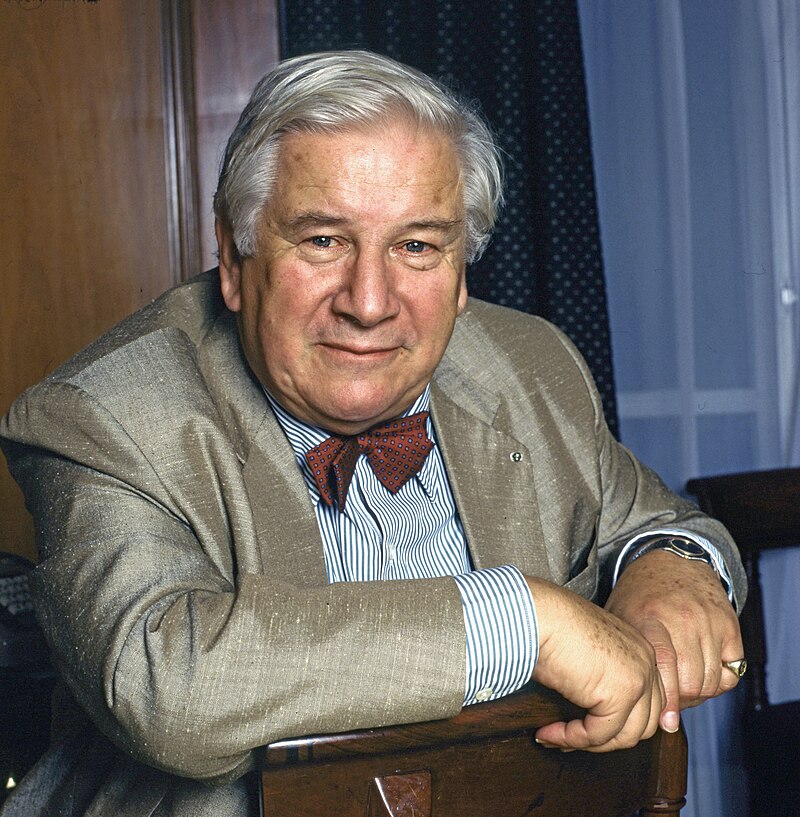
File:Sir_Peter_Ustinov_Allan_Warren.jpg · Wikimedia Commons · See Wikimedia Commons
Peter Ustinov
Sign in to saveAlso known as Sir Peter Alexander Ustinov, Sir Peter Alexander von Ustinov, Peter Alexander Ustinov
British actor, writer and director (1921–2004)
OverviewAI-generated
Peter Ustinov (1921–2004) was a British male artist whose professional career spanned from 1940 to 2004. He was recognized in the Academy Award Best Supporting Actor collection. Ustinov had four children and stood 180 units in height.
His literary output included 34 works, with notable titles such as *Die Liebe der vier Obersten / Der Unbekannte Soldat und seine Frau*, *Ach du meine Güte*, *Der Verlierer*, *Krumnagel*, and *The Banbury nose*. Crossref data lists five works associated with him.
Ustinov is the subject of various quotes, including statements on laughter, politicians, and Botticelli. His music is tagged as "All" on Last.fm, where it has accumulated 13,154 plays from 3,148 listeners.
Synthesized by Vinony from 23 facts across 8 sources: Wikidata, Last.fm, Crossref, Wikiquote, MusicBrainz, Open Library, Vinony collections, Vinony graph. Generated from structured data (not the Wikipedia text) and checked against those facts — may still contain errors.
Wikidata facts
- Instance of
- human
- Given name
- Peter
- Family name
- Ustinov
- Gender
- male
- Citizenship
- United Kingdom
- Place of birth
- London Borough of Camden
- Place of death
- Genolier
- Child
- Tamara Ustinov
- Father
- Jona von Ustinov
- Mother
- Nadia Benois
- Occupation
- director
- Position held
- UNICEF Goodwill Ambassador
- Educated at
- Westminster School
- Employer
- University of Dundee
- Languages spoken
- Modern Greek
- Religion
- humanism
- Noble title
- baron
- Record label
- Parlophone
- Sport
- tennis
- Conflict
- World War II
- Military branch
- British Army
- Image
- Sir Peter Ustinov Allan Warren.jpg
- Height
- 180
- Number of children
- 4
Show 15 more facts
- Residence
- Bursins
- end of work period
- 2004-00-00
- related category
- Category:Films directed by Peter Ustinov
- Commons category
- Peter Ustinov
- date of birth
- 1921-04-16
- date of death
- 2004-03-28
- cause of death
- heart failure
- nominated for
- Tony Award for Best Play
- topic's main category
- Category:Works by Peter Ustinov
- manner of death
- natural causes
- member of
- Royal Society of Arts
- name in native language
- Peter Ustinov
- start of work period
- 1940-00-00
- notable role
- Hercule Poirot
Sources (12)
via Wikidata · CC0
~21 min read
Encyclopedic overview
Sir Peter Alexander Ustinov (/ˈuːstɪnɒv/ OO-stin-ov; 16 April 1921 – 28 March 2004) was a British actor and humanitarian. An internationally known raconteur, he was a fixture on television talk shows and lecture circuits for much of his career. Ustinov received numerous accolades including two Academy Awards, three Primetime Emmy Awards, a Golden Globe Award, a Laurel Award, a Silver Bear, a Photoplay Award, a CableACE Award, an Evening Standard British Film Award and a Grammy Award, as well as nominations for three BAFTA Awards, two Tony Awards, two Laurence Olivier Awards, and a Gemini Award. In 1992, Ustinov was awarded with the British Academy Britannia Award.
Ustinov received two Academy Awards for Best Supporting Actor for his roles in Spartacus (1960), and Topkapi (1964). He also starred in notable films such as Quo Vadis (1951), The Sundowners (1960), Billy Budd (1962), and Hot Millions (1968). He voiced Prince John and King Richard in the Walt Disney Animated film Robin Hood (1973), and portrayed Agatha Christie's fictional detective Hercule Poirot six times for both film and television.
Excerpted from Wikipedia’s “Peter Ustinov” article, available under the CC BY-SA 4.0 licence.
Gallery (11)
Available in 64 languages
- Español
- Français
- Deutsch
- 中文
- 日本語
- Русский
- Português
- Italiano
- العربية
- Afrikaans
- Amharic
- Aragonese
- Armenian
- azb
- Bahasa Indonesia
- Bangla
- Basque
- be_x_old
Show 45 more
- Belarusian
- Bulgarian
- Catalan
- Croatian
- Czech
- Danish
- Egyptian Arabic
- Esperanto
- Estonian
- Finnish
- Galician
- Greek
- Hebrew
- Hungarian
- Ido
- Irish
- Latin
- Latvian
- Luxembourgish
- Malagasy
- Mongolian
- Nederlands
- Norwegian
- Norwegian Nynorsk
- Polski
- Quechua
- Romanian
- Scots
- Scottish Gaelic
- Serbian
- Serbian (Latin)
- simple
- Slovak
- Svenska
- Tatar
- Türkçe
- Ukrainian
- Urdu
- Volapük
- Western Frisian
- Wu Chinese
- Yoruba
- فارسی
- ไทย
- 한국어
via Wikidata sitelinks · CC0