
Adolf Hitler
Sign in to saveAlso known as Bohemian Corporal, Hitler
Adolf Hitler was an Austrian-born German politician who was the dictator of Germany during the Nazi era from 1933 until his suicide in 1945. He rose to power as the leader of the Nazi Party, becoming the chancellor of Germany in 1933 and then taking the title of Führer und Reichskanzler in 1934. Germany's invasion of Poland on 1 September 1939 under his leadership marked the outbreak of the Second World War. Throughout the ensuing conflict, Hitler was closely involved in the direction of German military operations and was central to the perpetration of the Holocaust, the genocide of about six million Jews and millions of other victims.
OverviewAI-generated
Adolf Hitler was a German soldier, painter, politician, and military commander born on 20 April 1889. He served in the Imperial German Army and the Bavarian Army, holding the rank of Gefreiter during World War I. His occupations included soldier, painter, politician, and military commander. He held the positions of Reich Chancellor, Reichsstatthalter, and president of Germany. He was also a dictator and watercolorist.
Hitler participated in World War I, World War II, the First Battle of Ypres, and the Battle of Fromelles. He was involved in the Beer Hall Putsch, the Munich agreement, Aktion T4, and The Holocaust. He died by suicide on 30 April 1945 at the Führerbunker in Berlin. He was married to Eva Braun and was the son of Alois Hitler and Klara Hitler. He suffered from Parkinson's disease and syphilis.
He wrote in German and was a vegetarian. His notable works include *Rede Adolf Hitlers vor dem Deutschen Reichstag am 19. Juli 1940* and *Adolf Hitler in Franken*. He received the Golden Party Badge, the Honour Cross of the World War 1914/1918, the Blood Order, and was named Time Person of the Year. He was affiliated with the German Empire and Nazi Germany.
Synthesized by Vinony from 39 facts across 4 sources: Wikidata, Open Library, Firecrawl, VIAF. Generated from structured data (not the Wikipedia text) and checked against those facts — may still contain errors.
Person · Open Library
- Born
- 20 April 1889
- Died
- 30 April 1945
- Works
- 468
Top works
- Hitler
- Rede van Rijkskanselier Adolf Hitler in den Rijksdag op 13 Juli 1934
- The words of Adolf Hitler
- The testament of Adolf Hitler
- Führer-Rede zum Kriegswinterhilfswerk 1941/1942, mit der Rede des Reichministers dr. Goebbels sowie dem Rechenschaftsbericht des Kriegswinterhilfswerkes 1940/41
via Open Library + Wikidata
Film & TV
Braunau am Inn, Austria
Adolf Hitler (April 20, 1889 – April 30, 1945) was an Austrian-born German politician and the leader of the National Socialist German Workers Party (German: Nationalsozialistische Deutsche Arbeiterpartei, abbreviated NSDAP), commonly known as the Nazi Party. He was Chancellor of Germany from 1933 to 1945, and served as head of state as Führer und Reichskanzler from 1934 to 1945. Hitler is most…
Known for
- apocalipse dos animais — Self (arquive footage)2026
- The Third Reich: In Private — a.z.2026
- FASCISM(s): A Film in Six Parts — Self (archive footage)2025
- Britain and the Blitz2025
- Christianity in the Third Reich2025
- Ghosts of Alderney: Hitler's Island Slaves — Self (archive footage)2025
- The Rise of Germany’s New Right — Self (archive footage)2025
- Planet Arium2025
- Breakdown: 1975 — Self (archive photo)2025
- Sverige och kriget — Self (archive footage)2025
via TMDB
Authority record · VIAF
- Lifespan
- 1889–1945
- Nationality
- AT, DE, DEU, AUT
- Role / Field
- Politician, Dictator, Politici, Diktatori, Watercolorist, Vojenska diktatura
- Language
- ger, deu
- Gender
- Male
Recorded by 46 libraries
via VIAF · OCLC
Wikipedia views (30d)
732,631 totalvia Wikimedia Pageviews API
Described at
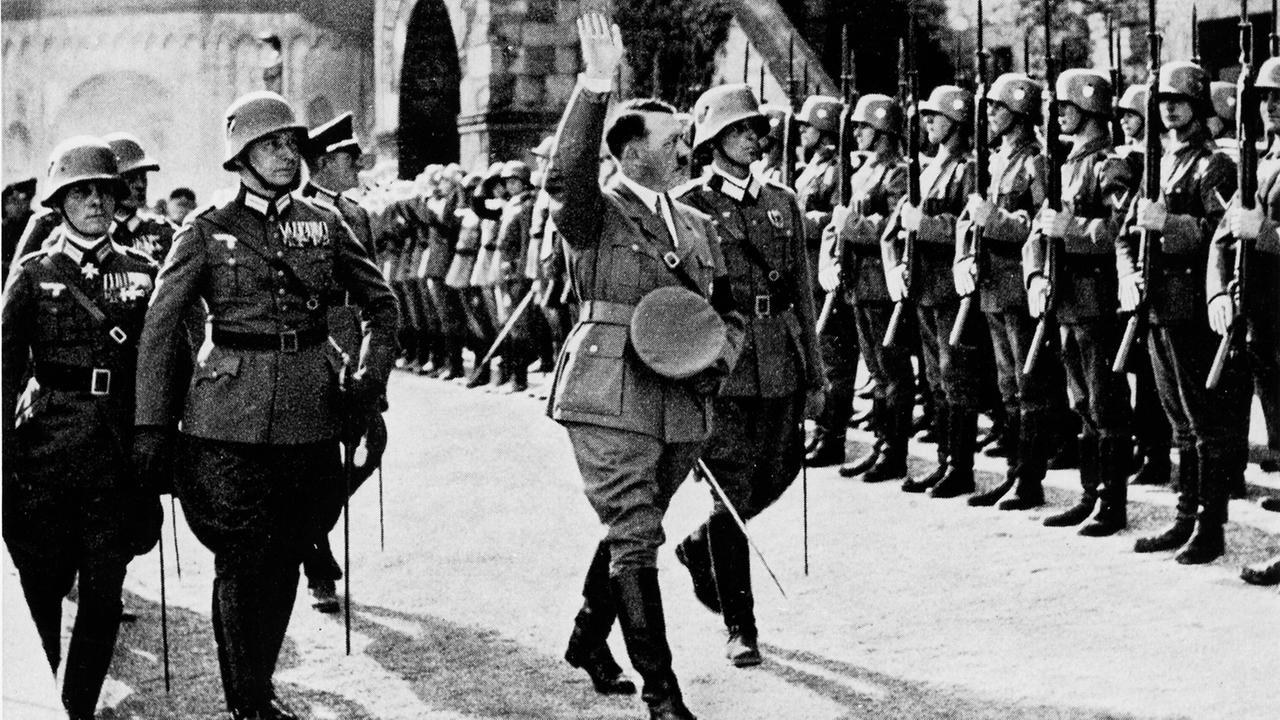
Wie Hitler vom Häftling zum Diktator aufstieg | tagesschau.de
Kurz vor Weihnachten 1924 kommt Adolf Hitler aus der Haft frei. In München baut er mithilfe reicher Gönner die NSDAP neu auf. Sein folgender Aufstieg ist für Experten ein fatales Beispiel dafür, wie Demokraten ihre Feinde unterschätzen. Von Rainer Volk.
tagesschau.de →Kurz vor Weihnachten 1924 kommt Adolf Hitler aus der Haft frei. In München baut er mithilfe reicher Gönner die NSDAP neu auf. Sein folgender Aufstieg ist für Experten ein fatales Beispiel dafür, wie Demokraten ihre Feinde unterschätzen. Am 22. Dezember 1924 darf Adolf Hitler die Gefängnisfestung Landsberg vorzeitig verlassen. Bayerns Behörden bescheinigen ihm nach dem Putschversuch vom 9. November 1923 in der Haft gute Führung. Sie müssten ihn als Österreicher eigentlich ausweisen; stattdessen darf er nach München zurück. Finanziell ist der Neustart gesichert. Er hat in Landsberg "Mein Kampf" geschrieben und einen Verlag gefunden: "Er hatte sich für den Eher-Verlag entschieden. Zum anderen hat er nach wie vor ein Netzwerk an Förderern und Unterstützern gehabt", sagt der Historiker Othmar Plöckinger, der die wissenschaftlich-kommentierte Ausgabe des Pamphlets miterarbeitet hat, im SWR . 80 Jahre nach dem versuchten Hitler-Attentat verblasst die Erinnerung an Stauffenberg und seine 200 Mitverschworenen. mehr Zu Hitlers Privatleben ab 1925 gibt es bis heute viele Legenden. Der "Tages-Schriftsteller", so die Eigenbezeichnung, verbringt Zeit in Cafés und seinem Stammlokal "Osteria Bavaria". Zudem führen ihn reiche Gönnerinnen wie Helene Bechstein, Gattin eines Klavierherstellers, und Elsa Bruckmann, Frau eines Verlegers, in Münchens gute Gesellschaft ein. Neben politischen Sympathien sieht der Hitler-Forscher Plöckinger Schutzinstinkte als Motiv: "Damit Hitler hier sich in einen gewissen Bereich zurückziehen kann, in dem er sich auch entspannen kann. Wo er auch Kultur genießen kann." Politisch ist die Situation dagegen mau. Bei der Haftentlassung hat Hitler sein Ehrenwort gegeben, gesetzestreu zu sein. Deshalb darf er die NSDAP neu gründen und öffentlich reden. Doch die ultrarechte und völkische Szene der 1920er-Jahre ist zerstritten; auch in seiner Partei toben Machtkämpfe. Berühmt sind Passagen in den Tagebüchern von Joseph Goebbels, in denen er von "verkalkten Bonzen in München" schreibt. Verschlossen in einem Tresor beim Magazin "Stern": Kaum jemand konnte die gefälschten Hitler-Tagebücher vollständig lesen. mehr Wenig bekannt ist, dass sich die Partei solide neu organisiert. Schatzmeister Franz Xaver Schwarz verlangt für Hitlers Saalauftritte Eintritt und kümmert sich um den Aufbau einer Geschäftsstelle. Diese arbeitet zunächst in einem Hinterhof nahe der Universität, doch schon 1933 kauft die Partei für ihre Reichsleitung ein Palais am Königsplatz - die Münchner nennen es wegen der Uniformfarben der Nazis "Braunes Haus". Für derlei Projekte geben Sponsoren aus der Wirtschaft Geld. "Fritz Thyssen war hier nicht ganz untätig", weiß der Historiker Plöckinger und fügt hinzu, derlei Finanzspritzen seien nicht lebensnotwendig für die NSDAP gewesen: "Der Kern der Einnahmen war diese Förderung sicherlich nicht." Aktuelle Nachrichten aus der Welt der Wissenschaft. Neue Studien und Hintergründe zu den Themen Klima, Gesundheit, Technik und Forschung. mehr München ist auch Schauplatz großer Auftritte Hitlers. Berühmt sind seine Reden vor Tausenden Anhängern im "Circus Krone". Der Münchner Rechtsanwalt Otto Gritschneder, der als 18-jähriger Gymnasiast im Herbst 1932 eine der Kundgebungen miterlebt, erinnerte sich in Zeitzeugen-Interviews später an die aufgeheizte Stimmung: "Der Hitler hat also den wahnsinnigsten Unsinn auf unflätigste Weise erzählt in einer so emotional überbetonten Weise, dass man sagen kann: Damit kann man ja keine Politik machen - das war mir schon klar." Durch die Weltwirtschaftskrise, die Millionen Menschen in Deutschland in Not stürzt, kann die NSDAP bei Wahlen Erfolge erzielen. 1932 gelingt zudem die Lösung eines anderen Problems: Hitler hat seine Staatsbürgerschaft in Österreich 1925 freiwillig abgegeben. Als Staatenloser kann er weder für ein politisches Amt kandidieren noch selbst wählen. Nun ernennt ihn Braunschweig, wo die NSDAP mitregiert, zum Regierungsrat, und als Beamter wird er automatisch deu
Excerpt from a page describing this subject · 9,800 chars · not written by Vinony
Wikidata facts
- Instance of
- human
- Given name
- Adolf
- Family name
- Hitler
- Gender
- male
- Citizenship
- Nazi Germany
- Place of birth
- Braunau am Inn
- Place of death
- Berlin
- Spouse
- Eva Braun
- Father
- Alois Hitler
- Mother
- Klara Hitler
- Sibling
- Angela Hitler
- Educated at
- Bundesrealgymnasium Linz Fadingerstraße
- Political party
- Nazi Party
- Languages spoken
- German
- Native language
- German
- Religion
- Catholicism
- Notable work
- Mein Kampf
- Participant in
- Munich agreement
- Family
- Hitler Family
- Field of work
- Führerprinzip
- Eye colour
- blue
- Hair colour
- brown hair
- Mass
- 72
- Conflict
- Beer Hall Putsch
Show 46 more facts
- Military branch
- Reichswehr
- Military rank
- Gefreiter
- Image
- Adolf Hitler cropped restored 3x4.jpg
- Height
- 175
- Number of children
- 0
- Work location
- Wolf's Lair
- Residence
- Kransberg Castle
- Convicted of
- high treason
- Significant event
- World War II
- Political ideology
- laconophilia
- start of work period
- 1914-00-00
- writing language
- German
- lifestyle
- vegetarianism
- Commons category
- Adolf Hitler
- topic's main category
- Category:Adolf Hitler
- date of birth
- 1889-01-01
- date of death
- 1945-04-30
- allegiance
- Nazi Germany
- Commons gallery
- Adolf Hitler
- medical condition
- syphilis
- manner of death
- Suicide
- unmarried partner
- Geli Raubal
- different from
- Adolf Hitler Uunona
- date of baptism
- 1889-04-22
- name in native language
- Adolf Hitler
- Commons Creator page
- Adolf Hitler
- place of detention
- Munich Prison
- nominated for
- Nobel Peace Prize
- commander of (DEPRECATED)
- Wehrmacht
- influenced by
- Friedrich Nietzsche
- has effect
- World War II
- has pet
- Blondi
- end of work period
- 1945-04-30
- significant person
- Eva Braun
- facial hair
- toothbrush moustache
- depicted by
- Time
- has works in the collection
- Anne Frank House
- related category
- Category:Personal staff of Adolf Hitler
- topic has template
- Template:Adolf Hitler
- interested in
- art collection
- partner in business or sport
- Joseph Stalin
- described at URL
- www.tagesschau.de/wissen/forschung/hitler-aufstieg-100.html
- candidacy in election
- March 1933 German federal election
- vehicle normally used
- Mercedes-Benz 770
- nickname
- Wolf
Sources (15)
via Wikidata · CC0
~40 min read
Encyclopedic overview
Adolf Hitler (20 April 1889 – 30 April 1945) was an Austrian-born German politician who was the dictator of Germany during the Nazi era from 1933 until his suicide in 1945. He rose to power as the leader of the Nazi Party, becoming the chancellor of Germany in 1933 and then taking the title of Führer und Reichskanzler in 1934. Germany's invasion of Poland on 1 September 1939 under his leadership marked the outbreak of the Second World War. Throughout the ensuing conflict, Hitler was closely involved in the direction of German military operations and was central to the perpetration of the genocide of about six million Jews in the Holocaust as well as the murders of millions of other victims.
Hitler was born in Braunau am Inn in Austria-Hungary and moved to Germany in 1913. He was decorated during his service in the German Army in the First World War, receiving the Iron Cross. In 1919, he joined the German Workers' Party (DAP), the precursor of the Nazi Party, and in 1921, was appointed the leader of the Nazi Party. In 1923, he attempted to seize governmental power in a failed coup in Munich and was sentenced to five years in prison, serving just over a year. While there, he dictated the first volume of his autobiography and political manifesto Mein Kampf (lit. 'My Struggle'). After his early release in 1924, he gained popular support by attacking the Treaty of Versailles as well as promoting pan-Germanism, antisemitism, and anti-communism with charismatic oratory and Nazi propaganda. He frequently denounced communism as being part of an international Jewish conspiracy.
Excerpted from Wikipedia’s “Adolf Hitler” article, available under the CC BY-SA 4.0 licence.
Gallery (15)
Available in 247 languages
- Español
- Français
- Deutsch
- 中文
- 日本語
- Русский
- Português
- Italiano
- العربية
- हिन्दी
- Abkhazian
- abstract
- Afrikaans
- Albanian
- Albanian
- Amharic
- Angika
- Aragonese
Show 228 more
- Aramaic
- Armenian
- Assamese
- Asturian
- Awadhi
- azb
- Azerbaijani
- Bahasa Indonesia
- Balinese
- Bangla
- Banjar
- Bashkir
- Basque
- bat_smg
- Bavarian
- be_x_old
- Belarusian
- Betawi
- Bhojpuri
- Bikol
- Bosnian
- Breton
- btm
- Bulgarian
- Buriat
- Burmese
- Catalan
- cdo
- Cebuano
- Central Kurdish
- Chechen
- Chuvash
- Colognian
- Cornish
- Corsican
- Crimean Tatar
- Croatian
- Czech
- Danish
- Dinka
- Divehi
- Egyptian Arabic
- eml
- Esperanto
- Estonian
- Extremaduran
- Faroese
- Fiji Hindi
- Filipino
- Finnish
- fiu_vro
- Friulian
- Fula
- Galician
- Gan Chinese
- Ganda
- gcr
- Georgian
- Gilaki
- Goan Konkani
- Greek
- Guarani
- Gujarati
- guw
- Haitian Creole
- Hakka Chinese
- Hausa
- Hawaiian
- Hebrew
- Hungarian
- hyw
- Iban
- Icelandic
- Ido
- Igbo
- Iloko
- Interlingua
- Interlingue
- Inuktitut
- Irish
- Jamaican Creole English
- Javanese
- Kabardian
- Kabyle
- Kannada
- Kanuri
- Kara-Kalpak
- Kashmiri
- Kashubian
- Kazakh
- kbp
- Khmer
- Kinyarwanda
- Kurdish
- Kyrgyz
- Ladino
- Lao
- Latgalian
- Latin
- Latvian
- Lezghian
- Limburgish
- Lingua Franca Nova
- Lithuanian
- lld
- Lojban
- Lombard
- Low German
- Luxembourgish
- Macedonian
- Madurese
- Maithili
- Malagasy
- Malay
- Malayalam
- Maltese
- Manx
- Māori
- map_bms
- Marathi
- Mari
- Mazanderani
- Minangkabau
- Mingrelian
- Mirandese
- Moksha
- Mongolian
- Moroccan Arabic
- N’Ko
- Navajo
- nds_nl
- Neapolitan
- Nederlands
- Nepali
- Newari
- Northern Frisian
- Northern Sami
- Norwegian
- Norwegian Nynorsk
- Novial
- Nyanja
- Occitan
- Old English
- olo
- Oromo
- Ossetic
- Pangasinan
- Papiamento
- Pashto
- Picard
- Piedmontese
- Polski
- Punjabi
- Quechua
- rki
- roa_rup
- roa_tara
- Romanian
- Romansh
- Romany
- Rusyn
- Sanskrit
- Santali
- Sardinian
- Saterland Frisian
- Scots
- Scottish Gaelic
- Serbian
- Serbian (Latin)
- Shona
- Sicilian
- Silesian
- simple
- Sindhi
- Sinhala
- skr
- Slovak
- Slovenian
- Somali
- Southern Sotho
- Sranan Tongo
- Standard Moroccan Tamazight
- Sundanese
- Svenska
- Swahili
- szy
- Tajik
- Talysh
- Tamil
- Tatar
- Telugu
- Tibetan
- Tiếng Việt
- Tigrinya
- Toki Pona
- Tongan
- Tumbuka
- Türkçe
- Tuvinian
- Udmurt
- Ukrainian
- Upper Sorbian
- Urdu
- Uyghur
- Uzbek
- Venetian
- Veps
- Volapük
- Walloon
- Waray
- Welsh
- West Flemish
- Western Frisian
- Western Panjabi
- Wu Chinese
- Yakut
- Yiddish
- Yoruba
- Zaza
- Zeelandic
- zh_classical
- zh_min_nan
- zh_yue
- Zhuang
- Zulu
- فارسی
- ไทย
- 한국어
via Wikidata sitelinks · CC0