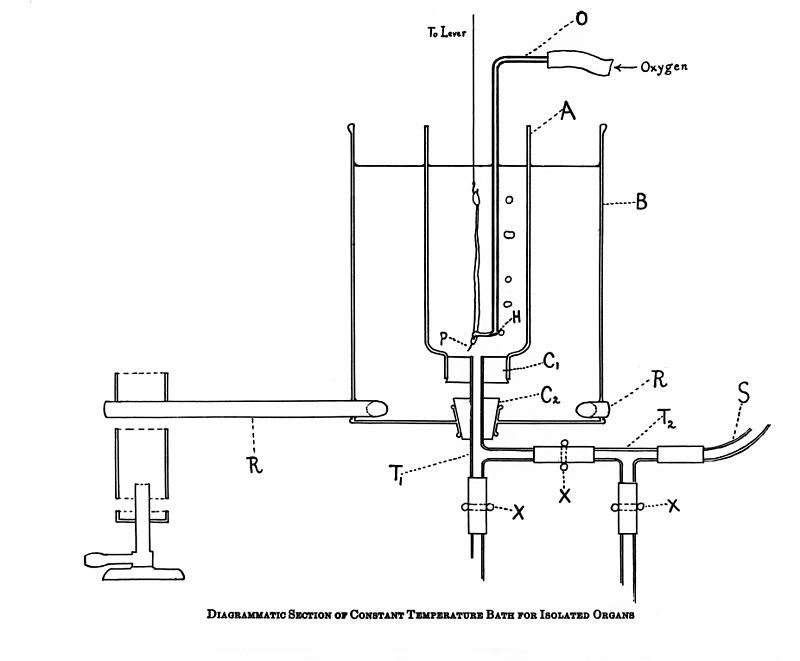
File:Constant_tempertature_bath_for_isolated_organs_Wellcome_M0013241.jpg · Wikimedia Commons · See Wikimedia Commons
pharmacology
Sign in to saveAlso known as therapeutics
Pharmacology is the science of drugs and medications, including a substance's origin, composition and interaction with biological systems; specifically through pharmacokinetics, pharmacodynamics, therapeutic use, and toxicology. The discipline examines these interactions through pharmacokinetics (what the body does to the drug) and pharmacodynamics (what the drug does to the body), both of which determine how a substance alters normal or abnormal biochemical function. Substances with medicinal properties are classified as pharmaceuticals, while the term drug encompasses any chemical agent that
Pharmacology is the science that studies drugs and medications—where they come from, what they're made of, and how they interact with the body through processes like absorption and effects on cells and tissues. It matters because understanding these interactions helps determine how substances can treat diseases, work as intended, and avoid causing harm.
AI-generated from the Wikipedia summary — may contain errors.
Research
6,836,078 papers- Utilizing clinical pharmacology in the drug repurposing arena: a look into COVID-19.ReviewExpert review of clinical pharmacology · 2022Ruggiero R, Balzano N, Di Napoli R et al.DOI: 10.1080/17512433.2022.2132226
- Essential pharmacology.ReviewAnnual review of pharmacology · 1969Burn JHDOI: 10.1146/annurev.pa.09.040169.000245
- Developmental pharmacology.ReviewAnnual review of pharmacology · 1970Mirkin BLDOI: 10.1146/annurev.pa.10.040170.001351
- Clinical pharmacology strategies in supporting drug development and approval of antibody-drug conjugates in oncology.ReviewCancer chemotherapy and pharmacology · 2021Liu SN, Li CDOI: 10.1007/s00280-021-04250-0
- Pharmacology of oral chemotherapy agents.ReviewClinical journal of oncology nursing · 2003Birner ADOI: 10.1188/03.CJON.S6.11-19
- TCM network pharmacology: A new trend towards combining computational, experimental and clinical approaches.ReviewChinese journal of natural medicines · 2021Wang X, Wang ZY, Zheng JH et al.DOI: 10.1016/S1875-5364(21)60001-8
- Pharmacology and toxicology of ophthalmic drugs.ReviewArchives of ophthalmology (Chicago, Ill. : 1960) · 1969Macri FJDOI: 10.1001/archopht.1969.00990020699022
- Development of bispecific T cell engagers: harnessing quantitative systems pharmacology.ReviewTrends in pharmacological sciences · 2023Qi T, Liao X, Cao YDOI: 10.1016/j.tips.2023.09.009
via PubMed
Wikidata facts
- Subclass of
- biology
- Image
- Pharmacologyprism.jpg
Show 8 more facts
- OpenStreetMap tag
- healthcare:speciality=pharmacology
- on focus list of Wikimedia project
- Wikipedia:Vital articles/Level/4
- is the study of
- effect
- Commons category
- Pharmacology
- topic's main category
- Category:Pharmacology
- practiced by
- pharmacologist
- topic has template
- Template:Pharmacology
- model item
- pharmacokinetics
via Wikidata · CC0
~28 min read
Encyclopedic overview
25 sectionsContents
- Etymology
- History
- Divisions
- Systems of the body
- <span class="anchor" id="Posology"></span>Clinical practice and drug discovery
- Drug discovery
- Wider contexts
- Emerging fields
- Theory of pharmacology
- Pharmacokinetics
- Key physiological parameters in pharmacokinetics include
- Pharmacodynamics
- Systems, receptors and ligands
- Pharmacodynamics
- Pharmacokinetics
- Gene expression modulation and epigenetics
- Administration, drug policy and safety
- Drug policy
- Societies and education
- Societies and administration
- Education
- See also
- References
- External links
- Further reading
Pharmacology is the science of drugs and medications, including a substance's origin, composition and interaction with biological systems; specifically through pharmacokinetics, pharmacodynamics, therapeutic use, and toxicology. The discipline examines these interactions through pharmacokinetics (what the body does to the drug) and pharmacodynamics (what the drug does to the body), both of which determine how a substance alters normal or abnormal biochemical function. Substances with medicinal properties are classified as pharmaceuticals, while the term drug encompasses any chemical agent that alters biological processes.
The field encompasses drug composition and properties, functions, sources, medicinal chemistry, drug design, molecular and cellular mechanisms, organ/systems mechanisms, signal transduction/cellular communication, molecular diagnostics, interactions, chemical biology, therapy, medical applications, toxicology, and antipathogenic capabilities. The two main areas of pharmacology are pharmacodynamics and pharmacokinetics. Pharmacodynamics studies the effects of a drug on biological systems, and pharmacokinetics studies the effects of biological systems on a drug. In broad terms, pharmacodynamics discusses the chemicals with biological receptors, and pharmacokinetics discusses the liberation, absorption, distribution, metabolism, and excretion (LADME) of chemicals from the biological systems.
Excerpted from Wikipedia’s “pharmacology” article, available under the CC BY-SA 4.0 licence.
Gallery (19)
Available in 92 languages
- Español
- Français
- Deutsch
- 中文
- 日本語
- Русский
- Português
- Italiano
- العربية
- हिन्दी
- Albanian
- Armenian
- Asturian
- azb
- Azerbaijani
- Bahasa Indonesia
- Bangla
- Bashkir
Show 73 more
- Basque
- be_x_old
- Belarusian
- Bosnian
- Bulgarian
- Burmese
- Catalan
- Central Kurdish
- Croatian
- Czech
- Danish
- Egyptian Arabic
- Esperanto
- Estonian
- Filipino
- Finnish
- Galician
- Georgian
- Greek
- Hausa
- Hebrew
- Hungarian
- Icelandic
- Ido
- Interlingua
- Irish
- Javanese
- Kannada
- Kazakh
- Kurdish
- Kyrgyz
- Lao
- Latin
- Latvian
- Lithuanian
- Lombard
- Macedonian
- Malay
- Malayalam
- Minangkabau
- Mingrelian
- Nederlands
- Norwegian
- Norwegian Nynorsk
- Occitan
- Pashto
- Polski
- Romanian
- Scots
- Serbian
- Serbian (Latin)
- simple
- Sinhala
- Slovak
- Slovenian
- Sundanese
- Svenska
- Tajik
- Tamil
- Tatar
- Tiếng Việt
- Türkçe
- Ukrainian
- Urdu
- Uzbek
- Waray
- Welsh
- Wu Chinese
- zh_min_nan
- zh_yue
- فارسی
- ไทย
- 한국어
via Wikidata sitelinks · CC0