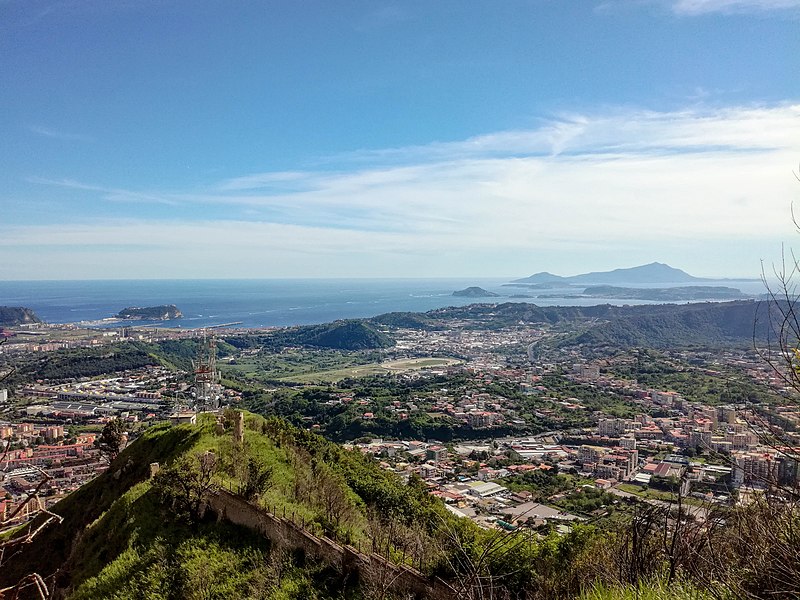
File:VedutaEremo2.jpg · Wikimedia Commons · See Wikimedia Commons
Phlegraean Fields
Sign in to saveAlso known as Campi Flegrei
volcanic region located in the Gulf of Pozzoles, west of Naples, Italy
The Phlegraean Fields is a volcanic region located west of Naples, Italy, in the Gulf of Pozzoles, where the ground is dotted with volcanic craters and thermal features shaped by ancient eruptions. This area matters because it remains geologically active and poses potential risks to the nearby population while also offering insights into volcanic processes.
AI-generated from the Wikipedia summary — may contain errors.
Wikidata facts
- Instance of
- volcanic field
- Part of
- Campanian volcanic arc
- Country
- Italy
- Located in
- Metropolitan City of Naples
- Continent
- Europe
- Elevation
- 458
- Highest point
- Solfatara
- Diameter
- 13
- Image
- Pozzuoli NASA ISS004-E-5376 added names.jpg
Show 3 more facts
- topic's main category
- Category:Phlegraean Fields
- Commons category
- Campi Flegrei
- volcano observatory
- Vesuvius Observatory
Sources (6)
via Wikidata · CC0
~18 min read
Encyclopedic overview
A 1911 map of the Phlegraean Fields A topographic relief map of the Phlegraean Fields A topographic relief map of the Gulf of Naples with the Phlegraean Fields and Mount Vesuvius A satellite photo of the Phlegraean Fields
The Phlegraean Fields (Italian: Campi Flegrei, Italian: [ˈkampi fleˈɡrɛi]; Neapolitan: Campe Flegree; Latin: Phlegraei campicode: lat promoted to code: la ; Ancient Greek: Φλεγραία Πεδία) is a large volcanic caldera west of Naples, Italy. The Neapolitan Yellow Tuff eruption (about 12ka BP) produced just 50 cubic kilometers. It is, however, one of relatively few volcanoes large enough to form a caldera. It is part of the Campanian volcanic arc, which includes Mount Vesuvius, about 9 km (6 miles) east of Naples. The Phlegraean Fields is monitored by the Vesuvius Observatory. Part of the city of Naples is built over it. The Phlegraean Fields' largest known eruptions have an estimated volcanic explosivity index (VEI) of 7. It is often called a supervolcano in popular media, although the accepted definition for that term is a volcano that has had an eruption with a VEI of 8, the highest level.
Excerpted from Wikipedia’s “Phlegraean Fields” article, available under the CC BY-SA 4.0 licence.
Gallery (11)
On the map
Available in 69 languages
- Español
- Français
- Deutsch
- 中文
- 日本語
- Русский
- Português
- Italiano
- العربية
- हिन्दी
- Aragonese
- Bahasa Indonesia
- Basque
- Breton
- Catalan
- Cebuano
- Chechen
- Chuvash
Show 50 more
- Czech
- Danish
- Egyptian Arabic
- Esperanto
- Filipino
- Finnish
- gpe
- Greek
- Hausa
- Hebrew
- Hungarian
- Inari Sami
- Kashmiri
- Kazakh
- Kyrgyz
- Lao
- Latin
- lld
- Lombard
- Macedonian
- Malay
- Manx
- Marathi
- Mingrelian
- Moroccan Arabic
- Neapolitan
- Nederlands
- Northern Frisian
- Norwegian
- Norwegian Nynorsk
- Occitan
- Piedmontese
- Polski
- Punjabi
- Romanian
- Serbian
- Serbian (Latin)
- simple
- Slovak
- Slovenian
- Svenska
- Tiếng Việt
- Ukrainian
- Welsh
- Western Frisian
- Wu Chinese
- zh_yue
- فارسی
- ไทย
- 한국어
via Wikidata sitelinks · CC0