Encyclopedia of Life · EOL (see source)
Pholadidae
Sign in to saveAlso known as piddock, angelwing
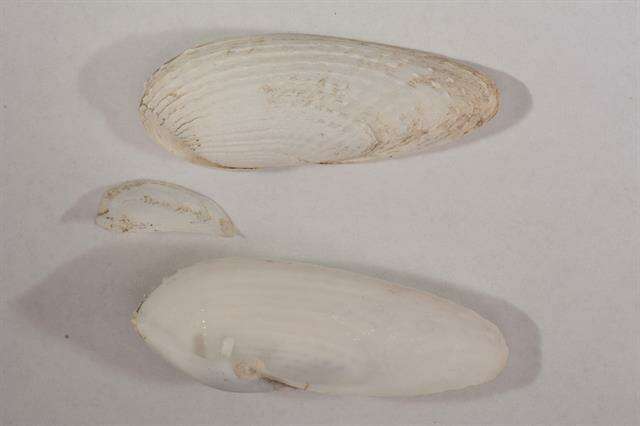
Pholadidae, known as piddocks or angelwings, are a family of bivalve molluscs similar to a clam.
Species
piddocks
FAMILY
- KingdomAnimalia
- PhylumMollusca
- ClassBivalvia
- OrderMyida
- FamilyPholadidae
鷗蛤科(學名:Pholadidae),或作海鷗蛤科[1]:245,其物種俗稱作穿石貝,是雙殼綱海螂目之下的一個軟體動物的科,外型跟蛤蜊有點相像。 目录 1 型態描述 2 分類 2.1 圖庫 3 參考文獻 4 外部連結 型態描述 殻薄、長型,態鑽黏土、木材或岩石[1]:245。兩殻上均有被稱為「骨突」的指狀突起物[1]:245。 分類 Two views of a whole shell of Barnea candida 盾海笋属 Aspidopholas P. Fischer, 1887[2] 全海笋属 Barnea Risso, 1826 Genus Chaceia Turner, 1855 Chaceia ovoidea (Gould, 1851) Genus Cyrtopleura Tryon, 1862 天使之翼海鷗蛤 Cyrtopleura costata (Linnaeus, 1758)[1]:245 Genus Diplothyra Tryon, 1862 Diplothyra smithii Tryon, 1862 铃蛤属 Jouannetia Desmoulins, 1828 雁蛤属 Martesia G. B. Sowerby I, 1824[3][4]:又名馬特海筍屬 Genus Netastoma Carpenter, 1864 Netastoma japonicum (Yokoyama, 1920) Netastoma rostratum (Valenciennes, 1846) Genus Nettastomella Carpenter, 1865 Nettastomella darwini (Sowerby, 1849) 沙鷗蛤屬 Parapholas Conrad, 1848 Parapholas californica (Conrad, 1837) 棒海筍屬 Penitella Valenciennes, 1846 Penitella conradi Valenciennes, 1846 Penitella fitchi Turner, 1955 Penitella gabbii (Tryon, 1863) Penitella hopkinsi Kennedy and Armentrout, 1989 Penitella kamakurensis (Yokoyama, 1922) Penitella penita (Conrad, 1837) Penitella richardsoni Kennedy, 1989 Penitella turnerae Evans and Fisher, 1966 Genus Pholadidea Turton, 1819 Pholadidea acherontea Beu and Clim
via GBIF
Museum specimens
- Specimen records
- 500
- With media
- 34
- Family
- Pholadidae
- Collections
- LACM
- Recorded in
- United States
Wikidata facts
- Instance of
- taxon
- Parent taxon
- Pholadoidea
- Image
- Pholadidae - Pholas dactylus.JPG
Show 5 more facts
- taxon rank
- family
- Commons category
- Pholadidae
- taxon name
- Pholadidae
- topic's main category
- Category:Pholadidae
- taxon common name
- Bohrmuscheln
Sources (1)
via Wikidata · CC0
~5 min read
Encyclopedic overview
6 sectionsContents
- Background
- Genera and selected species
- Gallery
- See also
- References
- External links
Pholadidae, known as piddocks or angelwings, are a family of bivalve molluscs similar to a clam.
==Background== Piddocks are unique in that each side of their shells is divided into 2 or 3 separate sections. Furthermore, one of the piddock's shells has a set of ridges or "teeth", which they use to grind away at clay or soft rock and create tubular burrows. The shape of these burrows is due to the rotating motion of the piddock as it grinds the rock to make its home. The piddock stays in the burrow it digs for the entirety of its eight-year lifespan, with only its siphon exposed to take in water that it filters for food. When the piddock dies and leaves an empty tubular burrow, other marine life such as sea anemone, crabs and other molluscs may use the burrow.
Excerpted from Wikipedia’s “Pholadidae” article, available under the CC BY-SA 4.0 licence.