File:Nur03506.jpg · Wikimedia Commons · See Wikimedia Commons
Phoronida
Sign in to saveAlso known as horseshoe worms
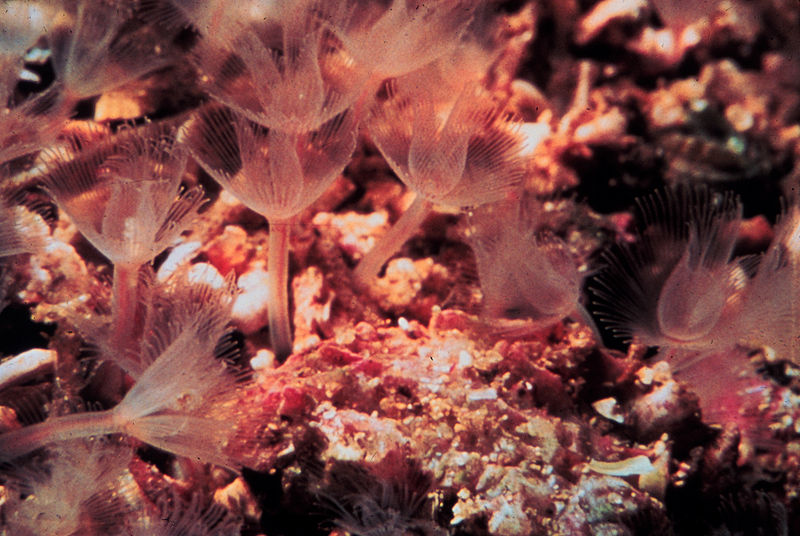
Phoronids (taxonomic name Phoronida, sometimes called horseshoe worms) are a small phylum of marine animals that filter-feed with a lophophore (a "crown" of tentacles), and build upright tubes of chitin to support and protect their soft bodies. They live in most of the oceans and seas, including the Arctic Ocean but excluding the Antarctic Ocean, and between the intertidal zone and about 400 meters down. Most adult phoronids are 2 cm long and about 1.5 mm wide, although the largest are 50 cm long.
Phoronids, also called horseshoe worms, are small marine animals that live inside chitin tubes on the ocean floor and use a crown of tentacles to filter food from the water. Though tiny and less well-known than many other ocean creatures, they are found in oceans and seas worldwide (except Antarctica) and play a role in their seafloor ecosystems.
AI-generated from the Wikipedia summary — may contain errors.
Species
horseshoe worms
Phoronida
PHYLUM
- KingdomAnimalia
- PhylumPhoronida
帚虫动物门(學名:Phoronida)是动物界的一个小门,當中的動物為濾食性,以由幾丁質組成的小管支撐。目前仅存2个属,10几个种,全部都是海洋底栖动物,能在南冰洋外的各大洋中約四百米深的海牀上找到,且大多體長只有約兩釐米。 成年帚蟲解剖圖
via GBIF
Museum specimens
- Specimen records
- 843
- With media
- 459
- Collections
- CAS, OCPC, USNM, UAM
- Recorded in
- United States, Canada
Wikidata facts
- Instance of
- taxon
- Subclass of
- invertebrate
- Parent taxon
- Spiralia
- Image
- Nur03506.jpg
Show 6 more facts
- Commons category
- Phoronida
- taxon rank
- phylum
- taxon name
- Phoronida
- topic's main category
- Category:Phoronids
- taxon common name
- hesteskoormer
- described by source
- Encyclopædia Britannica 11th edition
Sources (3)
via Wikidata · CC0
~25 min read
Encyclopedic overview
15 sectionsContents
- Overview
- Comparison of similar phyla
- Description
- Body structure
- Feeding, circulation and excretion
- Nervous system and movement
- Reproduction and lifecycle
- Ecology
- Evolutionary history
- Fossil record
- Family tree
- Taxonomy
- Notes
- References
- External links
Phoronids (taxonomic name Phoronida, sometimes called horseshoe worms) are a small phylum of marine animals that filter-feed with a lophophore (a "crown" of tentacles), and build upright tubes of chitin to support and protect their soft bodies. They live in most of the oceans and seas, including the Arctic Ocean but excluding the Antarctic Ocean, and between the intertidal zone and about 400 meters down. Most adult phoronids are 2 cm long and about 1.5 mm wide, although the largest are 50 cm long.
The name of the group comes from its type genus: Phoronis.
Excerpted from Wikipedia’s “Phoronida” article, available under the CC BY-SA 4.0 licence.