File:Phrase_2.jpg · Wikimedia Commons · See Wikimedia Commons
phrase
Sign in to saveAlso known as phrases, expression
In grammar, a phrase called an expression in some contexts is a group of one or more words acting as a grammatical unit. This means that a phrase can be treated as a unit within a larger structure. For instance, the English sentence "the squirrel is very happy" is a clause phrase which contains the noun phrase "the squirrel" and the verb phrase "is very happy". Additionally, "very happy" is an adjective phrase. Phrases can consist of a single word or a complete sentence. In theoretical linguistics, phrases are often analyzed as units of syntactic structure such as a constituent. There is a dif
A phrase is a group of words that functions together as a single grammatical unit, like "the squirrel" or "is very happy" in a sentence. Understanding phrases matters because they help explain how language is organized and structured—breaking sentences into smaller building blocks that linguists and grammarians can analyze.
AI-generated from the Wikipedia summary — may contain errors.
Research
11,934 papers- Against the Phrase "Aggressive Care".Cambridge quarterly of healthcare ethics : CQ : the international journal of healthcare ethics committees · 2025Bibler TMDOI: 10.1017/S096318012400077X
- Efficient phrase search with reliable verification over encrypted cloud-IoT data.PeerJ. Computer science · 2024Xu W, Zhu Z, Khalid MIDOI: 10.7717/peerj-cs.2235
- Minimal Phrase Composition Revealed by Intracranial Recordings.The Journal of neuroscience : the official journal of the Society for Neuroscience · 2022Murphy E, Woolnough O, Rollo PS et al.DOI: 10.1523/JNEUROSCI.1575-21.2022
- Examining the Transition from Single Words to Phrase Speech in Children with ASD: A Systematic Review.Clinical child and family psychology review · 2024Byrne K, Sterrett K, Lord CDOI: 10.1007/s10567-024-00507-1
- English Phrase Learning With Multimodal Input.Frontiers in psychology · 2022Huang Y, Zhang Z, Yu J et al.DOI: 10.3389/fpsyg.2022.828022
- Structural and sequential regularities modulate phrase-rate neural tracking.Scientific reports · 2024Zhao J, Martin AE, Coopmans CWDOI: 10.1038/s41598-024-67153-z
- A Clinical Phrase Book; in English and German, Containing the Usual Questions and Answers Employed in Examining and Prescribing for Patients; Questions in Asking for and Buying Medicines, Etc.: With an English-German and German-English Pronouncing Lexicon, of All the Words Occurring in the Phrases, with the Chief Technical Terms of Medical Writers and Apothecaries; Grammatical Appendix, Table of Idioms, &c., Designed to Aid Physicians and Surgeons in Hospitals, Alms House and Private Practice; Also Druggists and Pharmaceutists, in Dispensing Their Prescriptions.ReviewWestern journal of medicine and surgery · 1853
- Development of a Phrase-Based Speech-Recognition Test Using Synthetic Speech.Trends in hearing · 2024Ibelings S, Brand T, Ruigendijk E et al.DOI: 10.1177/23312165241261490
via PubMed
Wikidata facts
Show 4 more facts
- topic's main category
- Category:Phrases
- Commons category
- Phrases
- different from
- syntagma
- P13411
- Adriaan Paulen
Sources (7)
via Wikidata · CC0
~8 min read
Encyclopedic overview
7 sectionsContents
- Phrase trees
- Heads and dependents
- Functional categories
- Variation among theories of syntax
- See also
- Notes
- References
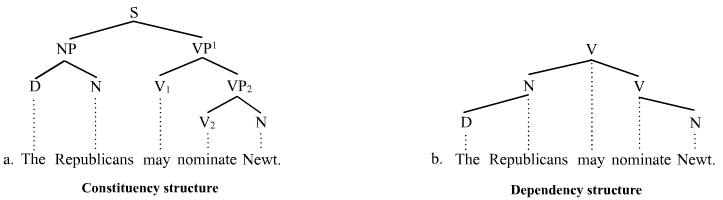
In grammar, a phrase called an expression in some contexts is a group of one or more words acting as a grammatical unit. This means that a phrase can be treated as a unit within a larger structure. For instance, the English sentence "the squirrel is very happy" is a clause phrase which contains the noun phrase "the squirrel" and the verb phrase "is very happy". Additionally, "very happy" is an adjective phrase. Phrases can consist of a single word or a complete sentence. In theoretical linguistics, phrases are often analyzed as units of syntactic structure such as a constituent. There is a difference between the common use of the term phrase and its technical use in linguistics. In common usage, a phrase is usually a group of words with some special idiomatic meaning or other significance, such as "all rights reserved", "economical with the truth", or "kick the bucket". It may be a euphemism, a saying or proverb, a fixed expression, a figure of speech, etc. In linguistics, these are known as phrasemes.
In theories of syntax, a phrase is any group of words, or sometimes a single word, which plays a particular role within the syntactic structure of a sentence. It does not have to have any special meaning or significance, or even exist anywhere outside of the sentence being analyzed, but it must function there as a complete grammatical unit. For example, in the sentence Yesterday I saw an orange bird with a white neck, the words an orange bird with a white neck form a noun phrase, or a determiner phrase in some theories, which functions as the object of the sentence.
Excerpted from Wikipedia’s “phrase” article, available under the CC BY-SA 4.0 licence.
Gallery (6)
Available in 61 languages
- Français
- Deutsch
- 中文
- 日本語
- Русский
- Português
- العربية
- Afrikaans
- Albanian
- Amharic
- Azerbaijani
- Bahasa Indonesia
- Bashkir
- Bhojpuri
- Bosnian
- Breton
- Central Kurdish
- Chechen
Show 42 more
- Czech
- Estonian
- Filipino
- Finnish
- Hebrew
- Icelandic
- Ido
- Inari Sami
- Javanese
- Kannada
- Kazakh
- Kyrgyz
- Lao
- Limburgish
- Lingua Franca Nova
- Lithuanian
- Malay
- Mari
- Nederlands
- Newari
- Norwegian
- Polski
- Punjabi
- Scots
- Serbian
- simple
- Sundanese
- Svenska
- Swahili
- Tatar
- Tiếng Việt
- Tigrinya
- Türkçe
- Ukrainian
- Urdu
- Yiddish
- zh_classical
- zh_min_nan
- zh_yue
- فارسی
- ไทย
- 한국어
via Wikidata sitelinks · CC0