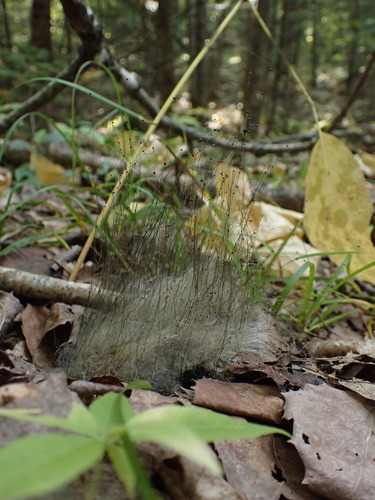
(c) Jan Thornhill, some rights reserved (CC BY-NC), uploaded by Jan Thornhill · cc-by-nc
Phycomyces
Sign in to savePhycomyces is a genus of fungus in the phylum Mucoromycota. They are known for their strong phototropism response and helical growth of the sporangium. The best studied species is Phycomyces blakesleeanus.
Species
GENUS
- KingdomFungi
- PhylumMucoromycota
- ClassMucoromycetes
- OrderMucorales
- FamilyPhycomycetaceae
via GBIF
Museum specimens
- Specimen records
- 19
- With media
- 3
- Family
- Phycomycetaceae
- Collections
- FLAS, TENN-F, BPI, CUP, WSP, UFPE
- Recorded in
- United States, Bermuda, Brasil, Sweden
Research
651 papers- Phycomyces and the biology of light and color.FEMS microbiology reviews · 2001
- Light reception of Phycomyces revisited: several white collar proteins confer blue- and red-light sensitivity and control dynamic range and adaptation.Photochemical & photobiological sciences : Official journal of the European Photochemistry Association and the European Society for Photobiology · 2024
- The sporangiophore of Phycomyces blakesleeanus: a tool to investigate fungal gravireception and graviresponses.Plant biology (Stuttgart, Germany) · 2014
- Sexual Crosses with the Mucoromycete Phycomyces blakesleeanus.Journal of visualized experiments : JoVE · 2025
- Behavioral genetics of Phycomyces.Annual review of microbiology · 1977
via PubMed
Wikidata facts
- Instance of
- taxon
- Parent taxon
- Phycomycetaceae
- Image
- Phycomyces.JPG
Show 4 more facts
- taxon name
- Phycomyces
- taxon rank
- genus
- Commons gallery
- Phycomyces
- Commons category
- Phycomyces
Sources (2)
via Wikidata · CC0
~2 min read
Encyclopedic overview
4 sectionsContents
- Asexual reproduction
- Sexual reproduction
- References
- External links
Phycomyces is a genus of fungus in the phylum Mucoromycota. They are known for their strong phototropism response and helical growth of the sporangium. The best studied species is Phycomyces blakesleeanus.
==Asexual reproduction== Phycomyces can reproduce via extension of mycelia, or by production of spores either asexually or sexually. The asexual cycle includes the formation of spore containing sporangia borne on the top of sporangiophores that may extend 10 to 15 cm above the surface of the fungal colony from which they emerged. The long filamentous sporangiophores respond to divergent environmental signals including light, gravity, wind, chemicals, and adjacent objects. The sporangia contain vegetative spores with one to six haploid nuclei. When these spores are dispersed, they can establish new colonies.
Excerpted from Wikipedia’s “Phycomyces” article, available under the CC BY-SA 4.0 licence.