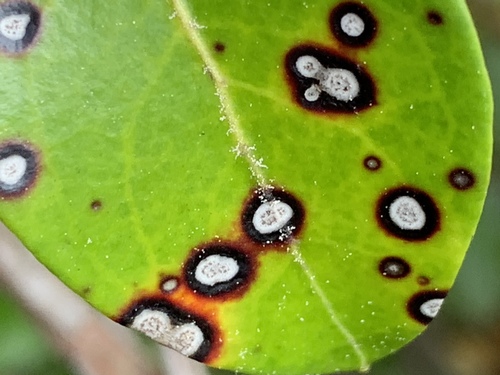
(c) Bill, some rights reserved (CC BY-NC), uploaded by Bill · cc-by-nc
Phyllosticta
Sign in to savePhyllosticta is a genus of fungi. Many of the species in this genus are common and important plant pathogens. They typically infect the foliage and cause tannish-gray leaf spots with dark brown to purple borders. However, Phyllosticta may also infect fruit and stems. Yield loss is a common consequence of Phyllosticta infection. Representatives of the genus are found worldwide and on a wide range of plant hosts.
Species
Mountain Laurel Leaf Spot
GENUS
- KingdomFungi
- PhylumAscomycota
- ClassDothideomycetes
- OrderBotryosphaeriales
- FamilyPhyllostictaceae
via GBIF
Museum specimens
- Specimen records
- 4,228
- With media
- 2,471
- Family
- Phyllostictaceae
- Collections
- F, ILLS
- Recorded in
- Germany, United States
Wikidata facts
- Instance of
- taxon
- Parent taxon
- Botryosphaeriaceae
- Image
- Phyllosticta polygonorum a1 (2).jpg
Show 5 more facts
- taxon name
- Phyllosticta
- taxon rank
- genus
- topic's main category
- Category:Phyllosticta
- Commons category
- Phyllosticta
- taxon author citation
- Pers.
Sources (2)
via Wikidata · CC0
~65 min read
Encyclopedic overview
4 sectionsContents
- History
- Species
- References
- External links
Phyllosticta is a genus of fungi. Many of the species in this genus are common and important plant pathogens. They typically infect the foliage and cause tannish-gray leaf spots with dark brown to purple borders. However, Phyllosticta may also infect fruit and stems. Yield loss is a common consequence of Phyllosticta infection. Representatives of the genus are found worldwide and on a wide range of plant hosts.
==History== Phyllosticta was introduced by German mycologist Persoon in 1818 and species Phyllosticta convallariae was designated as the type species (Donk 1968). Since Phyllosticta is distinct from other genera in that family, Seaver (1922) treated it in the family Phyllostictaceae of the order Phyllostictites. Nevertheless, Phyllosticta was accommodated in the family Botryosphaeriaceae (in order Botryosphaeriales C.L. Schoch et al.) in several major studies (e.g. Crous et al. 2006; Schoch et al. 2006; Liu et al. 2012). However, the phylogenetic analyses by Wikee et al. (2013a) allocated Phyllosticta in a clade sister to Botryosphaeriaceae. As a result, the genus was accepted in the family Phyllostictaceae, in the order Botryosphaeriales.
Excerpted from Wikipedia’s “Phyllosticta” article, available under the CC BY-SA 4.0 licence.