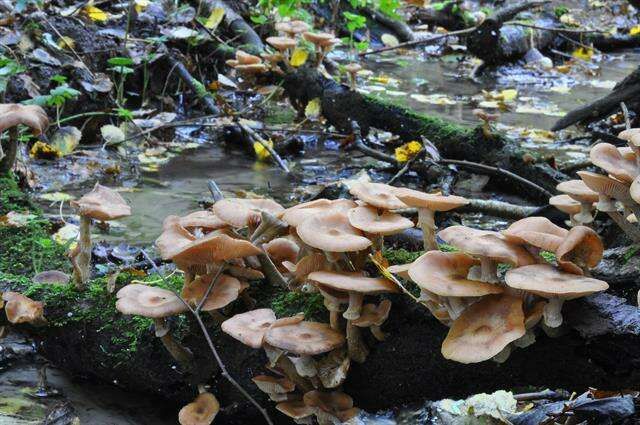
Encyclopedia of Life · EOL (see source)
Physalacriaceae
Sign in to saveThe Physalacriaceae are a family of fungi in the order Agaricales. Species in the family have a widespread distribution, ranging from the Arctic, (Rhizomarasmius), to the tropics, e.g. Gloiocephala, and from marine sites (Mycaureola) and fresh waters (Gloiocephala) to semiarid forests (Xerula).
Species
FAMILY
- KingdomFungi
- PhylumBasidiomycota
- ClassAgaricomycetes
- OrderAgaricales
- FamilyPhysalacriaceae
Научная классификация промежуточные ранги Домен: Эукариоты Царство: Грибы Подцарство: Высшие грибы Отдел: Базидиомицеты Подотдел: Agaricomycotina Класс: Агарикомицеты Подкласс: Агарикомицетовые Порядок: Агариковые Семейство: Физалакриевые Международное научное название Physalacriaceae Corner, 1970 Роды Armillaria Cylindrobasidium Cibaomyces Cryptomarasmius Cyptotrama Dactylosporina Flammulina Gloiocephala Guyanagaster Himantia Hormomitaria Hymenopellis Laccariopsis Mycaureola Naiadolina Oudemansiella Physalacria typus Ponticulomyces Protoxerula Rhizomarasmius Rhodotus Strobilurus Xerula Систематикана ВикивидахИзображенияна Викискладе ITIS 936533NCBI 862241EOL 5973MB 81165 Физалакриевые (лат. Physalacriaceae) — семейство грибов порядка Агариковые (Agaricales). Представители семейства произрастают на всех континентах, кроме Антарктиды, и во всех климатических зонах. Семейство представлено 23 родами. Содержание 1 Морфология 2 Систематика 3 Практическое значение 4 Примечания Морфология Плодовые тела большинства видов семейства шляпконожечные, гифальная система плодовых тел мономитическая, то есть состоит только из генеративных гиф — тонкостенных или со слабо утолщёнными стенками, содер
via GBIF
Museum specimens
- Specimen records
- 4
- Family
- Physalacriaceae
- Collections
- TENN-F, FLAS, INSTITUTO NACIONAL DE PESQUISAS DA AMAZÔNIA (INPA), ARIZ
- Recorded in
- United States, Brasil
Wikidata facts
- Instance of
- taxon
- Parent taxon
- Agaricales
- Image
- Wielangta Unidentified Fungus 5212.jpg
Show 5 more facts
- Commons category
- Physalacriaceae
- taxon rank
- family
- taxon name
- Physalacriaceae
- topic's main category
- Category:Physalacriaceae
- taxonomic type
- Physalacria
Sources (1)
via Wikidata · CC0
~2 min read
Encyclopedic overview
6 sectionsContents
- Description
- Taxonomy
- Genera
- See also
- References
- External links
The Physalacriaceae are a family of fungi in the order Agaricales. Species in the family have a widespread distribution, ranging from the Arctic, (Rhizomarasmius), to the tropics, e.g. Gloiocephala, and from marine sites (Mycaureola) and fresh waters (Gloiocephala) to semiarid forests (Xerula).
==Description== Most species in the Physalacriaceae form fruit bodies with caps and stipes. They have a monomitic hyphal system (wherein only generative hypha are produced), and clamp connections are present in the hyphae. Basidia (spore-bearing cells) are club-shaped with two to four sterigmata. The basidiospores generally have ellipsoidal, spindle-like (fusiform), cylindrical, or tear-drop (lacrimiform) shapes; they are thin-walled, hyaline, and do not react with Melzer's reagent. The family also contains corticioid fungi (in genus Cylindrobasidium) and a secotioid species (Guyanagaster necrorhiza).
Excerpted from Wikipedia’s “Physalacriaceae” article, available under the CC BY-SA 4.0 licence.