File:Quark_structure_pion.svg · Wikimedia Commons · See Wikimedia Commons
I don't see any context provided in your message. Could you please share the context material about pions that I should base my overview on?
AI-generated from the Wikipedia summary — may contain errors.
Key facts
- Particle.name
- Pion
- Particle.image
- Image:Quark structure pion.svg
- Particle.caption
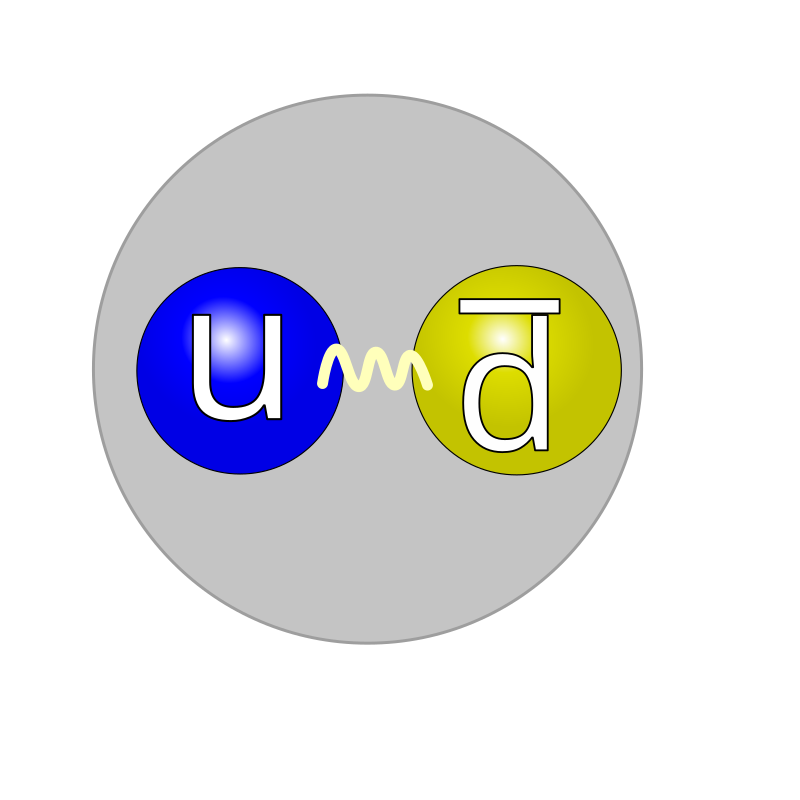
- The quark structure of the positively charged pion.
- Particle.num_types
- 3
- Particle.composition
- {{plainlist| : : \rm \tfrac{u\overline{u} - d\overline{d}}{\sqrt{2
via Wikipedia infobox
Described at

March 8, 1924 - Death of César Lattes, co-discoverer of the meson pi o pion - Rincón educativo
rinconeducativo.org →Link to a page describing this subject · 5,256 chars · not written by Vinony
Wikidata facts
- Image
- Quark structure pion.svg
Show 9 more facts
- interaction
- gravity
- spin quantum number
- 0
- parity quantum number
- -1
- isospin z-component
- 1
- isospin quantum number
- 1
- electric charge
- 1
- Commons category
- Pions
- discoverer or inventor
- C. F. Powell
via Wikidata · CC0
Article · Deutsch
Pionen oder -Mesonen (früher auch als Yukawa-Teilchen bezeichnet, da von Hideki Yukawa vorhergesagt) sind die leichtesten Mesonen. Sie enthalten nach dem Standardmodell der Teilchenphysik zwei Valenzquarks und werden daher heute meist nicht mehr als Elementarteilchen angesehen. Wie alle Mesonen sind sie Bosonen, haben also einen ganzzahligen Spin. Ihre Parität ist negativ. Es gibt ein neutrales Pion und zwei geladene Pionen: und sein Antiteilchen . Alle drei sind instabil und zerfallen durch schwache oder elektromagnetische Wechselwirkung.
Abstract from DBpedia / Wikipedia · CC BY-SA