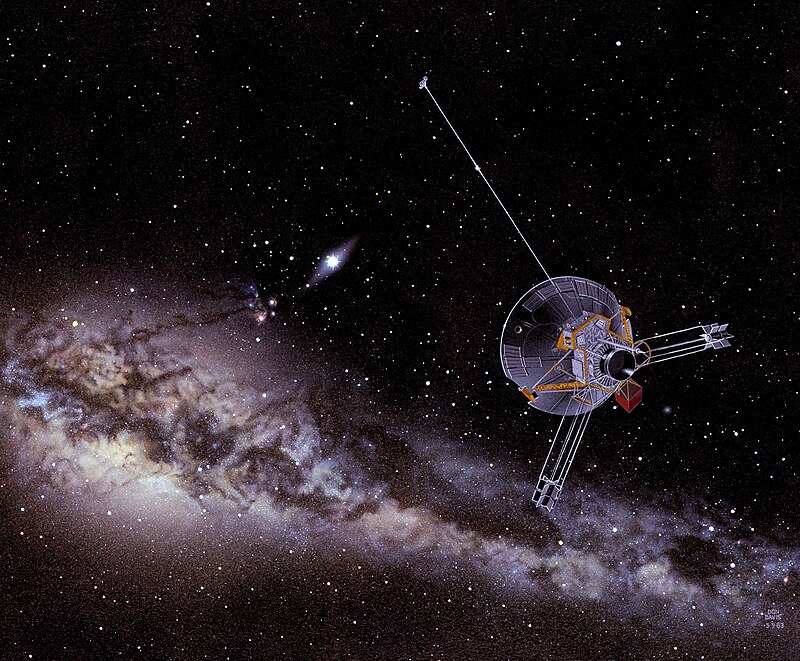
File:An_artist's_impression_of_a_Pioneer_spacecraft_on_its_way_to_interstellar_space.jpg · Wikimedia Commons · See Wikimedia Commons
Pioneer 11
Sign in to saveAlso known as Pioneer G
robotic space probe launched by NASA for planetary and heliosphere exploration
Pioneer 11 was a robotic spacecraft launched by NASA in 1973 to explore the outer planets and study the region of space around the Sun. It became famous for flying past Jupiter and Saturn, sending back the first close-up images of these giant planets and their moons, which greatly expanded our understanding of the solar system.
AI-generated from the Wikipedia summary — may contain errors.
Wikidata facts
- Instance of
- space probe
- Part of
- Pioneer program
- Country
- United States
- Operator
- Ames Research Center
- Followed by
- Pioneer Venus Orbiter
- Follows
- Pioneer 10
- Mass
- 259
- Manufacturer
- TRW Inc.
- Official website
- spaceprojects.arc.nasa.gov/Space_Projects/pioneer/PNhome.html
- Image
- Pioneer 10-11 spacecraft.jpg
Show 6 more facts
- Commons category
- Pioneer 11
- UTC date of spacecraft launch
- 1973-04-06
- space launch vehicle
- Atlas-Centaur
- start point
- Cape Canaveral Launch Complex 36
- uses
- magnetometer
- nominal power output
- 165
via Wikidata · CC0
~19 min read
Encyclopedic overview
Pioneer 11 (also known as Pioneer G) is a NASA robotic space probe launched on April 5, 1973, to study the asteroid belt, the environment around Jupiter and Saturn, the solar wind, and cosmic rays. It was the first probe to encounter Saturn, the second to fly through the asteroid belt, and the second to fly by Jupiter. Later, Pioneer 11 became the second of five artificial objects to achieve an escape velocity allowing it to leave the Solar System. Due to power constraints and the vast distance to the probe, the last routine contact with the spacecraft was on September 30, 1995, and the last good engineering data was received on November 24, 1995.
Mission background
Excerpted from Wikipedia’s “Pioneer 11” article, available under the CC BY-SA 4.0 licence.
Gallery (12)
Available in 67 languages
- Español
- Français
- Deutsch
- 中文
- 日本語
- Русский
- Português
- Italiano
- العربية
- हिन्दी
- Afrikaans
- Azerbaijani
- Bahasa Indonesia
- Bangla
- Basque
- be_x_old
- Belarusian
- Bosnian
Show 48 more
- Bulgarian
- Burmese
- Catalan
- Central Kurdish
- Croatian
- Czech
- Danish
- Esperanto
- Estonian
- Filipino
- Finnish
- Galician
- Georgian
- Greek
- Hebrew
- Hungarian
- Ido
- Latvian
- Lithuanian
- Lombard
- Low German
- Luxembourgish
- Malay
- Marathi
- Mirandese
- N’Ko
- Nederlands
- Norwegian
- Norwegian Nynorsk
- Polski
- Romanian
- Serbian
- simple
- Slovak
- Slovenian
- Svenska
- Tamil
- Tiếng Việt
- Türkçe
- Ukrainian
- Urdu
- Welsh
- Western Panjabi
- Wu Chinese
- zh_yue
- فارسی
- ไทย
- 한국어
via Wikidata sitelinks · CC0