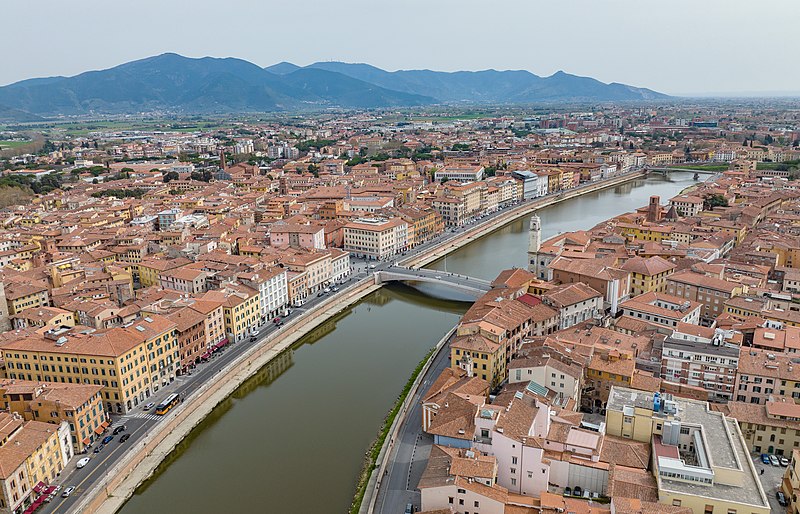
File:Italy_-_Pisa.jpg · Wikimedia Commons · See Wikimedia Commons
Pisa is a city in Tuscany, Italy, that served as a major maritime republic and is famous worldwide for its Leaning Tower, though it also contains numerous other historic churches and palaces from the medieval and Renaissance periods. The city's rich architectural heritage was built on the wealth it accumulated through its history as a powerful sea-faring republic.
AI-generated from the Wikipedia summary — may contain errors.
Weather now
7-day forecast
via Open-Meteo
Key facts
- Italian comune.name
- Pisa
- Italian comune.official_name
- Comune di Pisa
- Italian comune.image_shield
- Pisa-Stemma 2.svg
- Italian comune.image_flag
- Flag of the Republic of Pisa.svg
- Italian comune.pushpin_map
- Italy#Tuscany
- Italian comune.region
- Tuscany
- Italian comune.province
- Pisa (PI)
- Italian comune.frazioni
- Calambrone, Coltano, Marina di Pisa, San Piero a Grado, Tirrenia
- Italian comune.mayor
- Michele Conti
- Italian comune.area_total_km2
- 185
- Italian comune.population_total
- 98,778
- Italian comune.population_as_of
- July 31, 2023
- Italian comune.population_demonym
- PisanoPisan (English)
- Italian comune.elevation_m
- 4
- Italian comune.istat
- 050026
- Italian comune.saint
- San Ranieri
- Italian comune.day
- June 17
- Italian comune.postal_code
- 56121–56128
via Wikipedia infobox
Wikidata facts
- Instance of
- Italian city-state
- Has part
- Marina di Pisa
- Official name
- Pisa
- Demonym
- pisani
- Country
- Republic of Pisa
- Located in
- Province of Pisa
- Official language
- Italian
- Population
- 103600
- Area
- 185
- Elevation
- 4
- Time zone
- UTC+01:00
- Body of water
- Arno
- Head of government
- Michele Conti
- Capital of
- Republic of Pisa
- Shares border with
- San Giuliano Terme
- Official website
- www.comune.pisa.it
- Image
- Pisa - veduta dall'aereo 4.JPG
- Dialing code
- 050
- Licence plate code
- PI
- Patron saint
- Bona of Pisa
Show 13 more facts
- category for people who died here
- Category:Deaths in Pisa
- twinned administrative body
- Kolding Municipality
- postal code
- 56121–56128
- topic's main category
- Category:Pisa
- Commons gallery
- Pisa
- Commons category
- Pisa
- category for people born here
- Category:Births in Pisa
- category for films shot at this location
- Category:Films shot in Pisa
- category of associated people
- Category:People from Pisa
- native label
- Pisa
- owner of
- Palazzo Gambacorti
- different from
- pizza
- P12749
- Bergisch Gladbach
Sources (8)
via Wikidata · CC0
Travel guide
Understand
thumb|496x496px|The leaning tower Pisa would not be Pisa without the university. The city is animated by the students, who organize parties, shows, and cultural events, and fill the central street of the city at night. The University of Pisa has 60,000 students in a city of 90,000 inhabitants (200,000 in the metropolitan area). You'll notice the student flair in the city once you leave the touristy Campo dei Miracoli.
Get around
In the city centre, just walk.
See
thumb|450x450px|The Campo dei Miracoli from above: The leaning tower is on the left, the Duomo is in the centre, the Baptistery is on the right, and part of the Camposanto is in the right foreground Pisa is divided into 4 historical quarters. There is much more than the leaning tower in the city and several different walking itineraries are available.
Do
thumb|300px|The Arno river in the daylight
Take a photo of yourself holding, leaning against, or "anthropologically appropriating" the leaning tower of Pisa. Take a stroll along the central shopping roads of the city, Corso Italia and Borgo Stretto, both pedestrian-only. Enjoy an aperitivo (evening drink with a light dinner buffet) in one of the many bars and pubs that offer it, around Piazza Gambacorti, Piazza delle Vettovaglie o Via delle Case Dipinte. Football: Pisa SC were relegated in 2026 and now play soccer in Serie B, the second tier. Their Arena Garibaldi (capacity 25,000) is just north of the historic centre.
Buy
The central shopping area is centered around the Corso Italia, between the railway station and the Ponte di Mezzo (the central bridge) and also in the Via Borgo Stretto, north of the bridge. However, many specialized shops are sprinkled around the city.
The area around the leaning tower is geared toward tourists: There are lots of small souvenir kiosks, stands and "flying merchants", selling all kinds of souvenirs from small statues to hourglasses - of course the general motif is the leaning tower.
It is illegal to buy from one of the "flying merchants" that sell fake replicas. They are very persuasive and if you buy anything you must haggle – they'll drop their prices significantly.
Every two weeks there is a street market with antique books, records and old household items.
And don't forget to try some of Pisa's famous biscotti (biscuits or cookies). Bakeries all through town will sell multiple varieties, for a low price.
For the budget option, if coming from the Airport, there is a Coop supermarket on the left, on Via Pasquale Pardi.
Eat
thumb|Santa Maria della Spina, façade
Pasta and pizza are among the tourists' favorites like everywhere in Italy, but Tuscan and Pisan cuisine has more to offer: several kinds of soups made with bread (for instance, pappa al pomodoro, or kale-based bordatino), meat dishes (chianina and mucco pisano are renowned beef breeds; game such as boar or hare can be found in various restaurants), and cold cuts. The traditional street food is cecina, a chickpea flour pancake, served inside focaccia with a sprinkle of pepper.
Traditional Tuscan bread is without salt (pane sciocco); this surprises most visitors.
As for alcoholic beverages, Tuscany is renowned for red wine (Chianti, Brunello, Morellino) but nowadays many establishments also offer a good selection of local craft beers.
If you have access to transport, an alternative to eating in Pisa is to take the relatively short drive to Marina di Pisa, the harbor of Pisa at the Mediterranean sea some from central Pisa. Just follow the SS224 road west on the south side of River Arno and you are there in 20 minutes. There are several restaurants by the seafront, and having your dinner here, outside and when the sun sets in the west, is a rewarding experience. Parking and tables may be out if you arrive late, so check the opening hours (many restaurants do not open until around 19:00) and be there early. Even better, spend an hour or two just walking along the beach before the restaurants open. Try Roca de Mar.
Drink
During summer nights, everybody stays around the banks of the rivers, sipping drinks bought from the several bars in the area. A few very good wine bars are also available for colder, winter nights.
Bar Mocambo, Via S. Bernardo, 29. Cozy cocktail bar with a vast selection of drinks. Outstanding signature cocktails. Serves more than 100 kinds of rum from all over the world, often paired with treats such as specialty chocolate. Ask the bartender to help you choose! Vineria di Piazza, Piazza delle Vettovaglie. Serves great wine and very few dishes. You can find very traditional food here.
Sleep
The Pisa hills were already a popular destination for enlightened travellers in the first half of the 1700s, due mostly to the popularity of the thermal spa of San Giuliano, which quickly became a fashionable spot for the upper classes. The mansions on the road along the hills, already renowned as places of idleness and relaxation in the heart of the countryside, soon assumed the characteristics of true leisure resorts, just like those narrated by Carlo Goldoni. Stay at Bagni di Pisa ('health-giving' waters are still offered to an international clientele) and then visit Pisa during one of the city’s festivals, staying at the Agostini Palace to enjoy the best view of the festivities. The Villa has hosted many illustrious guests such as Gustavus III of Sweden, Christian II of Denmark, the Royal Family of Great Britain, Benedict Stuart Cardinal of York, General Murat, Luigi Buonaparte, Paolina Borghese, Carlo Alberto of Savoy, the poets Byron and Shelley, and various other personages from the history books.
Stay safe
Pisa is a safe city. You do not need to worry about your safety (except in some zones at night, such as the area surrounding the station). However, you should take the obvious precautions (like, if you stay in a very cheap hotel, take your valuables with you) and watch out for pickpockets in the touristy areas.
As stated in the Buy section, avoid purchasing sunglasses, umbrellas, and other trinkets from illegal sellers. Definitely steer clear of counterfeit luxury goods. Upon arriving to Pisa, it is not uncommon for tourists to be swarmed by African vendors. Some vendors can be pushy or even downright aggressive. Even saying "no thank you" can bring unwanted attention. It's much better to ignore them entirely. Don't worry about being rude.
Even though cheap prices are tempting, especially when travelling on a budget, the Italian police have fined tourists for buying from illegal sellers. These fines can be very steep (up to €1,000). In front of the Tower, there are several legal vendors who have permits to sell items to tourists or anyone else. Be responsible and buy from them. Legal vendors have stalls lined along the main road whereas illegal vendors keep merchandise in a sack, cardboard boxes, or (in the case of fake purses) on their arms.
Connect
As of June 2022, Pisa has 4G from Iliad, Tim and Vodafone, and 5G from Wind Tre.
Travel guide from Wikivoyage (CC BY-SA 4.0)
Gallery (44)
On the map
3 mapped locations
Available in 131 languages
- Español
- Français
- Deutsch
- 中文
- 日本語
- Русский
- Português
- Italiano
- العربية
- हिन्दी
- Afrikaans
- Akan
- Albanian
- Albanian
- Amharic
- Aragonese
- Armenian
- Asturian
Show 112 more
- azb
- Azerbaijani
- Bahasa Indonesia
- Balinese
- Bashkir
- Basque
- be_x_old
- Belarusian
- Bhojpuri
- Bikol
- Bosnian
- Breton
- Bulgarian
- Catalan
- Cebuano
- Chechen
- Corsican
- Croatian
- Czech
- Danish
- Egyptian Arabic
- eml
- Esperanto
- Estonian
- Extremaduran
- Faroese
- Filipino
- Finnish
- fiu_vro
- Galician
- Georgian
- Greek
- Hebrew
- Hungarian
- hyw
- Icelandic
- Ido
- Interlingua
- Interlingue
- Irish
- Javanese
- Kabyle
- Kazakh
- Kotava
- Kurdish
- Lao
- Latin
- Latvian
- Ligurian
- Lingua Franca Nova
- Lithuanian
- lld
- Lombard
- Low German
- Luxembourgish
- Macedonian
- Malagasy
- Malay
- Malayalam
- Maltese
- Marathi
- Mingrelian
- Mongolian
- Neapolitan
- Nederlands
- Norwegian
- Norwegian Nynorsk
- nrm
- Occitan
- Ossetic
- Papiamento
- Piedmontese
- Polski
- Quechua
- roa_tara
- Romanian
- Sanskrit
- Sardinian
- Scottish Gaelic
- Serbian
- Serbian (Latin)
- Sicilian
- Silesian
- simple
- Slovak
- Slovenian
- Svenska
- Swahili
- Tamil
- Tatar
- Tiếng Việt
- Türkçe
- Ukrainian
- Urdu
- Uyghur
- Uzbek
- Venetian
- Volapük
- Waray
- Welsh
- West Flemish
- Western Frisian
- Western Panjabi
- Wu Chinese
- Xhosa
- Zaza
- Zeelandic
- zh_min_nan
- zh_yue
- فارسی
- ไทย
- 한국어
via Wikidata sitelinks · CC0