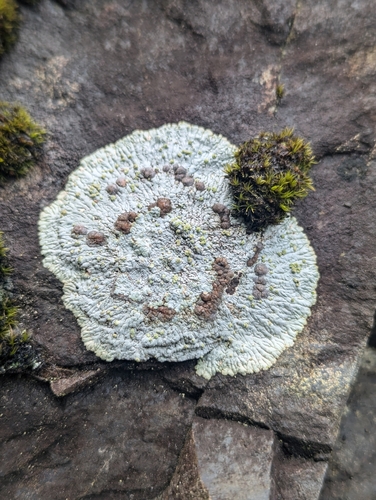
(c) Lori Johnson, all rights reserved, uploaded by Lori Johnson
Placopsis
Sign in to savePlacopsis is a genus of lichen-forming fungi in the family Trapeliaceae. First introduced as a subgenus in 1861 by William Nylander, the genus now comprises about 50 named species worldwide and shows its greatest diversity in the Southern Hemisphere. These lichens are conspicuous crustose to forms that typically grow on rock or soil, characterised by orbicular or irregularly spreading patches with lobed margins. A defining feature of the genus is the presence of cephalodia, which are nodules containing cyanobacteria that are often centrally placed on the thallus. This distinctive appearance in
Species
GENUS
- KingdomFungi
- PhylumAscomycota
- ClassLecanoromycetes
- OrderBaeomycetales
- FamilyTrapeliaceae
via GBIF
Museum specimens
- Specimen records
- 434
- With media
- 132
- Family
- Trapeliaceae
- Collections
- LSU, COLO, DUKE, MEL, WIS, NY
- Recorded in
- Costa Rica, Chile, Australia, New Zealand, Malaysia, Ecuador, Kenya
Wikidata facts
- Instance of
- taxon
- Parent taxon
- Agyriaceae
- Image
- Placopsis lambii Jymm.jpg
Show 5 more facts
- taxon name
- Placopsis
- taxon rank
- genus
- Commons category
- Placopsis
- taxonomic type
- Placopsis gelida
- taxon author citation
- (Nyl.) Linds.
via Wikidata · CC0
~6 min read
Encyclopedic overview
5 sectionsContents
- Taxonomy
- Description
- Species
- References
- Cited literature
Placopsis is a genus of lichen-forming fungi in the family Trapeliaceae. First introduced as a subgenus in 1861 by William Nylander, the genus now comprises about 50 named species worldwide and shows its greatest diversity in the Southern Hemisphere. These lichens are conspicuous crustose to forms that typically grow on rock or soil, characterised by orbicular or irregularly spreading patches with lobed margins. A defining feature of the genus is the presence of cephalodia, which are nodules containing cyanobacteria that are often centrally placed on the thallus. This distinctive appearance inspired the common name 'bull's-eye lichens' for some North American species.
==Taxonomy==
Excerpted from Wikipedia’s “Placopsis” article, available under the CC BY-SA 4.0 licence.